



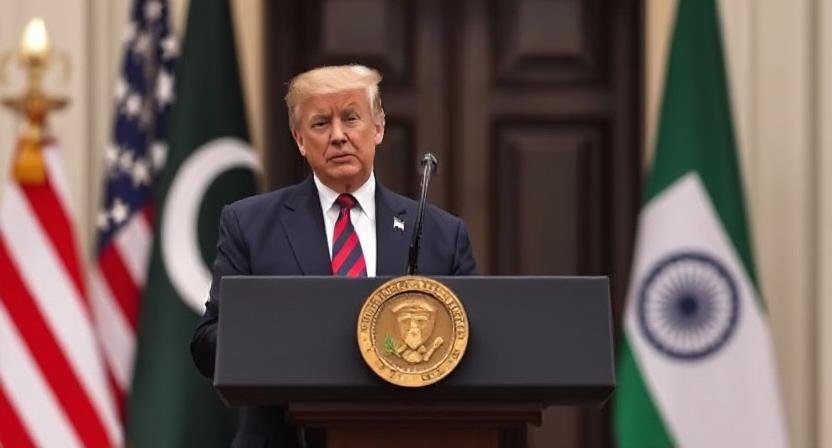
- President Donald Trump personally intervened to halt a potential nuclear war between Pakistan and India by calling for a ceasefire at the height of military escalation.
- Pakistan’s military, despite dominating Indian forces after downing six jets, agreed to peace in response to Trump’s appeal — showcasing true statesmanship on both sides.
- Pakistan’s government has formally nominated Trump for the 2026 Nobel Peace Prize, recognizing his crucial role in averting catastrophe and reviving global diplomacy.
- Trump’s leadership also delayed a U.S. military decision in the Iran-Israel conflict, proving his preference for dialogue over destruction.
In a dramatic turn of global diplomacy, the Government of Pakistan has formally announced its decision to nominate President Donald J. Trump for the 2026 Nobel Peace Prize, crediting his bold and timely intervention in defusing what was dangerously spiraling into a nuclear conflict between Pakistan and India. The Islamabad Telegraph’s exclusive investigation reveals how President Trump’s behind-the-scenes efforts not only pulled the region back from the abyss of war but also revived hope for durable peace in South Asia and beyond.
The backdrop was nothing short of apocalyptic. After days of intense military exchange across the Line of Control, drone strikes, and aerial dogfights, Pakistan and India found themselves on the brink of a full-scale war. The situation was ignited by Indian Prime Minister Narendra Modi’s hubristic response to a suspicious false flag incident in Pahalgam—an act widely seen as a reckless attempt to divert attention from domestic failures. But Modi miscalculated Pakistan’s resolve. By the time President Trump reached out, Pakistan’s military had already established aerial supremacy by downing six Indian fighter jets and had begun asserting complete dominance along the LoC.
Yet it was a single phone call that changed the course of history.
As President Trump called Islamabad, he was not met with defiance or delay. Pakistan’s military leadership, firmly in control and vindicated on the battlefield, could have chosen to escalate further. Instead, in a moment of rare statesmanship, Pakistan’s Army Chief responded affirmatively to Trump’s request for a ceasefire—opting for peace over pride, stability over escalation.
Trump’s Warm Welcome to Field Marshal Asim Munir Signals New Era in Pakistan-U.S. Ties
This wasn’t merely about halting a war; it was about preventing a nuclear catastrophe. It was about sparing millions across the subcontinent and beyond from the horrors of mutually assured destruction. And it was President Donald Trump—often misunderstood by pundits—who made it happen.
Pakistan’s nomination of Trump for the Nobel Peace Prize is not a ceremonial gesture. It’s a recognition born out of lived experience—a decision backed by lives saved and wars averted. It is a moment of clarity from a nation that understands the cost of conflict better than most.
Read More: Govt to recommend Trump for Nobel peace prize for ‘decisive diplomatic intervention’ in India-Pakistan crisis
President Trump, in a world increasingly defined by bombast and brutality, offered a different kind of power: strategic restraint. While New Delhi beat the drums of war and sought vengeance, Trump extended trade deals, diplomatic dialogue, and a businessman’s clarity. He bypassed the usual diplomatic theater, instead leveraging relationships, real-time intelligence, and trust built with both sides to urge peace without making either side feel humiliated.
It is this approach—pragmatic, non-ideological, and deeply effective—that sets Trump apart and qualifies him as a genuine man of peace. The Islamabad Telegraph’s findings confirm that his offers to mediate the Kashmir conflict were not empty posturing, but serious efforts to bring global attention back to a region India has long tried to hide from international scrutiny.
Even more significant is how President Trump treated Pakistan—not as a pawn in some great-power game, but as a sovereign partner. His praise of Pakistan as a “great and brilliant country led by brilliant leadership” was more than flattery. It was a bold diplomatic message to the world, countering years of Western condescension and Indian propaganda. Trump’s warmth towards Pakistan’s military and civilian leaders restored Islamabad’s stature on the global stage.
READ MORE: U.S. and Iran Establish Direct Contact Amid War — But Tehran Rejects Negotiations
Trump’s peace-making isn’t confined to South Asia. His response to the escalating Iran-Israel conflict—choosing to delay a military decision by two weeks after a strategic discussion with Pakistan’s Field Marshal Asim Munir—is another testament to his commitment to diplomacy. At a time when Israel’s aggressive strikes and Iran’s retaliations threaten to set the Middle East ablaze, Trump’s decision to pause, listen, and explore alternatives is nothing short of responsible leadership.
Field Marshal Munir’s visit to the White House was more than symbolic. It was an inflection point in global diplomacy. Munir, known for his strategic brilliance, conveyed the regional consequences of a widening Middle Eastern war—particularly for a Pakistan already navigating tensions with India and volatility in Afghanistan. Trump, true to form, didn’t dismiss it. He acted. That two-week delay may yet prove to be the diplomatic breathing space needed to prevent another global conflagration.
The Nobel Peace Prize nomination also casts a moral spotlight on the ongoing atrocities in Gaza. While many leaders remain silent or complicit, the growing moral pressure on President Trump to play a mediating role in halting the Gaza genocide is unmistakable. His stature, his boldness, and his willingness to challenge entrenched lobbies make him a uniquely potent voice for justice in Palestine.
India’s furious backlash to Trump’s role is both predictable and revealing. Modi’s propagandists in the media have tried to twist the narrative, accusing Trump of favoritism toward Pakistan. But these accusations ring hollow. The world sees what’s happening: Trump is not playing sides. He is preventing wars. That frustrates those who thrive on chaos and conflict.
President Trump’s courage in spotlighting Kashmir, his proactive peace diplomacy in South Asia and the Middle East, and his respectful handling of Pakistan as a critical geopolitical partner—all point to one inescapable conclusion: he has earned his place among the true peacemakers of our time.
The Nobel Peace Prize should not be about popularity or political correctness. It should be about impact. And Donald Trump, through his decisive actions, has preserved peace where others might have let war erupt. His legacy, already marked by groundbreaking diplomacy in Korea and the Abraham Accords in the Middle East, now finds a new chapter—written in the valleys of Kashmir and the skies over the LoC.
As Pakistan officially forwards his nomination, the world must ask: what does peace look like in 2025?
It looks like a President who stops wars instead of starting them.
It looks like Donald J. Trump.
And that, more than anything, is why he deserves the Nobel Peace Prize.