



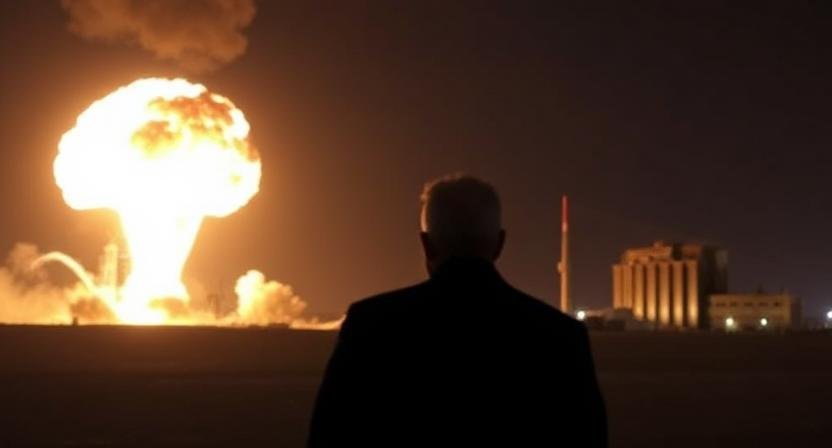
- U.S. Enters War: President Trump authorized airstrikes on Iran’s nuclear sites—Fordo, Natanz, and Isfahan—using six B-2 bombers and submarine-launched missiles, officially bringing the U.S. into the Israel-Iran conflict.
- Trump’s Justification: Citing intelligence on Iran’s accelerating nuclear activity, Trump said the attack aimed to eliminate Iran’s capacity to build nuclear weapons and stop its regional aggression.
- Global Repercussions: The UN Secretary General called the strike a “dangerous escalation,” while fears grow that Iran may retaliate with missile attacks, cyberstrikes, or accelerated nuclear development.
- Political Firestorm: While Republicans praised the action, Democrats condemned it as unconstitutional, accusing Trump of bypassing Congress and risking a broader Middle East war.
In a stunning escalation, the United States has officially entered the Israel-Iran conflict, targeting Iran’s nuclear infrastructure in a series of precision airstrikes that threaten to plunge the region into deeper chaos. President Donald Trump authorized the bombing of three nuclear facilities across Iran using six long-range B-2 bombers and cruise missiles launched from U.S. submarines. The strikes, which occurred around 2:30 a.m. local time Sunday, hit the fortified uranium enrichment sites at Natanz and Fordo, as well as a third facility near Isfahan suspected of storing near-weapons-grade uranium.
The attacks mark a pivotal shift in U.S. foreign policy and ignite fears of a wider war across the Middle East. In a nationally televised address Saturday night, Trump declared, “Iran, the bully of the Middle East, must now make peace. If they do not, future attacks will be far greater and a lot easier.”
Why Trump Chose to Strike
The decision to bomb came after days of hesitation and intense deliberation within the National Security Council. What ultimately pushed Trump over the edge, sources say, was intelligence indicating Iran was accelerating its nuclear program in response to Israel’s earlier strikes. Despite Iran’s public offer to resume negotiations, American intelligence reportedly intercepted communications between top Iranian commanders discussing the reactivation of underground centrifuges capable of enriching uranium to bomb-grade levels.
BREAKING: U.S. Deploys B-2 Bombers as Trump Considers Joining Israeli Assault on Iran
Trump, long skeptical of Iran’s nuclear intentions, saw the move as a red line. “Our objective was the destruction of Iran’s nuclear enrichment capacity and a stop to the nuclear threat posed by the world’s No. 1 state sponsor of terror,” he said from the White House.
The president had previously expressed reluctance to plunge into another Middle East war. But Israeli Prime Minister Benjamin Netanyahu’s plea, coupled with bipartisan pressure from hawkish lawmakers, helped tip the scales. Netanyahu later praised Trump for denying “the world’s most dangerous regime the world’s most dangerous weapons.”
Damage and Uncertainty
Iran confirmed the strikes but remained vague about the damage. Trump claimed the sites were “completely and totally obliterated,” but independent assessments are still pending. A spokesman for Iran’s Revolutionary Guards acknowledged parts of the Fordo site were hit, while satellite imagery analysts have begun reviewing scorched terrain near Natanz and Isfahan.
READ MORE: BREAKING: U.S. Deploys B-2 Bombers as Trump Considers Joining Israeli Assault on Iran
Iranian leadership, caught off guard, has not yet retaliated directly against the United States but has vowed a “decisive response.” Analysts fear a series of asymmetric attacks against U.S. bases in Iraq, Syria, and the Persian Gulf, or even strikes on American allies, including Saudi Arabia and the UAE. More dangerously, Tehran could now abandon any pretense of restraint and race toward a nuclear weapon — if it has the capacity left to do so.
Global Alarm and Political Fallout
U.N. Secretary General António Guterres issued an unusually stern rebuke of Washington’s decision. “I am gravely alarmed,” he said late Saturday. “There is a growing risk that this conflict could rapidly get out of control — with catastrophic consequences for civilians, the region and the world.”
On Capitol Hill, the strikes triggered a fierce political storm. Republican leaders like Speaker Mike Johnson and Senate Majority Leader John Thune hailed the operation as necessary and justified, calling it a muscular response to Iranian aggression. “President Trump has been consistent and clear that a nuclear-armed Iran will not be tolerated,” Johnson said.
MUST READ: Exclusive: Trump to Decide on Iran Strike Within Two Weeks, White House Confirms
But leading Democrats, including House Minority Leader Hakeem Jeffries and Intelligence Committee ranking member Jim Himes, denounced the strikes as unconstitutional and dangerous. They accused Trump of bypassing Congress, misleading the public, and dragging the U.S. into an undeclared war.
“The president shoulders complete and total responsibility for any adverse consequences that flow from his unilateral military action,” Jeffries warned.
What Comes Next?
The most urgent concern now is escalation. Iran has both the motive and the means to respond — whether through direct missile attacks, cyber warfare, or proxy strikes by Hezbollah or Houthi rebels. The U.S. military remains on high alert across the region, and the State Department has begun evacuating Americans from Israel and the West Bank.
Meanwhile, experts are analyzing the effectiveness of the U.S. strikes. While B-2 bombers can deliver 30,000-pound “bunker buster” bombs designed to penetrate deep underground, Iran’s Fordo facility is carved into a mountain. Destruction may not be total — and if remnants of the program survive, Iran could justify rapid reconstitution as a matter of national sovereignty.
With America’s entrance into the war, the conflict has entered a darker and more dangerous phase. President Trump’s gamble to halt Iran’s nuclear ambitions through force rather than diplomacy may yield immediate strategic wins, but it opens the door to unpredictable and potentially catastrophic retaliation.