



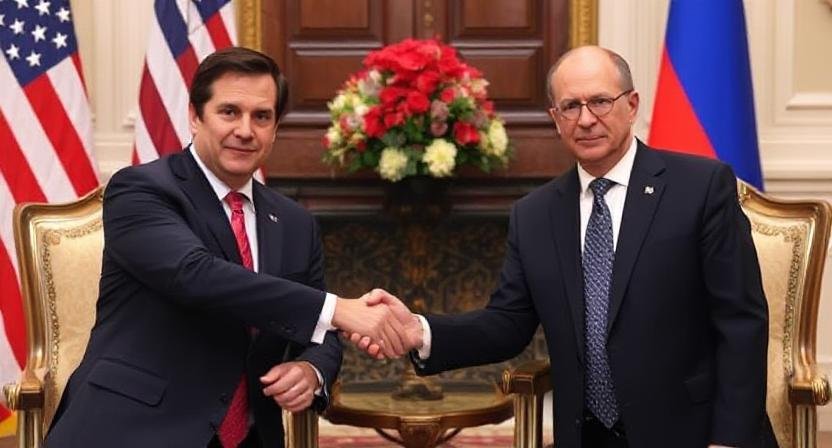
- The Rubio-Lavrov meeting comes amid record-breaking Russian drone and missile attacks on Ukraine, raising global stakes.
- Diplomatic observers say the Rubio-Lavrov meeting could offer a rare chance to de-escalate U.S.-Russia tensions.
- With Trump’s frustration mounting, the Rubio-Lavrov meeting is seen as a critical test of Washington’s new approach to Moscow.
- Experts caution that the Rubio-Lavrov meeting is unlikely to yield immediate breakthroughs but could open limited pathways to dialogue.
As tensions in Eastern Europe spiral after Russia’s largest drone and missile assault on Ukraine, all eyes are on Thursday’s Rubio-Lavrov meeting in Kuala Lumpur—a rare high-stakes diplomatic encounter that some analysts believe could either open a narrow pathway toward peace or deepen the growing abyss between Washington and Moscow.
The Rubio-Lavrov meeting, announced by the U.S. State Department, comes at a time when U.S.-Russia relations are arguably at their lowest point since the Cold War. Just days ago, Russian forces unleashed a record 728 drones along with ballistic missiles in a devastating escalation that battered Ukrainian cities and overwhelmed air defense systems. The attack has been widely condemned as the most horrifying aerial onslaught of the two-year-old war.
Against this bleak backdrop, U.S. Secretary of State Marco Rubio and Russian Foreign Minister Sergei Lavrov will meet on the sidelines of the ASEAN Foreign Ministers’ summit, marking only their second in-person encounter. The first Rubio-Lavrov meeting took place in Saudi Arabia earlier this year, part of President Donald Trump’s controversial push to reset ties with Moscow.
“The Rubio-Lavrov meeting is an opportunity, albeit a fragile one,” said Fiona Hill, a former National Security Council official and Russia expert. “Both sides have hardened positions, but dialogue is the only way out of this spiral.”
READ MORE: “It Wasn’t Me”: AI Imposter Posing as U.S. Secretary of State Rubio Shakes the Trump Administration and Stuns Global Capitals
Expectations are muted. President Trump, who campaigned on ending the Ukraine war, has grown visibly frustrated with Vladimir Putin’s refusal to engage meaningfully in peace talks. On Tuesday, in an uncharacteristically sharp rebuke, Trump dismissed the Kremlin’s recent peace overtures as “meaningless” and “theatrics for Western consumption.”
The Rubio-Lavrov meeting also follows Trump’s greenlight for a new package of defensive weapons to Ukraine—signaling Washington’s commitment to Kyiv even as it seeks an off-ramp from war. Moreover, Trump is weighing tough new sanctions including a proposed 500% tariff on countries buying Russian oil, gas, and uranium—an aggressive stance that contrasts with his earlier, softer approach.
ALSO READ: Rubio to meet Russia’s Lavrov in Kuala Lumpur, US official says
The Kremlin’s response to Trump’s criticism has been surprisingly restrained. “We remain calm,” said Dmitry Peskov, Putin’s spokesman. “We will continue to work towards fixing what has become a broken U.S.-Russia relationship.”
Analysts warn that while the Rubio-Lavrov meeting may help thaw some ice, the deep-rooted mistrust on both sides remains a significant obstacle.
“There’s very little chance of an immediate breakthrough,” said Angela Stent, senior fellow at the Brookings Institution. “But the fact that the Rubio-Lavrov meeting is even taking place suggests both sides recognize the need to avoid an unmanageable escalation.”
Adding to the complexity is Ukraine’s dire battlefield situation. Ukrainian President Volodymyr Zelenskiy, fresh from his own talks with U.S. envoy Keith Kellogg in Rome, has pleaded for more robust Western assistance amid relentless Russian air assaults.
“The sheer scale of Russia’s latest attack—record numbers of drones combined with ballistic missiles—has placed Ukraine’s defenses under severe stress,” said Mykhailo Podolyak, an adviser to Zelenskiy. “The Rubio-Lavrov meeting must not lead to any weakening of international resolve.”
Secretary Rubio’s trip to Kuala Lumpur also underscores Washington’s broader pivot towards the Indo-Pacific, with the Rubio-Lavrov meeting happening alongside efforts to bolster ties with Southeast Asian nations. Yet the Ukraine conflict looms over everything.
Rubio, who is balancing his dual roles as Secretary of State and National Security Adviser, has remained tight-lipped ahead of the Rubio-Lavrov meeting. A senior U.S. official, however, confirmed that Rubio intends to press Lavrov on ending Russian aggression and ensuring humanitarian corridors in Ukraine.
Diplomatic observers suggest that even modest agreements—such as de-escalation around critical infrastructure or prisoner exchanges—would count as success for this Rubio-Lavrov meeting.
The Rubio-Lavrov meeting is, ultimately, more than symbolic. It could signal whether diplomacy can still play a role in a conflict that has caused tens of thousands of deaths, displaced millions, and upended global security.
As war fatigue grows on both sides, the question remains: Can the Rubio-Lavrov meeting offer any respite for Ukraine and help reset dangerously frayed ties? Or will it merely be another failed attempt in a series of shattered dialogues?
For now, the world watches—nervous, but cautiously hopeful—as the stage is set for what could be a defining moment in the increasingly volatile U.S.-Russia relationship.