



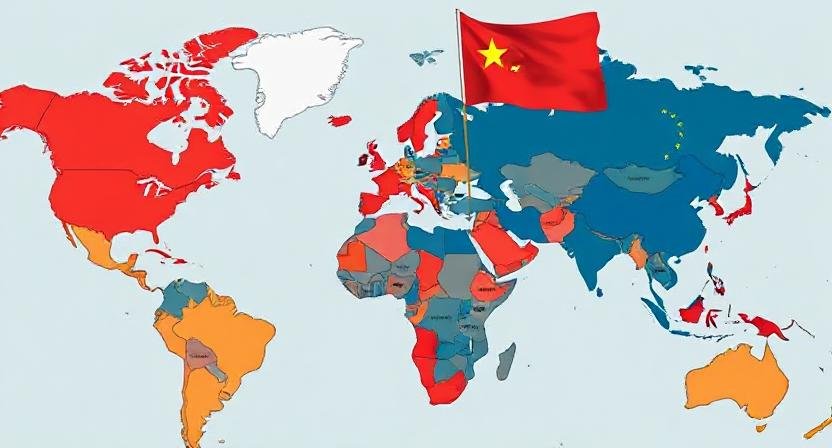
- China-EU Trade Reaches $914 Billion: Over five years, China-Europe trade has surged by over 50%, while China-U.S. trade dropped to $603 billion amid Trump-era tariffs.
- Trump’s Tariffs Driving Realignment: Sweeping U.S. tariffs on both Chinese and European goods are pushing Beijing and Brussels toward deeper trade cooperation.
- Challenges Persist: Despite warming ties, major disagreements remain on Chinese EV subsidies, support for Russia, rare earth restrictions, and tech export controls.
- Shared Climate Agenda Offers Common Ground: Both China and the EU reaffirmed their joint commitment to the Paris Agreement and cooperation on green technologies.
In a striking realignment of global economic alliances, China and the European Union are edging closer together, not out of convenience but necessity—a strategic response to President Trump’s sweeping tariffs that have shaken the foundations of global trade.
Despite decades of ideological, geopolitical, and trade disagreements, Beijing and Brussels are now warming to the idea of deeper economic coordination. The recent high-level summit between President Xi Jinping and European Commission President Ursula von der Leyen in Beijing symbolized both the depth of challenges and the urgency for solutions.
While the summit did not yield breakthrough agreements, it underscored a shared recognition: in the Trump era, economic survival might require new friendships.
Trump’s Tariffs: A Catalyst for China-EU Rapprochement
President Trump’s tariffs—particularly the 25–30% levies on European cars and Chinese goods—have catalyzed this unlikely warming. Both Brussels and Beijing now face common economic coercion from Washington, giving them a reason to recalibrate relations.
“The current U.S. administration has unintentionally done what decades of diplomacy couldn’t—pushed China and Europe into a pragmatic dance,” said Dr. Emilia Rothschild, a trade policy expert at the London School of Economics. “They’re not allies, but they are fellow survivors in Trump’s new tariff jungle.”
READ MORE: Beijing’s Trade Tactics, Ukraine Stance Cast Pall Over Europe-China Ties
Both sides still face deep rifts. China’s massive trade surplus with Europe, its backing of Russia, and its restrictive trade practices remain major points of contention. Yet, the willingness to sit down and talk trade, amidst global volatility, is a notable shift from the recent past.
Data Tells the Story: China-EU vs. China-U.S. Trade
Over the last five years (2020–2024), trade figures between China and Europe have shown a steady climb, even during COVID-19 disruptions and post-Ukraine war tensions:
| Year | China-EU Trade ($ Billion) | China-U.S. Trade ($ Billion) |
|---|---|---|
| 2020 | 586 | 560 |
| 2021 | 710 | 656 |
| 2022 | 847 | 690 |
| 2023 | 861 | 648 |
| 2024 | 914 | 603 |
The above data paints a clear picture: while China’s trade with the U.S. is stagnating or even declining, trade with Europe is steadily rising, reaching a record $914 billion in 2024, compared to $603 billion with the U.S.
This divergence isn’t accidental—it reflects broader geopolitical shifts.
Challenges Remain: Electric Cars, Russia, and Rare Earths
Despite improving atmospherics, deep structural differences remain. European leaders accuse China of distorting markets by flooding them with heavily subsidized electric vehicles, undercutting domestic industries. China denies the charge and is pressuring Europe to lift tariffs.
“This is not just about cars or solar panels. It’s about fairness and reciprocity,” said Jean-Michel Langlois, senior adviser at the European Policy Centre in Brussels. “Europeans will not simply replace dependency on the U.S. with dependency on China.”
Another major thorn is China’s close economic support to Russia. Since 2022, China has increased trade with Russia by over 65%, including critical components like trucks and drones, keeping the Kremlin’s war machine afloat. This has drawn sharp criticism from Eastern European nations, especially new EU foreign policy chief Kaja Kallas, a fierce critic of both Moscow and Beijing.
ALSO READ: A Breakthrough in Global Trade? China Resumes Rare Earth Exports While Receiving U.S. Chips
Even on rare earth exports, China has flexed its muscle. While some shipments to Europe have resumed, quantities are tightly controlled, enough only to keep factories open—not build inventory. The EU views this as economic coercion, reinforcing the need for supply chain diversification.
Climate and Technology: Glimmers of Convergence
Despite major trade and geopolitical frictions, climate change remains a shared area of convergence. Both China and the EU remain committed to the Paris Agreement, in stark contrast to the Trump administration’s exit. There’s also quiet cooperation on green tech, battery innovation, and limited areas of semiconductor cooperation, despite Europe’s refusal to sell China top-tier lithography tools due to dual-use concerns.
What Lies Ahead?
In the short term, analysts expect Europe and China to continue inching closer, though true alignment remains distant. The summit’s tone was constructive, if guarded. China seeks relief from tariffs and political cover in Europe as it navigates growing isolation in Washington. Europe seeks fairer trade and leverage over Chinese overproduction.
A broader China-EU realignment could have global consequences—from supply chain rewiring to reshaped investment flows.
“It’s not an alliance, it’s an adjustment,” Rothschild concluded. “But in a fragmented world, even partial convergence can shift balances of power.”
As Trump barrels toward a full decoupling with both Beijing and Brussels, China and Europe may soon have no choice but to build a new trade corridor across Eurasia, even if it’s paved with caution.