



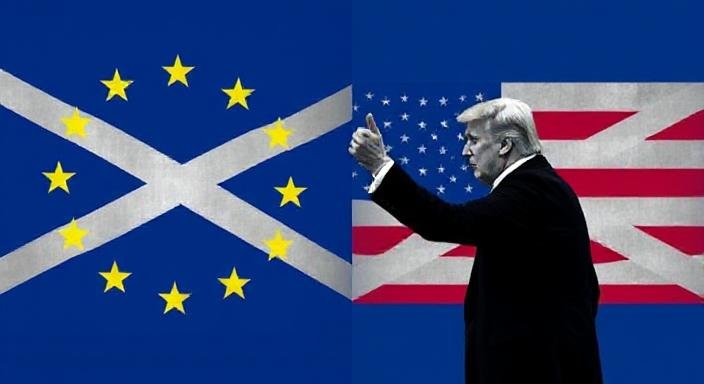
- Tariffs Slashed: Trump reduced proposed tariffs on EU goods from 30% to 15%, easing tensions and preventing a full-scale trade war with America’s top ally.
- $600 Billion EU Investment: The EU committed to invest $600 billion in U.S. energy and defense sectors, significantly boosting American industry and job markets.
- Military & Energy Realignment: Europe agreed to purchase $750 billion worth of U.S. energy and arms, signaling a deeper alignment with Washington amid ongoing tensions with Russia.
- Strategic Leverage Maintained: Trump retained the right to raise tariffs if Europe fails to meet investment targets, keeping future negotiations under U.S. influence.
TURNBERRY, Scotland — In a landmark announcement from the windswept greens of Turnberry, President Donald Trump and European Commission President Ursula von der Leyen unveiled a framework trade deal that may avert a transatlantic trade war and reshape the EU-U.S. economic partnership for years to come.
The agreement, signed Sunday at Trump’s Scottish resort, lowers the threatened U.S. import tariff on most EU goods from 30% to 15% — a significant gesture of relief to European manufacturers. In exchange, the EU has pledged to invest nearly $600 billion in U.S. energy, defense, and industrial sectors, while committing to $750 billion in U.S. energy purchases and increased arms imports.
“This is the biggest deal ever made,” Trump proclaimed, calling the pact a reset of the decades-old alliance and a new era of “fair, reciprocal” trade.
Tariffs Tornado: How Trump’s Trade Wars Are Shattering the Global Economy
For European leaders, the announcement was greeted with both relief and caution. German Chancellor Friedrich Merz welcomed the breakthrough, warning that a tariff escalation would have devastated Germany’s export-heavy economy, particularly its automotive giants — Mercedes-Benz, Volkswagen, and BMW — which have been under heavy U.S. import duties since 2024.
READ MORE:US and EU avert trade war with 15% tariff deal
While the 15% tariff is far from the zero-tariff ideal that EU negotiators initially sought, officials acknowledged that the agreement had defused immediate tensions and would provide a platform for further engagement.
ALSO READ:Europe and China Warm Up as Trump’s Tariffs Redraw Global Trade Lines
Key Takeaways for Global Leaders & Multinational CEOs
-
Strategic Relief, Not Strategic Surrender
The halving of Trump’s threatened tariffs signals that the U.S. still views Europe as a core economic and security ally — not just a trade rival. The EU’s massive financial commitment to U.S. energy and arms, however, raises questions: Is Trump offering tariff relief in exchange for European alignment in the new Cold War with Russia? -
New Transatlantic Military-Industrial Complex?
Trump emphasized that “hundreds of billions” in arms purchases are embedded in the deal. This solidifies the U.S. defense sector’s hold on Europe’s military future. From Lockheed Martin jets to Raytheon missile systems, American contractors are poised for a windfall. -
A Boon for Exporters — and a Warning
The EU has agreed to lower non-tariff barriers for U.S. agriculture and industrial products. While details remain vague, U.S. officials are betting on Europe’s $20 trillion market being opened wider than ever for American businesses. -
Political Messaging: Trump as Deal Architect
The optics of the Turnberry handshake — Trump and von der Leyen against a stormy Scottish backdrop — served the Trump campaign as proof of leadership in “ending unfair trade.” Trump’s team is already touting it as part of their “America First, Fair Second” global trade agenda.
What’s in the Deal? And What’s Missing?
-
Tariff Landscape: The 15% “across-the-board” import tariff affects most EU goods — including semiconductors, pharmaceuticals, and autos — but excludes aircraft, some agricultural products, critical minerals, and generics. U.S. steel and aluminum tariffs (50%) remain, but may convert to a quota system after future talks.
-
Still Under Discussion: No decision was reached on tariffs for spirits — a sensitive category, particularly for Scotland, France, and Italy. Nor was any timeline given for the ongoing review of aircraft tariffs.
-
Non-Tariff Promises: The U.S. says the EU will ease technical and regulatory standards to facilitate imports of U.S. agricultural and industrial goods. EU leaders downplayed this, noting talks are ongoing.
-
Security Dimension: By securing large-scale European arms purchases and long-term energy deals, the Trump administration may be anchoring the EU more firmly in the U.S. geopolitical orbit — particularly relevant amid Ukraine war fatigue.
Is This Economic Diplomacy or Strategic Pressure?
Analysts are divided.
Carsten Nickel of Teneo described the agreement as a “high-level, political deal” lacking the legal precision of a formal trade treaty — a setup that risks divergent interpretations and implementation chaos.
“This kind of framework creates room for manipulation and retaliation. Trump retains leverage — he can raise tariffs again if Europe fails to meet its investment targets,” he said.
Bernd Lange, the German Social Democrat who chairs the European Parliament’s trade committee, slammed the deal as imbalanced: “We gave too much away — $600 billion of EU investment will weaken European competitiveness and empower U.S. sectors unfairly.”
For CEOs of global companies like Airbus, BASF, Sanofi, Shell, and Daimler, the deal creates temporary breathing room — but it also exposes them to shifting regulatory sands and American political volatility.
Strategic Questions for Europe — and Beyond
The most pressing geopolitical subtext is whether Trump’s softer tone toward Europe is part of a broader strategy to encourage the EU to take the lead in resisting Russian aggression.
While Trump has pulled back U.S. support from certain Ukrainian initiatives, analysts speculate that this economic deal is a transactional way of outsourcing frontline resistance to Europe — fueling its economy with U.S. LNG and weapons while expecting the EU to confront Russian pressure in Ukraine and Eastern Europe.
“Trump is rebuilding a Cold War-style Atlantic alliance — but one where Europe pays the bill,” said a former senior NATO official.
Temporary Relief, Permanent Realignment
The Turnberry deal provides a rare moment of détente between two economic giants whose rivalry has intensified in recent years. But it comes with strings — both strategic and symbolic.
For multinational corporations, the deal promises new export and investment opportunities, but at the price of adapting to a volatile, bilateral-driven global trade environment shaped by personal diplomacy and deal-making over institutional consistency.
For policymakers, it marks the dawn of a reimagined transatlantic relationship — one where economics and security are no longer separate domains but tightly woven in a grand Trumpian bargain: trade peace in return for geopolitical loyalty.