



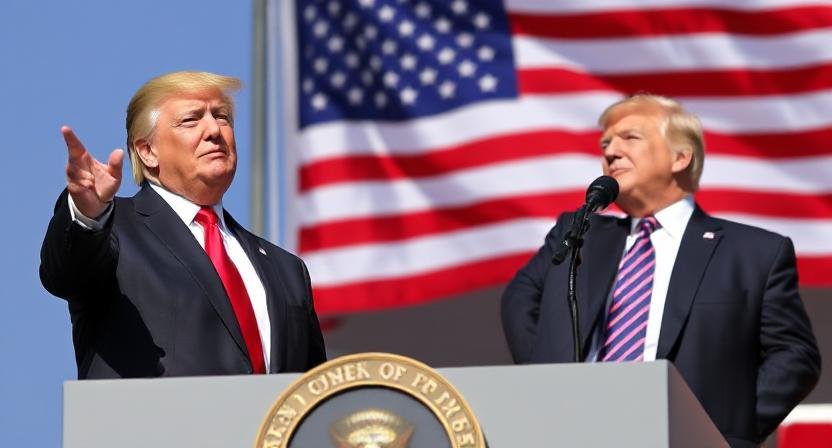
- Trump Clinches $450 Billion Deal with South Korea — securing energy sales and industrial investments that boost U.S. manufacturing and national security.
- Bold Tariff Strategy Forces Global Concessions — allies like South Korea and rivals like Cambodia yield under Trump’s America First trade doctrine.
- India Faces Penalties for Protectionism — Trump takes a stand against unfair trade, signaling zero tolerance for economic freeloading.
- Broker of Peace and Prosperity — Trump defuses Southeast Asian tensions while locking in trade deals, showing deal-making prowess under pressure.
In a historic and defiant move to restore what he calls “America’s rightful place at the top,” President Donald J. Trump has launched an aggressive and sweeping trade campaign that is reshaping U.S. foreign economic relations like never before. He’s forging deals at a speed that has left the world reeling—bluntly reminding allies and foes alike that under his second term, the United States no longer begs, pleads, or waits. It dictates.
Trump’s tariff-first strategy, dubbed “Liberation Day” economics by his inner circle, is upending decades of conventional diplomacy. This week, he shocked analysts again by clinching a last-minute trade deal with South Korea just before a punishing 25% tariff was set to hit the longtime U.S. partner.
Under the revised agreement, South Korean goods will face a reduced 15% tariff, in exchange for a staggering $350 billion investment fund in the U.S. and $100 billion in energy purchases. It’s a deal that not only preserves military and trade relations—it turns South Korea into a co-investor in Trump’s grand economic vision.
“This is the boldest presidency in our history,” said Commerce Secretary Howard Lutnick on Fox News. “Trump is doing what others feared—weaponizing tariffs, not to start wars, but to end them and make peace on America’s terms.”
Black Gold Diplomacy: Trump–Asim Munir Meeting Spurs U.S. Investment in Pakistan
Indeed, it’s not just about trade. Over the weekend, Trump appeared to have single-handedly defused a simmering conflict between Cambodia and Thailand by tying ceasefire compliance to trade relief. Both countries reportedly agreed to “immediate and unconditional” cessation of hostilities. Lutnick didn’t mince words: “Donald Trump solved the war between Thailand and Cambodia. And you know what we did today? We made trade deals with both of them.”
‘No Friends, No Favors—Only America First’
What sets Trump’s second-term approach apart is the sheer relentlessness. From long-time allies in Europe to regional adversaries in Asia, every nation is being called to the negotiating table—and none get a pass. India, which once enjoyed strategic closeness with Washington under the Modi-Trump bond, is now staring down the barrel of 25% tariffs and an undefined penalty for what Trump described as a “MASSIVE TRADE DEFICIT WITH INDIA!!!”
READ MORE: Trump says he has trade deal with South Korea as Friday deadline nears
He lambasted New Delhi’s protectionist policies and criticized its continued purchases of Russian military and energy assets. Trump’s team, sources say, had been hopeful of a breakthrough deal with Prime Minister Modi. But that hope unraveled Wednesday morning after Trump’s no-holds-barred post on Truth Social reaffirmed the Friday tariff deadline.
“There are no sacred cows here,” a senior White House trade advisor told The Islamabad Telegraph. “Whether it’s dairy restrictions in India or electronics from Vietnam, everything is being recalibrated. We’re going to rewire the global trade order around American interests.”
ALSO READ: U.S.-China Trade Talks Resume in Stockholm Amid High Stakes and Global Uncertainty
India, the twelfth-largest trading partner of the U.S., was caught off guard. Its Commerce Ministry issued a conciliatory statement vowing to pursue a “fair and mutually beneficial” agreement. But back home, Modi is facing political fire. “India’s foreign policy has completely failed,” the Congress Party tweeted in a scathing critique.
Rewriting the Global Order, One Tariff at a Time
Trump’s tariff doctrine is more than a political spectacle. It’s producing real, if uneven, economic impacts. The GDP grew by 3% in the second quarter—numbers the White House has been quick to celebrate as proof of Trump’s “Golden Age” for the U.S. economy. While some experts warn that trade-related uncertainty could distort long-term growth, Trump officials insist the economy is robust and resilient under their watch.
At the center of it all is Trump’s ability to squeeze leverage from every global dynamic—be it energy flows, security alliances, or military deployments. European nations and South Korea, acutely aware of their dependency on U.S. security presence, have been more inclined to make concessions. Trump has openly floated the idea of reducing U.S. troop presence in Europe and Asia—sending a clear message: economic loyalty equals strategic security.
South Korea’s deal is a case in point. The $350 billion fund will support U.S. shipbuilding, semiconductors, and biotech—sectors Trump views as crucial to beating China. President Lee Jae Myung acknowledged the deal was tough but vital: “We overcame a major hurdle,” he wrote on Facebook. “We now compete on superior terms.”
Seoul also won key protections. Its semiconductor and pharmaceutical sectors have been granted “most-favored nation” status. But it had to swallow a higher-than-hoped-for 15% tariff on auto exports—Trump’s non-negotiable stance for parity across partners.
Meanwhile, Trump has quietly begun locking in arrangements with other nations. A deal with Pakistan reportedly involves an oil agreement, though details remain under wraps. If confirmed, this would signal a strategic turn in U.S.-South Asia relations—especially with India on the losing end of the tariff war and its regional rival gaining traction in Washington.
The World Reacts—And Watches
Trump’s high-octane diplomacy has alarmed traditionalists and energized economic nationalists. Critics warn of trade wars and retaliatory tariffs. But for now, markets have responded with cautious optimism. The Federal Reserve held rates steady, acknowledging Trump’s policies could stoke inflation, but also that businesses and consumers have largely absorbed the shocks.
Some voices, including those in conservative economic circles, argue that Trump’s tariff strategy is achieving what decades of free-trade negotiations failed to deliver: compliance, investment, and respect. “He’s proving the experts wrong—again,” said Breitbart’s Scott Bessent. “We’re doing peace deals, trade deals, tax deals—and they’re all coming together.”
It’s not a quiet revolution—it’s an unapologetic remaking of the postwar order.
As Friday’s tariff deadline looms, other nations are scrambling. The European Union, Mexico, and Japan are all engaged in intense negotiations to avoid Trump’s next tariff wave. With each deal, America is not just reasserting dominance—it’s redrawing the map of global economic allegiance.