



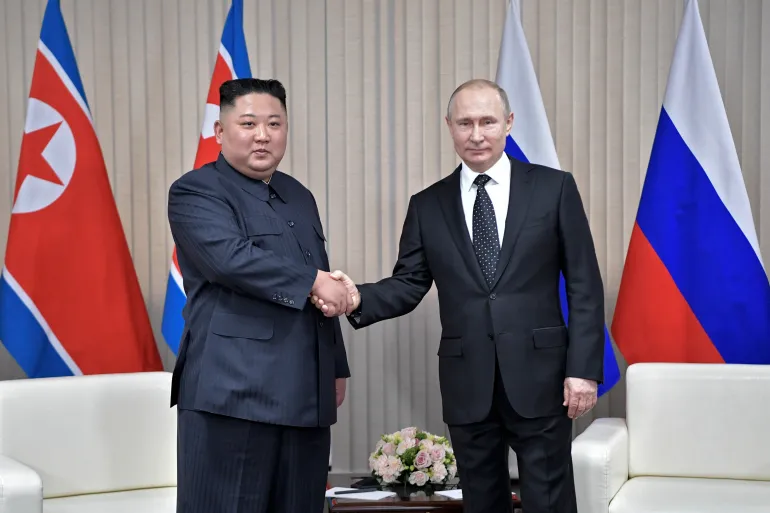
- Russia’s tech support accelerates North Korea’s nuclear weapons program, alarming the U.S., South Korea, and Japan.
- Pyongyang’s advances in MIRVs, hypersonic missiles, and nuclear submarines reshape Asia’s security balance.
- Washington, Seoul, and Tokyo boost missile defenses and military drills in response to growing threats.
- Experts warn Moscow-Pyongyang cooperation risks triggering a new regional nuclear arms race.
A new strategic alignment between Moscow and Pyongyang is rapidly accelerating North Korea’s nuclear weapons program, leaving Washington, Seoul, and Tokyo scrambling to reassess security strategies in the Asia-Pacific.
Last week, Beijing confirmed that North Korean leader Kim Jong Un will join Russian President Vladimir Putin and Chinese President Xi Jinping at China’s massive Victory Day military parade — his first visit to China since 2019. Behind the symbolism of unity against the U.S.-led global order lies a stark reality: with Russian technological assistance, North Korea is now making nuclear advances once considered out of its reach.
Senior U.S. defense officials told Reuters that North Korea’s nuclear ambitions, long slowed by sanctions and isolation, have gained “alarming momentum” since Pyongyang began supplying artillery shells and rockets for Russia’s war in Ukraine. Western intelligence sources believe Moscow has reciprocated with critical missile and submarine technology, as well as air defense systems that are strengthening North Korea’s once-obsolete military infrastructure.
How the Alliance Changed the Equation
When Kim Jong Un announced his five-year nuclear expansion plan in 2021, many analysts dismissed it as aspirational. But the Ukraine war turned North Korea into a valuable partner for Moscow. By mid-2023, North Korean artillery was reportedly sustaining parts of Russia’s frontline operations, and in return, Moscow began sharing know-how on multiple-warhead missiles, nuclear-powered submarines, and hypersonic glide vehicles.
South Korean intelligence agencies now warn that Pyongyang could soon deploy miniaturized nuclear warheads on intercontinental ballistic missiles (ICBMs) capable of reaching the U.S. mainland — a red line Washington has long feared.
“This is no longer the North Korea of 2017,” said Dr. Go Myong-hyun of Seoul’s Institute for National Security Strategy. “With Russian help, Kim is modernizing his arsenal at a pace the West never anticipated.”
Regional Fallout: U.S., South Korea, Japan on High Alert
The reaction in Seoul, Washington, and Tokyo has been one of growing alarm.
-
United States: Pentagon officials confirmed ongoing discussions about deploying additional missile defense assets to Guam and Hawaii. A senior U.S. official, speaking anonymously, said Washington is “reviewing every option,” including expanding joint military drills with South Korea and Japan.
-
South Korea: Seoul has accelerated its “Kill Chain” preemptive strike doctrine, aimed at neutralizing North Korean launch sites before missiles can be fired. President Yoon Suk-yeol’s administration is also seeking deeper intelligence-sharing with Washington and Tokyo.
-
Japan: Tokyo, already revising its pacifist defense policy, announced it will double military spending over the next five years. Prime Minister Fumio Kishida warned in a recent Diet session that “North Korea’s partnership with Russia marks the most serious threat to regional stability in decades.”
The Moscow Factor: A New Nuclear Axis?
Russia’s motives extend beyond military pragmatism. By empowering North Korea, Moscow ties down U.S. allies in Asia, forcing Washington to split its strategic focus between Europe and the Pacific.
Experts point to the September 2023 Kim-Putin summit at Russia’s Vostochny Cosmodrome as the turning point. Satellite imagery analyzed by the Center for Strategic and International Studies (CSIS) shows increased activity at North Korea’s Yongbyon nuclear facility since that meeting, suggesting accelerated uranium enrichment.
“Russia is using North Korea as both a partner and a proxy,” said Bruce Bennett, a defense analyst at the RAND Corporation. “The danger is that nuclear technology transfers, once made, can’t be rolled back.”
The Road Ahead: Provocations Likely
U.S. Indo-Pacific Command believes Pyongyang may soon stage new missile tests, possibly involving multiple independently targetable reentry vehicles (MIRVs) or hypersonic systems. Such moves would likely trigger stronger sanctions but could also push the region closer to confrontation.
Seoul-based analyst Yang Uk warns that Kim, emboldened by Moscow’s backing, may adopt a riskier posture toward South Korea, including limited military provocations near the disputed Northern Limit Line in the Yellow Sea.
“Kim now feels he has insurance from Moscow,” Yang said. “That makes him far less likely to compromise — and far more dangerous.”
As Washington, Seoul, and Tokyo deepen trilateral security cooperation, the emerging Moscow-Pyongyang axis threatens to redraw Asia’s nuclear map. What began as an arms-for-technology trade has evolved into a strategic partnership that could destabilize the region for years to come.
The Biden administration, already managing crises in Ukraine and the Middle East, now faces a third nuclear flashpoint — one where Russia’s fingerprints are increasingly visible, and where North Korea is no longer bargaining from a position of weakness.