



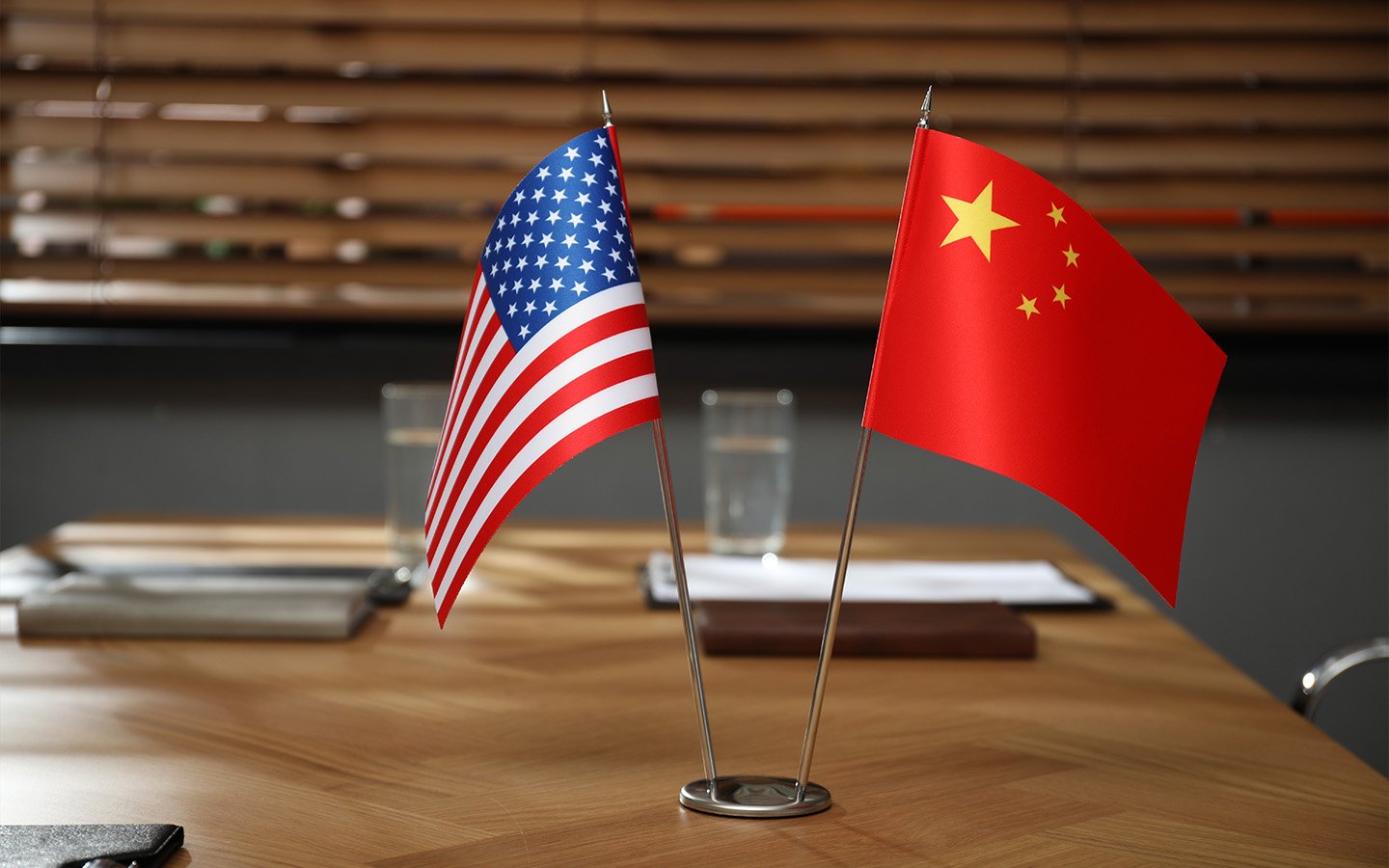
- Talks in Madrid mark the fourth U.S.–China negotiation in 2024, following Geneva, London, and Stockholm.
- Discussions cover tariffs, TikTok’s future, semiconductor restrictions, and Russian oil trade pressure.
- Bilateral trade topped $665B in 2023, with projections crossing $700B by 2025 if barriers ease.
- Experts predict incremental progress, with major deals likely postponed until a possible Trump–Xi meeting later this year.
Madrid in September is a city dressed in gold. The morning sun spills across the cobbled plazas, its light catching the tiled roofs and baroque facades of Spain’s capital. The air carries the warmth of summer fading into autumn, a soft breeze sweeping down from the Sierra de Guadarrama. Cafés spill onto the streets, terraces glow in the evening, and the Spanish sky turns into a palette of red and orange as the sun sets. Against this stunning backdrop, two of the world’s most powerful nations—the United States and China—have gathered to decide whether beauty can also be diplomacy’s ally.
For four days, from September 14 to 17, Madrid is playing host to high-stakes talks between senior U.S. officials—Treasury Secretary Scott Bessent and Trade Representative Jamieson Greer—and China’s Vice Premier He Lifeng, alongside Beijing’s top negotiator Li Chenggang. This is the fourth meeting in as many months, a signal that despite the lingering shadows of tariffs, sanctions, and suspicion, both sides remain committed to talking rather than walking away.
Trump, China Seek Common Ground as Trade Talks Resume in Washington
The billion-dollar question is simple, if poetic: will Madrid’s soft mornings, its warm afternoons, and its breathtaking evenings nudge Washington and Beijing toward progress? Or will the city’s charm merely serve as a beautiful frame for another round of cautious posturing?
The Stakes: Truce Under Pressure
The Madrid meeting comes at a delicate moment. President Donald Trump, who built his trade policy on tariffs that shook global supply chains, has extended a fragile truce with China. U.S. duties on Chinese goods remain at about 55%, while Beijing has held back on retaliatory tariffs, ensuring that rare-earth minerals crucial to American industries continue to flow. The current pause expires on November 10, making Madrid a stage for determining whether détente can be extended—or upgraded.
READ MORE: Exclusive: U.S. and China Resume Trade Talks in Stockholm Amid Global Economic Crossroads
Adding to the urgency is the looming September 17 deadline for TikTok’s divestiture of its U.S. assets. The app, owned by China’s ByteDance, faces a potential ban if it does not move into American hands. Trump has already extended the deadline three times, and while insiders expect another extension, the decision carries political weight. Republicans and Democrats alike have criticized the delays, while Trump himself recently opened a TikTok account, blurring the lines between policy and politics.
Then there is Russia. Washington is pressing its G7 allies to join in penalizing China and India for their continued purchases of Russian oil. Treasury Secretary Bessent has urged tariffs on buyers of Russian crude, calling it the only way to choke off funding for Vladimir Putin’s war machine. While the U.S. has imposed a 25% duty on Indian goods over the issue, China has so far escaped such punishment—a reflection, perhaps, of the fine balance Washington wants to strike between pressure and engagement.
The Mood in Madrid
But beyond the statistics and strategy, Madrid itself has become part of the story. Spain, under Prime Minister Pedro Sanchez, has positioned itself as a venue for delicate diplomacy. The talks are being held at the Palacio de Santa Cruz, a baroque jewel that once housed Spanish ambassadors and now serves as the foreign ministry. Spanish officials are keen to project their city as a hub for global negotiations, not only between East and West but also as a potential site for peace talks on conflicts ranging from Ukraine to the Middle East.
ALSO READ: US, Chinese officials to launch talks in Spain on trade irritants, TikTok deadline
The atmosphere in Madrid is a study in contrasts. On one side, negotiators huddle in conference rooms, surrounded by stacks of briefing papers, trade flow charts, and legal drafts. On the other, outside the ministry’s tall windows, the Spanish sun dapples the cobbled courtyards, and tourists sip sangria under parasols. It is almost as if the city itself insists on reminding the negotiators that beauty exists beyond politics, that compromise might be easier under a crimson sunset than in the sterile rooms of Geneva or Washington.
Foreign policy experts have picked up on this symbolism. “Talks are often as much about mood as about substance,” said one European trade analyst. “Madrid offers warmth, history, and a sense of neutrality. That helps create an environment where even rivals can imagine common ground.”
The Barriers: Agriculture, Technology, and Trust
Still, the hurdles are formidable. Agriculture remains a sore point. Chinese tariffs of 23% on U.S. soybeans have hurt American farmers, while Washington’s restrictions on farmland purchases by Chinese entities continue to irk Beijing. Technology, too, is contentious. China has launched investigations into what it calls U.S. “discrimination” in chip policies, accusing Washington of using export controls to curb its rise in advanced computing and artificial intelligence.
The U.S., meanwhile, demands greater access to China’s domestic markets, particularly in finance and services. But deeper still are questions of trust. Washington insists that Beijing reduce its reliance on state subsidies and adopt a more consumption-driven economic model. Beijing, in turn, seeks guarantees that U.S. sanctions won’t be wielded arbitrarily against its companies.
Experts caution against expecting quick results. Wendy Cutler, a former U.S. trade negotiator, noted that more substantive agreements—on TikTok, soybeans, and fentanyl-related tariffs—are likely being saved for a possible Trump-Xi Jinping meeting later this year in Seoul. “Madrid is groundwork,” she said. “The real breakthroughs may come when leaders step in.”
Trump’s Balancing Act
For President Trump, the Madrid talks are another chapter in his balancing act. He has made tariffs a signature of his economic policy, but he has also shown a willingness to strike deals when the time is right. The Phase 1 agreement of 2020, under which China pledged $200 billion in additional U.S. purchases, remains a reference point. Though pandemic disruptions prevented full implementation, both sides took away a lesson: tariffs may bruise, but dialogue sustains.
Trump has repeatedly said he does not seek decoupling, only “fair trade.” His critics accuse him of inconsistency, but his supporters argue that his unpredictability keeps adversaries on edge while leaving space for eventual compromise. The Madrid talks, therefore, are less about tearing down walls than about adjusting their height.
Will Beauty Matter?
And so, the question lingers: can the beauty of Madrid itself influence the outcome? It may sound romantic, even naïve, to suggest that sunshine and architecture matter in trade negotiations. Yet history is full of moments where atmosphere shaped diplomacy—from the Camp David accords in the pastoral hills of Maryland to summits in the alpine serenity of Geneva. Madrid offers its own brand of persuasion: the elegance of its plazas, the glow of its evenings, the charm of its streets that invite walking, talking, and—perhaps—rethinking entrenched positions.
As the delegations meet under the Spanish sun, the world watches. The issues on the table are complex, the trust deficit deep, and the economic stakes enormous. Bilateral trade between the two giants remains above $660 billion annually, proof that despite tariffs and rhetoric, interdependence endures. The talks may not yield dramatic breakthroughs, but they may keep the doors open, and in diplomacy, that is often victory enough.
Madrid, with its sunshine and its shadows, has become more than a host city. It is a reminder that even in an era of confrontation, beauty can create space for dialogue. Whether that space leads to a path forward depends not on the city, but on the willingness of Washington and Beijing to see beyond their grievances and toward their shared interests.
-
Optimistic Scenario (Talks Succeed):
Trade volumes rise from about $705B in 2025 to around $755B in 2026, fueled by tariff reductions, renewed agricultural purchases, and expanded tech cooperation. -
Stalled Scenario (Talks Fail):
Trade stagnates, holding near $680B by 2026, reflecting continued tariffs, restricted market access, and political mistrust.