



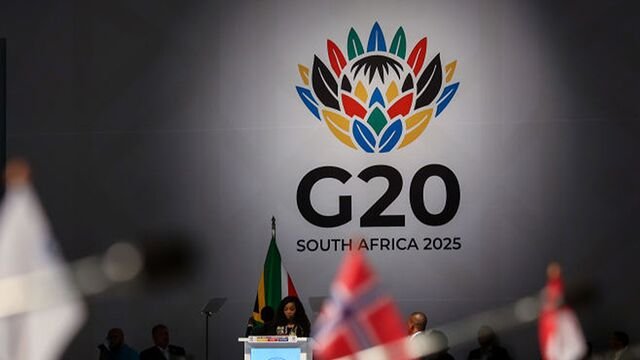
- Trump G20 Boycott sparks global concern: U.S. absence from Johannesburg summit raises questions about Washington’s role in global economic governance.
- South Africa rejects U.S. claims: Pretoria calls Trump’s allegations of white farmer persecution “not based on fact.”
- Trade ties under pressure: Bilateral trade worth $26.2 billion in 2024 now faces steep tariffs and aid cuts.
- Global impact of Trump G20 Boycott: The move could erode U.S. diplomatic leverage and empower rival powers like China.
When President Donald Trump announced that no U.S. officials would attend the G20 Summit in Johannesburg, he reignited old diplomatic fires and triggered new global anxieties. The Trump G20 Boycott, framed around alleged “human rights abuses” against white South Africans, threatens to overshadow the very goals of this year’s summit—Solidarity, Equality, Sustainability.
Trump’s announcement, made in a social media post, claimed that “Afrikaners and other South Africans of European descent are being killed and their land illegally confiscated.”
U.S. Treasury Secretary’s Absence at G20 Signals Deeper Rift with South Africa
The statement echoes Trump’s long-standing and controversial narrative from his first term, when he alleged—without evidence—that white farmers were being targeted on a “large scale.” These claims have been repeatedly debunked by both South African courts and independent investigations.
South Africa’s Foreign Ministry swiftly rejected Trump’s latest claims, calling them “regrettable” and “not substantiated by fact.” President Cyril Ramaphosa’s administration emphasized that while South Africa faces high crime rates, there is no evidence that white farmers are being persecuted.
Absence of Putin and Xi Sets New Diplomatic Stage at G20: Modi and Biden Seize the Moment
The country’s 2017 Land Audit showed that white South Africans, representing about 7% of the population, still own nearly 73% of agricultural land—one of the enduring legacies of apartheid that the government seeks to reform.
Impact of U.S. Absence on the G20 Summit
The Trump G20 Boycott is more than symbolic. The U.S. has historically been a key pillar of G20 decision-making. Without its participation, the summit’s legitimacy and agenda-setting capacity could be compromised in several ways:
-
Loss of U.S. Influence:
The U.S. has traditionally used the G20 platform to shape global trade, climate, and security policies. Its absence cedes ground to China and the European Union, both eager to expand their influence. -
Erosion of Summit Credibility:
The G20 derives power from inclusivity among major economies. With the U.S. absent, member nations may perceive the summit as weakened, reducing the urgency of collective commitments. -
Diplomatic Isolation:
Trump’s decision distances the U.S. from allies, particularly the EU and Canada, which view multilateralism as critical for global stability. -
Economic and Political Fallout:
South Africa, already grappling with high unemployment and sluggish growth, fears that deteriorating ties with Washington could affect trade and investment.
Bilateral Relationship Under Strain
The Trump G20 Boycott underscores how far U.S.–South Africa relations have deteriorated. Once strong partners under programs like the African Growth and Opportunity Act (AGOA), both nations now face a chill unprecedented since the apartheid era.
Trump Pulls US Officials From G20 Summit in Protest of Alleged Bias Against White South Africans
According to the U.S. Trade Representative, U.S. goods and services trade with South Africa reached $26.2 billion in 2024, slightly down from the previous year. Goods exports totaled $5.8 billion, while imports reached $14.7 billion, leaving the U.S. with a trade deficit of about $8.9 billion. In 2023, the deficit was smaller, around $6.8 billion.
South Africa exports vehicles, minerals, and precious metals to the U.S., while importing machinery, aircraft, and agricultural products. American companies maintain substantial investments in South Africa—roughly $10 billion—spanning energy, pharmaceuticals, and technology.
Yet these economic links are being tested. Earlier this year, Trump suspended most U.S. aid to South Africa and imposed steep tariffs—up to 31%—on key imports, citing “unfair treatment of white South Africans.” Pretoria condemned the move, accusing Washington of politicizing race relations and trade policy.
South Africa’s Response: Calm but Calculated
South Africa has chosen measured restraint in response to the Trump G20 Boycott. In a statement, the Foreign Ministry said it “noted with regret” the U.S. decision but reaffirmed its commitment to host a “successful and inclusive” summit. Ramaphosa’s government sees Trump’s rhetoric as an attempt to score domestic political points with right-wing constituencies ahead of next year’s elections.
Behind the scenes, however, Pretoria is quietly reassessing its economic strategy. Officials have hinted at diversifying trade and deepening partnerships with China, Russia, and the European Union. Analysts warn that this pivot could permanently reduce Washington’s influence in one of Africa’s largest economies.
A Broader Diplomatic Gamble
Ultimately, the Trump G20 Boycott is a high-stakes gamble. Trump believes it reinforces his stance as a defender of “Western civilization” and a critic of globalism. But the cost may be steep. By walking away from the G20, Washington risks undermining its leadership role in setting global rules—on trade, debt relief, and climate finance—and alienating African nations that once saw the U.S. as a partner in progress.
For South Africa, the challenge is to prove that the G20 can thrive without American participation. For Trump, it is a test of whether unilateral boycotts can serve as effective diplomacy—or merely isolate the United States in an increasingly multipolar world.