



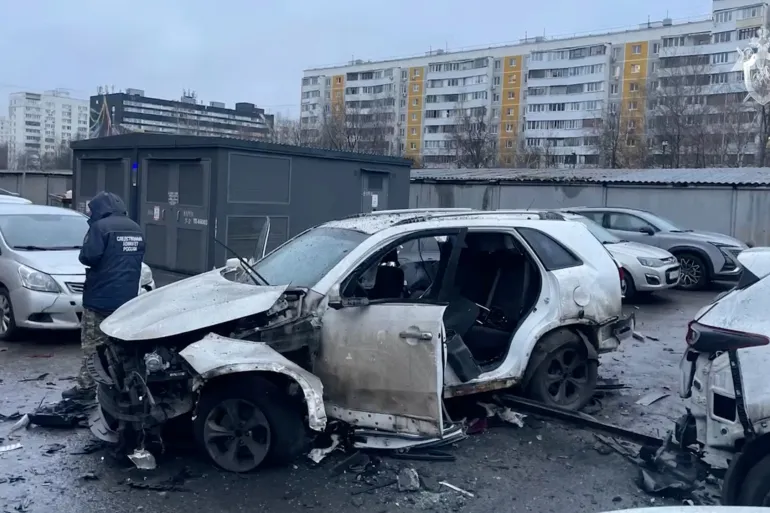
- Moscow Car Bomb Kills Top General Fanil Sarvarov, marking the third high-ranking assassination in the Russian capital within a single calendar year.
- The fatal explosion occurred on the heels of productive peace negotiations in Florida, leading to suspicions of intentional diplomatic sabotage.
- Russian investigators are officially pursuing the theory that Ukrainian special services orchestrated the strike to destabilize the Kremlin’s military leadership.
- Despite the violence, U.S. and Russian envoys remain at the negotiating table, though military bloggers warn of a severe and inevitable “tit-for-tat” retaliation.
A high-ranking Russian general was assassinated in a daring car bombing in southern Moscow on Monday, a strike that investigators are already linking to Ukrainian special services. The death of Lt. Gen. Fanil Sarvarov, the head of the army’s Directorate for Operational Training, marks the third such high-profile assassination of a general in the Russian capital within a year, sending shockwaves through the Kremlin just as delicate negotiations for a Ukraine Peace Deal reach a critical juncture in Florida.
Moscow Car Bomb Kills Top General: Precision and Brutality
The explosion occurred at approximately 7:00 a.m. local time in a residential parking lot on Yasenevaya Street. Investigators report that a sophisticated explosive device was planted directly under the driver’s seat of Sarvarov’s white SUV. The blast was so powerful that it shredded the vehicle’s frame, leaving behind a grim scene of blood-stained upholstery and scorched debris. Sarvarov, 56, a veteran of conflicts in Chechnya and Syria, died shortly after being rushed to the hospital.
Ukraine War Peace Talks in Florida: U.S. and Russian Officials Meet Amid High Demands
Svetlana Petrenko, spokesperson for Russia’s Investigative Committee, stated that while several leads are being followed, the “possible organization of the crime by Ukrainian special services” is the primary line of inquiry. This follows a pattern of lethal covert operations; exactly twelve months ago, Lt. Gen. Igor Kirillov was killed by a scooter bomb, and in April, Lt. Gen. Yaroslav Moskalik was similarly targeted in a Moscow suburb.
Shadow of the Florida Summit
The timing of the assassination is as significant as the target. Over the weekend, U.S. and Russian envoys—including real estate mogul Steve Witkoff and Kremlin negotiator Kirill Dmitriev—met in Florida to discuss a 20-point framework for a Ukraine Peace Deal.
India and Pakistan Fuel South Caucasus Arms Race: Fighter Jet Deals with Armenia and Azerbaijan Escalate Tensions
While Witkoff described the talks as “productive and constructive,” the assassination of a general responsible for operational training suggests that hostile forces may be moving to sabotage any prospect of a ceasefire.
G7 Summit 2025: Trade Tensions, Global Wars, and Tariff Talks Dominate High-Stakes Gathering
Who is Behind the Trigger?
Russian military bloggers and analysts have been quick to point the finger at the SBU (Ukraine’s domestic security agency) or the GUR (military intelligence). However, a more complex theory is emerging among Moscow’s elite: the “Sabotage of Peace” theory.
-
Hostile Forces: Analysts suggest that “hawks” on both sides of the conflict—those who view a Ukraine Peace Deal as a betrayal or a strategic mistake—may be using high-profile assassinations to harden public opinion and force a withdrawal from the negotiating table.
-
Reciprocity: The attack comes just as Russia intensified its offensive in Eastern Ukraine and allegedly deported 50 citizens from the Sumy region. The assassination may be a lethal signal from Kyiv that “tranquility” in Moscow is a fantasy as long as Ukrainian soil is occupied.
-
The “Stern Reaction”: Russian lawmaker Andrey Kolesnik called for the “destruction on the spot” of anyone involved, echoing the Kremlin’s recent shift toward a policy where every action meets a devastating reaction.
Global Reactions: Washington and Beyond
In Washington, the State Department issued a cautious statement, condemning “all acts of terrorism and extrajudicial killings” while urging all parties to remain focused on the Florida diplomatic track.
Car bomb in Moscow kills senior Russian general, third such attack in a year
President Donald Trump, who has personally championed the 28-point peace plan, reportedly viewed the attack as a “calculated provocation” intended to derail his administration’s signature foreign policy initiative.
Across the globe, the reaction has been one of deep concern.
-
The EU: European leaders, meeting in Brussels, expressed fears that the assassination would lead to a “uncontrolled escalation” in the shadow war between intelligence agencies.
-
Ukraine: While the SBU and GUR have remained officially silent, Foreign Minister Andrii Sybiha criticized Russia’s “medieval raids” in Sumy, effectively framing the Moscow blast as a domestic Russian failure rather than a Ukrainian operation.
-
China: Following its new “tit-for-tat” policy, Beijing’s foreign ministry warned that a lack of security and trust would continue to claim lives unless a sustainable Ukraine Peace Deal is reached through mutual respect.
A Harbinger of More Conflict?
For the Kremlin, the security breach is an embarrassment. If a general cannot be protected in the heart of Moscow, the “victory” narrative of the war feels hollow to the public. As military blogger Andrei Rudenko noted, “It’s hard to talk about peace when your opponent is preparing for an even bigger war.“
The assassination of Fanil Sarvarov has effectively turned the Florida beach talks into a high-stakes crisis room. If the Russian leadership views this as an attempt to weaken their hand before a deal, they may respond with a surge on the front lines. If, however, they see it as the desperate gasp of a “terrorist regime” (as described by state media), they may double down on the Witkoff-Dmitriev talks to end the cycle of violence. One thing is certain: the message of “do good and have good” has been replaced by the cold reality of a bomb under a car.