



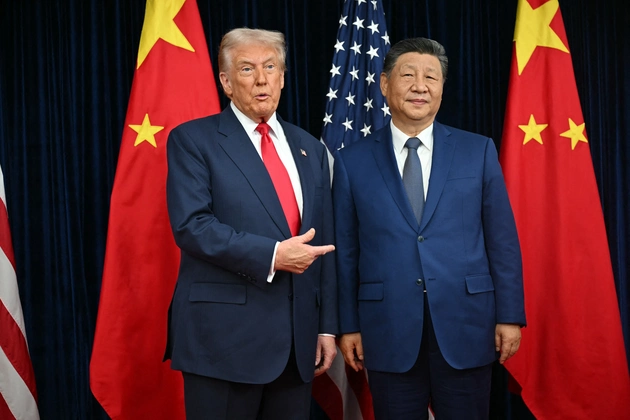
- U.S.–China relations 2026 are defined by competition, cautious cooperation, and strategic decoupling.
- Bilateral trade contracted in 2025: U.S. imports from China fell 19%, exports dropped 13%, signaling supply-chain stress.
- China controls 60% of global rare earth production, while the U.S. ramps up stockpiles and alliances to reduce dependency.
- Flashpoints such as Taiwan ($2.45 trillion in annual trade), semiconductors, and rare earths will continue to test stability.
As 2026 unfolds under the second Trump administration, U.S.–China relations continue to be defined by competition blended with cautious cooperation rather than reconciliation. Despite high-profile summits, trade agreements, and restored communication channels, the structural sources of rivalry — technology, supply chains, and strategic autonomy — remain deeply entrenched, shaping global commerce, national strategies, and geopolitical alignments.
The duality of economic interdependence and strategic decoupling dominates the relationship. In late 2025, Washington and Beijing concluded a trade and economic deal, temporarily halting certain tariffs and export controls on critical materials. China agreed to suspend rare-earth export restrictions, resume U.S. farm imports including soybeans, and roll back some retaliatory tariffs through late 2026.
The U.S., in turn, paused heightened measures on Chinese imports. While these adjustments reduced the risk of crisis, they fall short of normalizing bilateral ties.
U.S.- China Relations 2026: Bilateral Trade: Sizeable but Stressed
Bilateral trade remains large but disrupted. In 2024, U.S. goods exports to China reached $143.5 billion, while imports were $438.9 billion, resulting in a $295.4 billion deficit — a long-standing structural feature. In 2025, tariffs and trade restrictions pushed January–September exports to $109.9 billion and imports to $332.3 billion, narrowing the deficit but reflecting real contraction in commerce.
Trump says Venezuela does not give China a Taiwan precedent, but ‘it’s up to’ Xi
Through November 2025, China’s exports to the U.S. totaled roughly $385 billion, a 19 percent decline year-on-year, while U.S. exports fell over 13 percent. Soybean exports nearly collapsed before revival in late 2025. These figures underscore the impact of tariffs, export controls, and political tension on trade flows. Japan’s condemnation of China’s dual-use export restrictions further demonstrates how supply-chain disruptions are reverberating regionally.
Trump, China Seek Common Ground as Trade Talks Resume in Washington
China’s broader trade performance, however, remained resilient. Total exports rose 5.4 percent to $3.4 trillion, imports fell 0.6 percent to $2.3 trillion, and the trade surplus hit $1.08 trillion, signaling Beijing’s growing capacity to absorb external shocks.
Strategic Decoupling: Chips and Rare Earths
A defining feature of U.S.–China rivalry is strategic decoupling in technology and critical materials. China is gradually ending reliance on U.S.-made chips, investing heavily in indigenous semiconductor production, AI, and advanced materials. U.S. export controls reduced chip sales to China by 23 percent, and chip-making equipment by 17.9 percent in 2025, yet Beijing’s push for technological self-reliance is accelerating.
Conversely, Washington is reducing dependency on China’s rare-earth supplies. China dominates 60 percent of global rare earth production and up to 90 percent of refining capacity, crucial for EVs, electronics, and defense systems. U.S. initiatives — including the CHIPS Act, Critical Minerals programs, and an $8.5 billion strategic minerals deal with Australia — aim to build reserves and diversify supply chains. Rare-earths thus remain a strategic leverage point in U.S.–China competition.
Geopolitical Maneuvering
Trade disputes are inseparable from geopolitical competition. China is cultivating new markets in ASEAN, Africa, and the Middle East, hedging against U.S. influence. The U.S. is preoccupied with Venezuela, Greenland, and Arctic security, signaling a shift from direct Indo-Pacific confrontation. Military competition — particularly over Taiwan and the South China Sea — remains acute. In 2024, U.S. military spending was $997 billion versus $314 billion in China, reflecting asymmetric capacity, while China’s nuclear and missile capabilities continue to advance.
Taiwan alone handles $2.45 trillion in annual maritime trade, underscoring why any flashpoint there could have global repercussions. Both sides treat Taiwan, rare earths, and critical technologies as red lines, channeling competition into manageable forms without triggering full-scale conflict.
Shifting U.S. and Chinese Perceptions
Public and policy perceptions are evolving. A 2025 Pew survey found 56 percent of Americans view China as a competitor, versus 33 percent seeing it as an enemy — a notable drop from 2024. Policy documents, including Trump’s National Security Strategy, reflect a shift from ideological framing to economic competition as the central stake. Meanwhile, China’s Communist Party emphasizes strategic initiative amid fierce international competition, combining civilian innovation with military capability to maintain leverage.
Outlook for 2026: Managed Competition
Looking ahead, 2026 is likely to see stable but competitive U.S.–China relations. China aims to consolidate economic resilience, strengthen technological autonomy, and expand into new markets. The U.S. seeks a negotiable and manageable relationship, leveraging historic advantages while addressing domestic innovation gaps. Fundamental improvements in ties remain unlikely, as structural differences endure.
Experts from the Atlantic Council note that the U.S. must invest in science, research, and education to maintain long-term competitiveness, while China focuses on resilience and strategic autonomy in critical sectors. The relationship will oscillate between competition, selective cooperation, and careful containment, forming a bipolar economic order where each side guards its interests while avoiding direct confrontation.
2026 will not be a year of rapprochement, but of competition normalized, stability maintained, and strategic patience exercised on both sides.