



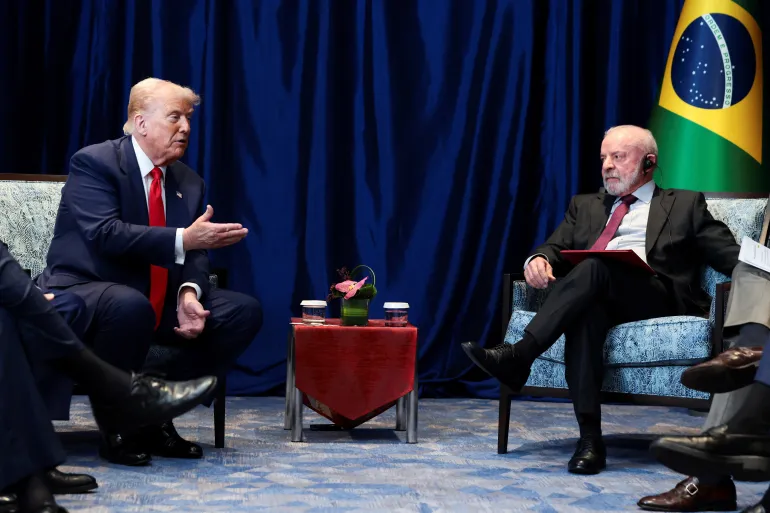
- Lula’s Washington Visit : U.S.-Brazil relations reset after years of hostility following a breakthrough Trump–Lula phone call
- Brazil’s China trade has surged to $171 billion, dwarfing U.S. economic ties
- Lula’s Washington visit could redefine tariffs, security cooperation, and investment flows
- Experts question whether closer U.S. ties will weaken Brazil’s strategic partnership with Beijing
After years of mistrust, diplomatic friction, and public disagreements between President Luiz Inácio Lula da Silva and U.S. President Donald Trump, the announcement of Lula’s upcoming visit to Washington marks a significant thaw in bilateral relations.
The shift stemmed from a 50-minute telephone conversation on Monday, January 26, 2026, a call that Brazilian officials characterized as both constructive and forward-looking. The call addressed Venezuela, organized crime, the Middle East “Board of Peace,” and broader regional stability. Most importantly, it appears to have reset the diplomatic tone between two of the Western Hemisphere’s largest economies — and possibly recalibrated long-strained ties.
Trump Tariffs on Brazil Ignite High-Stakes Trade War Amid BRICS Tensions
Much of the credit — at least in diplomatic commentary — goes to Trump’s willingness to engage directly and boldly on contentious regional issues, notably Venezuela, where Lula previously accused the United States of overreach following Washington’s role in the removal and extradition of Nicolás Maduro. That tension had served as a persistent irritant in the relationship. But evolving geopolitical priorities — particularly in Latin America — have created incentives on both sides for rapprochement.
Yet beyond the rhetoric of diplomatic renewal, the underlying economic context is uneven: while Brazil and the U.S. are major trade partners, their commercial relationship remains overshadowed by Brazil’s far larger economic ties with China.
Brazil’s Lula holds call with Trump, agrees to visit Washington
Brazil–China Trade: The Dominant Economic Axis
In 2025, total bilateral trade between Brazil and China reached a record US $171 billion, the highest on record since data collection began in 1997. This figure represented an 8.2 percent annual increase and was more than double the trade volume between Brazil and the United States in the same period — approximately US $83 billion. China’s share of Brazil’s total foreign trade was roughly 27.2 percent in 2025, underscoring its dominant role in Brazilian commerce.
Brazil’s exports to China — totaling about US $100 billion in 2025 — were concentrated in agricultural commodities and extractive industries, with soybeans alone accounting for over a third of that figure. Oil, beef, and iron ore also featured prominently. On the import side, Brazil bought approximately US $70.9 billion worth of Chinese machinery, electronics, vehicles, fertilisers, and chemicals — reflecting China’s role as a major supplier of manufactured goods.
Brazil Considers U.S. Court Challenge Over Steep Trump Tariffs: Background, Updates, and Analysis
The durability of this commercial relationship is notable: Brazil has maintained a trade surplus with China for 17 years running, and China remains the largest export destination for Brazilian soybeans, beef, minerals, and increasingly, energy products.
The Brazil–U.S. Trade Relationship: Potential, Not Pinnacle
By comparison, the trade relationship between Brazil and the United States is smaller and more volatile. Total Brazil–U.S. trade in 2025 stood at about US $83 billion — less than half of Brazil’s trade with China. Brazilian exports to the U.S. include a mix of energy products, steel, agricultural goods, and manufactured items such as machinery and aerospace components, but this market has been squeezed by recent U.S. tariffs on Brazilian steel and other goods implemented in 2025.
G7 Summit 2025: Trade Tensions, Global Wars, and Tariff Talks Dominate High-Stakes Gathering
Those tariffs contributed to a decline in Brazilian exports to the U.S., while stimulating redirection toward other markets.
Brazil’s share of imports from the United States — about 16.1 percent of total imports in 2025 — underscores that the U.S. remains Brazil’s second-largest source of imported goods after China. These stem largely from machinery, industrial inputs, petroleum products, and advanced manufactured goods.
Unlike with China, Brazil’s trade balance with the U.S. has tended toward narrower surpluses or near balance, reflecting a more diversified bilateral exchange that lacks the concentrated export surpluses seen in the China relationship.
India and Pakistan Fuel South Caucasus Arms Race: Fighter Jet Deals with Armenia and Azerbaijan Escalate Tensions
Strategic Implications: Will the Thaw Reshape Trade?
The emerging diplomatic warmth between Washington and Brasília — if sustained — could have mixed effects on Brazil’s foreign economic relationships:
- Economic Diversification vs. Dependence: Strengthened U.S.–Brazil ties could help reduce dependence on China by expanding bilateral cooperation in technology, defence, energy, and manufactured exports. However, China’s demand for Brazilian commodities and strategic raw materials remains unparalleled in scale. Consequently, any U.S.–Brazil trade growth is likely to be complementary rather than substitutive in the near term.
- Geopolitical Balancing: Brazil’s renewed engagement with the United States could be interpreted by Beijing as a hedging strategy, rather than a pivot away from China. Latin American leaders often strive for balanced diplomacy; Brazil’s trade with China continues to grow on its own terms, even amid U.S.–China trade tensions.
- Tariffs and Trade Policy: The resolution of tariff disputes — especially U.S. levies on Brazilian goods — will be a litmus test for the depth of the new bilateral relationship. A negotiated reduction of barriers could stimulate U.S. demand for Brazilian exports, while reinvigorating U.S. investment in Brazil’s industrial sectors.
- Global Supply Chains and Competitiveness: China’s role as an integrated supplier of manufactured products means that Brazil’s import dependence on Chinese goods will likely persist. The U.S.–Brazil rapprochement may spur selective shifts toward American high-tech and capital goods, but the overall structure of Brazil’s trade with China is deeply entrenched.
Lula’s forthcoming visit to Washington symbolizes more than a diplomatic reset; it reflects Brazil’s strategic balancing amid global economic reconfigurations.
Turkey’s Balancing Act: Navigating Complex Relations with Russia and Ukraine Amid Ongoing Conflict
Yet while political rhetoric now leans toward cooperation, the economic landscape tells a story of enduring China dominance and a still-modest U.S. trade footprint by comparison. The future of Brazil’s foreign policy will hinge not just on diplomatic charm, but on realigned trade policies, tariff negotiations, and strategic economic diversification — as both Washington and Brasília seek to convert rhetoric into revenue for their citizens.
Comparative Trends Summary
| Metric | Brazil–China | Brazil–U.S. |
|---|---|---|
| 2000 | ~US $1 billion exports | Leading partner |
| 2010s | Dominant partner | Declining share |
| 2025 | ~US $171 billion total trade | ~US $83 billion total trade |
| Export composition | Commodities (soy, iron ore, oil) | Diversified (manufactured goods, energy) |
| Trade balance | Long surplus for Brazil | Mixed, impacted by tariffs |
Overall Interpretation
- China’s role in Brazil’s economy has grown exponentially over the past two decades, transforming from a minor partner to Brazil’s largest trade partner by far. This reflects China’s massive demand for Brazilian commodities and its growing position as a supplier of manufactured goods.
- The United States, while still the second-largest trading partner, has seen its share of Brazilian trade shrink amid tariff disputes and China’s ascendancy.
- The composition of trade also differs structurally: China dominates Brazil’s commodity exports, while the U.S. trade relationship is more manufacturing and industrial goods-oriented — a factor that points to complementary economic interests but uneven scale.
Experts believe Lula’s upcoming visit could help ease political tensions and improve the diplomatic climate between the two nations. However, most analysts agree it is highly unlikely that the United States will displace China as Brazil’s dominant trading partner in the foreseeable future.