



- U.S critical minerals strategy introduces coordinated price floors to protect domestic mining and processing industries
- Washington forms a preferential trade bloc with over 55 countries to reduce reliance on China’s mineral supply chains
- Project Vault launches a $12 billion strategic stockpile to stabilize critical mineral access
- Analysts warn of short-term cost increases and heightened trade tensions with Beijing
The Trump administration’s unveiling of a preferential trade bloc for critical minerals marks a significant escalation in Washington’s long-running effort to loosen China’s grip over materials that underpin modern industrial power — from semiconductors and electric vehicles to advanced weapons systems.
At the heart of the proposal, announced by U.S. Vice President JD Vance in Washington, is a coordinated system of reference prices — effectively price floors — across the supply chain of key minerals such as lithium, rare earths, nickel and cobalt. The mechanism would be enforced through adjustable tariffs within a “preferential zone” of allied nations, designed to prevent cheap imports from undercutting domestic producers and discouraging private investment.
Though China was not named directly in official remarks, the target was unmistakable. Beijing dominates the processing stage of many critical minerals and has repeatedly used export controls, price manipulation and supply gluts as geo-economic tools. Last year’s expansion of Chinese export restrictions on rare earths triggered production disruptions across U.S. and European auto industries, while a China-driven lithium oversupply stalled mining expansion plans in North America.
For Washington, these vulnerabilities have moved from economic concern to national security threat.
The gathering of 55 countries — including Japan, India, Germany, Australia, Pakistan, South Korea and mineral-rich nations such as the Democratic Republic of Congo — underscores a growing recognition that unilateral policies are insufficient to counter China’s scale and market power. Interior Secretary Doug Burgum confirmed that at least 11 more countries would soon join the emerging trade club, with 20 others expressing strong interest.
This multilateral push also reflects a strategic recalibration by the U.S. after years of “America First” trade measures strained relations with allies. As Scott Kennedy of the Center for Strategic and International Studies noted, Washington now appears to accept that reducing dependence on China requires collective action — not just tariffs and subsidies at home.
The price floor strategy aims to solve a core problem that has plagued Western mineral policy: private investors have been reluctant to fund new mining and processing projects because Chinese supply has consistently undercut global prices. By guaranteeing minimum returns through coordinated trade rules, the U.S. hopes to unlock billions in stalled investment.
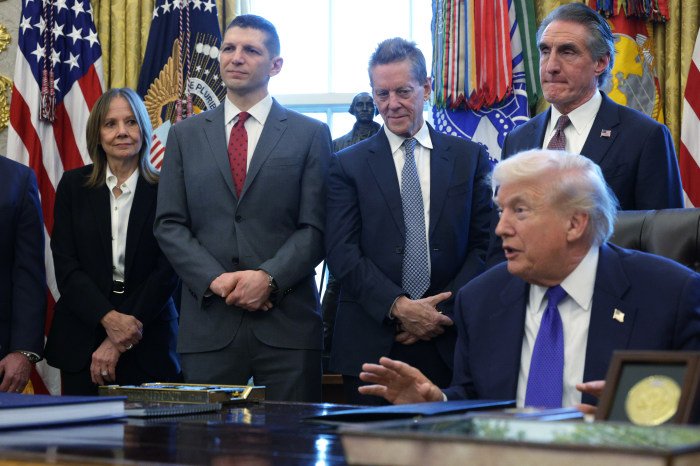
This initiative is being reinforced by concrete financial muscle. Earlier this week, President Trump launched “Project Vault,” a strategic stockpile of critical minerals backed by $10 billion in U.S. Export-Import Bank funding and $2 billion in private capital. The White House has also taken direct stakes in mineral companies — an increasingly interventionist approach that mirrors policies used in semiconductors and pharmaceuticals.
Yet the strategy carries risks.
In the short term, higher mineral prices could raise costs for manufacturers of electric vehicles, batteries and electronics, potentially slowing clean energy transitions and consumer adoption. Globally coordinated price floors may also provoke retaliation from Beijing, which could tighten export controls further or flood alternative markets.
China’s embassy in Washington signaled its displeasure, defending Beijing’s role in stabilizing global mineral supply chains and warning implicitly against politicization of resource trade.
The timing is also diplomatically delicate. President Trump is expected to visit China in April, and just days ago he described a call with President Xi Jinping as “excellent,” discussing trade and security issues — though notably omitting minerals. In October, China’s leverage was starkly demonstrated when tariff reductions were reportedly exchanged for Beijing easing rare earth restrictions.
Looking ahead, the success of the U.S.-led minerals bloc will depend on three key factors.
First, whether allied nations can align regulatory frameworks, environmental standards and subsidies quickly enough to compete with China’s vertically integrated supply chains.
Second, whether guaranteed pricing truly mobilizes large-scale private investment — particularly in politically unstable but resource-rich regions like Africa.
Third, how aggressively China responds.
Beijing retains overwhelming control over processing infrastructure and could adapt by shifting supply routes, offering selective discounts to non-aligned countries, or accelerating technological alternatives.
In strategic terms, however, Washington’s move signals a broader shift toward economic bloc-building reminiscent of Cold War industrial coordination. Critical minerals are now being treated less as commodities and more as strategic assets — akin to oil in the 20th century.
If sustained, the initiative could gradually reshape global supply chains, reducing China’s dominance over the next decade. But in the near term, it is likely to intensify trade frictions and inject fresh volatility into already fragile industrial markets.
What is clear is that the battle for control of the world’s critical minerals has entered a new phase — one defined not just by tariffs and export bans, but by coordinated pricing power and geopolitical alliance-building.