



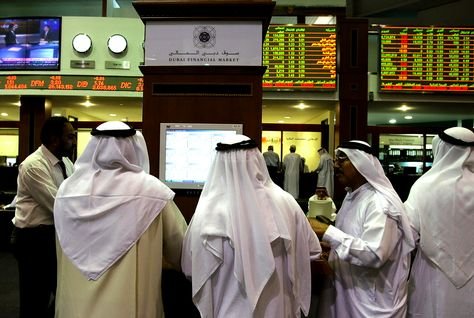
- Dubai economy war impact is becoming visible as UAE stock markets lose more than 7% in three trading sessions.
- Real estate developers such as Emaar and Aldar have suffered sharp share declines amid investor uncertainty.
- Wealthy residents and expatriate investors are moving funds to financial centers like Singapore and Europe.
- International luxury brands and retailers are closing stores or reducing operations as tourism and travel slow.
The escalating war between the United States and Iran is beginning to reverberate through the Gulf’s most glittering financial hub, shaking investor confidence in Dubai and exposing the vulnerabilities behind one of the world’s fastest-growing economic success stories.
In early Friday trading, the United Arab Emirates’ stock markets extended a steep sell-off triggered by Iranian missile and drone attacks targeting Gulf infrastructure. Dubai’s main share index fell another 2 percent, deepening losses that now exceed 7 percent in just three trading days, a sharp reversal for a market that had been riding a wave of post-pandemic optimism and record inflows of foreign capital.
The turbulence has been particularly severe among companies tied to Dubai’s real estate and tourism sectors — pillars of the emirate’s prosperity. Shares of Emaar Properties, the developer behind landmarks such as the Burj Khalifa, dropped nearly 5 percent, while airline operator Air Arabia also fell almost 5 percent as travel disruptions ripple across the region.
In Abu Dhabi, the capital’s stock index slipped further, setting the stage for a weekly decline of more than 4 percent, with property giant Aldar Properties and several major banks posting steep losses.
For investors accustomed to viewing the UAE as a geopolitical safe haven in an often volatile Middle East, the sudden shock has been jarring.
A Safe Haven Under Pressure
Dubai built its reputation over decades as a sanctuary for global wealth — a city where billionaires, entrepreneurs, and investors could park their capital far from conflict zones.
But the Iranian strikes on Gulf targets, including infrastructure around major cities, have punctured that perception.
Within hours of the first attacks, wealthy expatriates and entrepreneurs quietly began moving money abroad.
According to a French news wire, two Indian entrepreneurs living in Dubai attempted to transfer more than $100,000 each from local bank accounts to Singapore, seeking to hedge against the possibility that the conflict could spiral further. Banking sources say such transfers, while still limited, are beginning to accelerate as high-net-worth individuals diversify holdings into Asian and European financial centers.
Private bankers in the region say the shift reflects a classic wartime instinct among global investors: move liquidity to safer jurisdictions until the situation stabilizes.
Real Estate Boom Faces Its First Real Test
Even more consequential may be the shock hitting Dubai’s spectacular real estate boom.
Over the past three years the emirate experienced one of the fastest property expansions in the world. According to Fitch Ratings, Dubai real estate prices surged nearly 60 percent between 2022 and early 2025, fueled by an influx of foreign investors from Europe, Russia, China, and South Asia.
Luxury towers sold out within hours. Ultra-rich buyers snapped up beachfront villas and penthouses worth tens of millions of dollars.
But the war has introduced a sudden cloud of uncertainty.
Off-plan property deals — sales of homes not yet built — accounted for about 65 percent of Dubai’s real estate transactions in 2025, meaning the sector relies heavily on continued investor confidence. With missiles now falling across parts of the region and airspace disruptions affecting travel, analysts warn that demand could cool sharply.
Shares of leading developers have already reacted. Both Emaar and Aldar fell around 5 percent after markets reopened following a two-day trading suspension imposed to calm volatility.
Bond markets, a critical funding channel for developers, have also effectively frozen. Investors are demanding sharply higher risk premiums for lending to UAE real estate companies, raising the prospect that some planned projects could be delayed or canceled if the conflict drags on.
One senior real-estate banker said his firm has already shelved a planned capital-raising transaction tied to a large property development.
“Investors are not thinking about investing in the region right now,” he said, noting that geopolitical risk has suddenly become the dominant factor in valuations.
Retail and Tourism Feel the Shock
Dubai’s luxury retail ecosystem — another cornerstone of its economy — is also beginning to feel the impact.
Several international brands have temporarily shut stores or scaled back operations across the Gulf as security concerns grow and tourism collapses.
Luxury conglomerates linked to brands such as Louis Vuitton, Cartier, and Gucci have suspended some regional operations, while travel disruptions and closed airspace have sharply reduced visitor flows that normally feed Dubai’s massive shopping malls.
At the same time, major corporations are adopting emergency measures. Amazon has temporarily suspended delivery operations in parts of the region, and several multinational firms have instructed employees to work remotely.
Even within Dubai’s iconic malls, some stores are now operating with skeleton staff as companies allow employees to decide whether they feel safe coming to work.
A Billion-Dollar Tourism Machine at Risk
Tourism, which brings tens of millions of visitors annually to Dubai, may be the sector most vulnerable to prolonged conflict.
Missile strikes in the region — including damage reported near a luxury beachfront hotel — have already begun to deter travelers. Industry analysts estimate that if tourism activity slows for just a month, hundreds of millions of dollars in retail and hospitality revenue could evaporate.
That shock would ripple through the wider economy, from airlines and hotels to real estate developers dependent on wealthy buyers visiting the city.
Still Resilient — For Now
Despite the turmoil, some analysts caution against assuming a lasting collapse.
Oil prices have surged amid fears of disruption in the Strait of Hormuz, boosting revenues across the Gulf and potentially offsetting some economic losses. UAE authorities have also implemented emergency market controls, including temporary price limits on stocks, to prevent panic selling.
“Markets may remain sensitive to regional developments,” said Milad Azar, an analyst specializing in Middle East markets. “But Dubai’s underlying fundamentals remain strong and could support a rebound once tensions ease.”
For now, however, the conflict has delivered a rare and unsettling reality check for a city that built its prosperity on stability, global finance, and the promise that war would always remain far beyond its skyline.
As missiles and geopolitics intrude on that promise, Dubai’s glittering economic miracle is confronting one of the most serious tests in its modern history.