



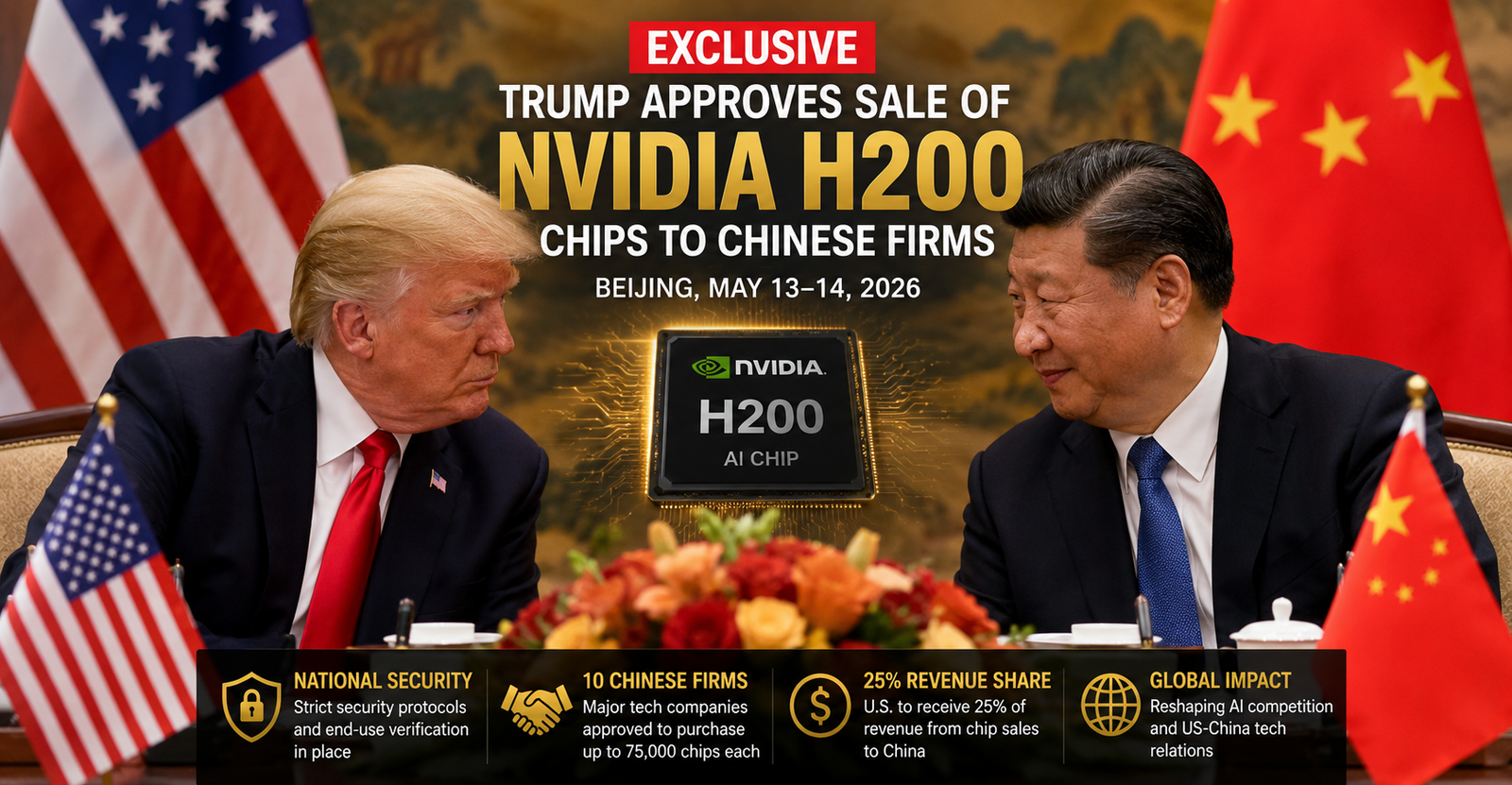
- Trump approves H200 chip sales to Chinese firms after months of delays
- Decision confirms earlier exclusive reporting and signals a shift in US-China tech policy
- Deal includes strict security rules and a controversial revenue-sharing condition
- Move could reshape global AI competition and semiconductor market dynamics
In a decisive move that could reshape the global artificial intelligence landscape, U.S. President Donald Trump has granted final approval for the sale of Nvidia’s powerful H200 AI chips to ten Chinese firms, formally announcing the decision during his high-stakes visit to Beijing on May 13–14, 2026. The announcement came after a closely watched meeting with Chinese President Xi Jinping, marking what analysts describe as a carefully calibrated shift in the ongoing U.S.-China technology rivalry.
The decision not only ends months of regulatory limbo but also confirms an exclusive report published by The Islamabad Telegraph on December 9, 2025, which first revealed that Washington was preparing to approve the export of Nvidia’s H200 chips to China under strict conditions. At the time, the report was met with skepticism in policy circles. Five months later, Trump’s announcement in Beijing has validated that early disclosure, underscoring the publication’s insight into the evolving geopolitical tech landscape.
Trump Approves H200 Chip Sales: A Deal Stuck in Limbo Finally Moves Forward
Despite prior approvals from the U.S. Department of Commerce, not a single H200 chip had been delivered to China before Trump’s intervention. Sources familiar with the matter indicate that approximately ten Chinese firms—including major technology giants such as Alibaba, Tencent, ByteDance, and JD.com—had already received licenses to purchase the chips.
Nvidia H200: Trump’s Nvidia Approval Gives China Fresh Confidence Amid Surplus Announcement
In addition, key distributors like Lenovo and Foxconn were authorized to facilitate sales. Each approved buyer was permitted to acquire up to 75,000 units under U.S. export regulations.
Yet the process stalled. Beijing, wary of overdependence on foreign technology, quietly discouraged domestic firms from finalizing purchases. Simultaneously, evolving U.S. compliance requirements—particularly those related to security assurances and supply chain monitoring—created further delays.
Trump Eases Chip Ban: NVIDIA Cleared to Ship AI Processors to China
Trump’s direct involvement appears to have broken this deadlock. By announcing final approval in Beijing itself, the U.S. president elevated the deal from a bureaucratic clearance to a strategic diplomatic signal.
Trump Approves H200 Chip Sales To China: Jensen Huang’s Quiet Diplomacy
At the center of the breakthrough is Jensen Huang, the CEO of Nvidia, who has emerged as an unlikely but pivotal figure in U.S.-China relations.
Exclusive: US clears H200 chip sales to 10 China firms as Nvidia CEO looks for breakthrough
Initially absent from the official U.S. delegation, Huang joined Trump’s trip after a last-minute invitation. According to insiders, Trump personally picked him up in Alaska en route to Beijing—a symbolic gesture that underscored the importance of Nvidia’s role in the broader negotiations.
Huang’s presence reflects the growing influence of corporate diplomacy in an era where technological supremacy defines geopolitical power. For Nvidia, the stakes are immense. Before U.S. export restrictions tightened, the company controlled approximately 95% of China’s advanced AI chip market, with China accounting for around 13% of its global revenue.
EXCLUSIVE: Trump Greenlights Nvidia’s Return to China After CEO’s Personal Plea
The Chinese AI sector itself is projected to be worth tens of billions of dollars annually, making it a market Nvidia cannot afford to lose. Yet Huang has repeatedly warned that prolonged restrictions could accelerate China’s push toward technological self-sufficiency—ultimately undermining U.S. dominance.
China’s Strategic Hesitation
Even with Trump’s approval, China’s response remains cautious. Officials in Beijing have yet to formally endorse large-scale purchases of H200 chips, reflecting deeper strategic concerns.
Chinese policymakers fear that reliance on imported semiconductors could weaken domestic innovation efforts. In recent years, Beijing has invested heavily in homegrown chip development, with companies such as Huawei leading the charge.
Emerging AI firms in China have increasingly turned to domestic alternatives, citing both national policy incentives and concerns over potential vulnerabilities in foreign hardware. This shift has already eroded Nvidia’s market share in China, which Huang himself has acknowledged has effectively dropped to near zero.
Adding to the complexity are new Chinese regulations on supply chain security, which mandate rigorous scrutiny of foreign technology used in critical infrastructure. These measures have heightened skepticism toward the U.S.-mandated requirement that H200 chips pass through American territory before reaching China.
The 25% Revenue Clause and Security Conditions
One of the most controversial aspects of the deal is a unique revenue-sharing arrangement negotiated by the Trump administration. Under the agreement, the United States will receive 25% of the revenue generated from H200 chip sales to China.
To comply with U.S. legal frameworks, the chips must be routed through the United States before being exported to China—a workaround that has raised concerns in Beijing about potential tampering or embedded vulnerabilities.
Additionally, Chinese buyers must demonstrate that the chips will not be used for military purposes and that adequate security protocols are in place. Nvidia, for its part, is required to certify sufficient domestic inventory before fulfilling export orders.
These conditions reflect Washington’s attempt to strike a delicate balance: enabling commercial engagement while safeguarding national security interests.
A Divisive Decision in Washington
Trump’s approval has triggered sharp debate within the United States. Critics argue that allowing China access to advanced AI chips could accelerate its technological rise and narrow America’s competitive edge.
“Any deal that allows more chips to flow to China ultimately reduces U.S. leverage,” said one Washington-based analyst, echoing concerns among national security hawks.
Supporters, however, view the decision as pragmatic. They argue that completely cutting off China would only hasten its development of indigenous alternatives, potentially eroding U.S. influence in the global tech ecosystem.
This debate reflects a broader dilemma facing U.S. policymakers: whether to contain China’s technological growth or engage it in a controlled manner that preserves American leadership.
Global Implications and Market Reactions
The approval of H200 chip exports is expected to have far-reaching implications for global markets. Investors see the move as a sign of potential de-escalation in U.S.-China tensions, particularly in the technology sector.
For multinational corporations, the decision offers a glimpse of stability in an otherwise volatile geopolitical environment. Semiconductor supply chains, which have been disrupted by years of trade restrictions, could gradually normalize if both sides continue on this path.
At the same time, uncertainty remains. The absence of actual deliveries underscores the fragility of the agreement. Chinese regulatory approval, logistical challenges, and political shifts could still derail the deal.
Confirming an Exclusive—and Shaping the Future
For The Islamabad Telegraph, Trump’s announcement represents more than just a geopolitical development—it is a validation of its reporting. The publication’s December 9, 2025 exclusive correctly anticipated not only the approval itself but also the broader framework under which it would occur.
As the world watches the next phase of U.S.-China relations unfold, one thing is clear: the battle for technological supremacy is entering a new, more nuanced stage. The approval of Nvidia’s H200 chips does not signal the end of the tech war—it signals its transformation.
In Beijing, amid ceremonial handshakes and carefully crafted statements, Trump’s decision has opened a narrow window of cooperation between two rivals locked in strategic competition. Whether that window widens or closes will define the trajectory of the global AI race in the years to come.