



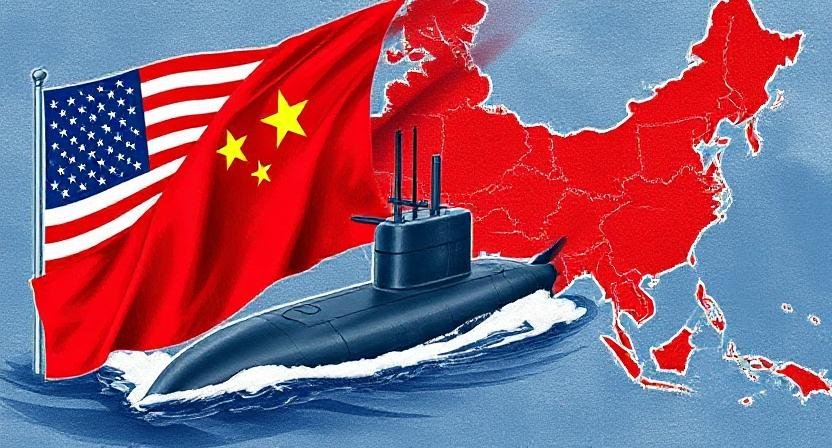
- Pentagon’s Review Raises Alarm: The U.S. is reassessing the AUKUS defense pact with Australia and the U.K., potentially altering plans to provide Australia with nuclear-powered submarines.
- Industrial and Strategic Bottlenecks: U.S. submarine production delays and pressure on its own fleet have cast doubt on delivering Virginia-class subs to Australia.
- Pressure on Australia to Spend More: U.S. Defense Secretary Pete Hegseth urges Australia to raise defense spending to 3.5% of GDP, signaling a tougher stance under the “America First” doctrine.
- Alliance Still Alive—For Now: Despite tensions, officials in Canberra and London insist AUKUS is still on track, though the pact’s future now hinges on political recalibration and regional security shifts.
The Pentagon has launched a sweeping review of the AUKUS security pact with Australia and the U.K., casting fresh uncertainty over a keystone alliance designed to deter Chinese aggression in the Indo-Pacific and deliver nuclear-powered submarines to Australia by the 2030s.
A U.S. defense official confirmed the review, saying, “The department is reviewing AUKUS as part of ensuring that this initiative of the previous administration is aligned with the president’s ‘America First’ agenda.” The official added the administration seeks to ensure “allies step up fully to do their part for collective defense” and that U.S. industrial priorities aren’t compromised.
Exclusive: China Slaps 6-Month Limit on Rare Earth Exports to U.S. Amid Fragile Trade Truce
Signed in 2021 under President Biden, the AUKUS agreement was hailed as a landmark in trilateral defense cooperation, encompassing not just nuclear-powered submarines for Australia but joint work on advanced technologies like hypersonic missiles, undersea warfare systems, and quantum computing. Now, under the Trump administration, the initiative finds itself under scrutiny amid capacity constraints and shifting strategic priorities.
Submarine Supply Shortfalls
At the heart of the review lies a practical dilemma: the U.S. Navy is struggling to maintain and expand its own submarine fleet. With 53 attack submarines listed—some of which are non-operational or under construction—the pressure is mounting on U.S. shipyards, where it now takes up to nine years to build a new vessel.
Australia was to purchase up to five Virginia-class submarines from the U.S. beginning in 2032 as a stopgap until it could produce its own new class in cooperation with the U.K. But that plan now faces doubts, with defense hawks warning that the U.S. may not be able to spare the boats without compromising its own deterrence posture.
READ MORE: Pentagon Review of Aukus Security Pact Worries U.K., Australia
Elbridge Colby, now U.S. undersecretary of defense for policy, wrote on X before joining the administration that it would be “crazy” not to have enough submarines “in the right place and time” to deter China.
AUKUS: Tensions Behind the Scenes
Export controls have further complicated trilateral cooperation. Even under the Biden administration, British officials expressed concern that the U.S. might walk away due to delays in technology transfers and production schedules. The Trump administration appears poised to leverage the review as a tool of pressure, particularly on Canberra.
“The review could be used to put pressure on Australia to think about whether it wants to offer better terms of exchange,” said Philip Shetler-Jones, a senior fellow at the Royal United Services Institute in London.
One clear area of friction is defense spending. While Australia has pledged to raise its military budget from 2% to 2.4% of GDP by 2033, that may not satisfy Washington. Secretary of Defense Pete Hegseth recently pushed for an immediate increase to 3.5% of GDP in a meeting with Australian Defense Minister Richard Marles in Singapore.
Australia Pushes Back
Despite the mounting scrutiny, Australian officials remain optimistic. “I’m very confident this is going to happen,” said Marles on Thursday, referring to the submarine acquisition. He downplayed the review, noting that it’s “not unusual” for new governments to revisit legacy agreements.
Also Read: EXCLUSIVE: Immigrant Protests Turn Violent Across California, Trump Deploys National Guard to Restore Order
Prime Minister Anthony Albanese has also defended the pact, with a possible meeting with President Trump at the G7 summit in Canada expected to address lingering differences.
Marles said meetings with U.S. officials had been “very positive,” emphasizing Canberra’s commitment to the agreement. Australian sailors are already embedded in U.S. submarine crews, and joint training exercises—like the upcoming Talisman Sabre drill involving 30,000 personnel from 19 countries—underscore Australia’s operational integration with the U.S. military.
AUKUS Strategic Stakes
Even if the U.S. slows its role, some analysts suggest the U.K. and Australia could continue independently. “It is understandable that a new administration would want to review its approach to such a major partnership,” the British government said in a statement. London affirmed its commitment to working with Canberra on the new submarine class regardless of Washington’s final stance.
The Pentagon’s concerns are not purely logistical. With tensions rising over Taiwan and China’s naval assertiveness, submarines are seen as a critical deterrent in the Indo-Pacific. “Any conflict over the self-ruled island would involve large-scale use of submarines,” one defense analyst noted.
Domestic Optics and Geopolitical Realities
Critics of AUKUS in Australia argue the country has no fallback if the deal falters and risks being drawn into a U.S.-China conflict. Yet public support remains strong: a recent Lowy Institute poll found 67% of Australians favor acquiring nuclear submarines.
John Hamre, CEO of the Center for Strategic and International Studies, believes the current tensions may be overblown. “Australia has very high standing in the U.S. political and security establishment,” he said. “They’re going to naturally see that Australia is an asset, not a liability.”
Still, the timing of this review—on the eve of critical diplomatic summits—risks projecting instability. As the U.S. repositions for a possible showdown in the Pacific, it’s not clear whether AUKUS will remain a pillar of strategy or become a casualty of shifting priorities.