



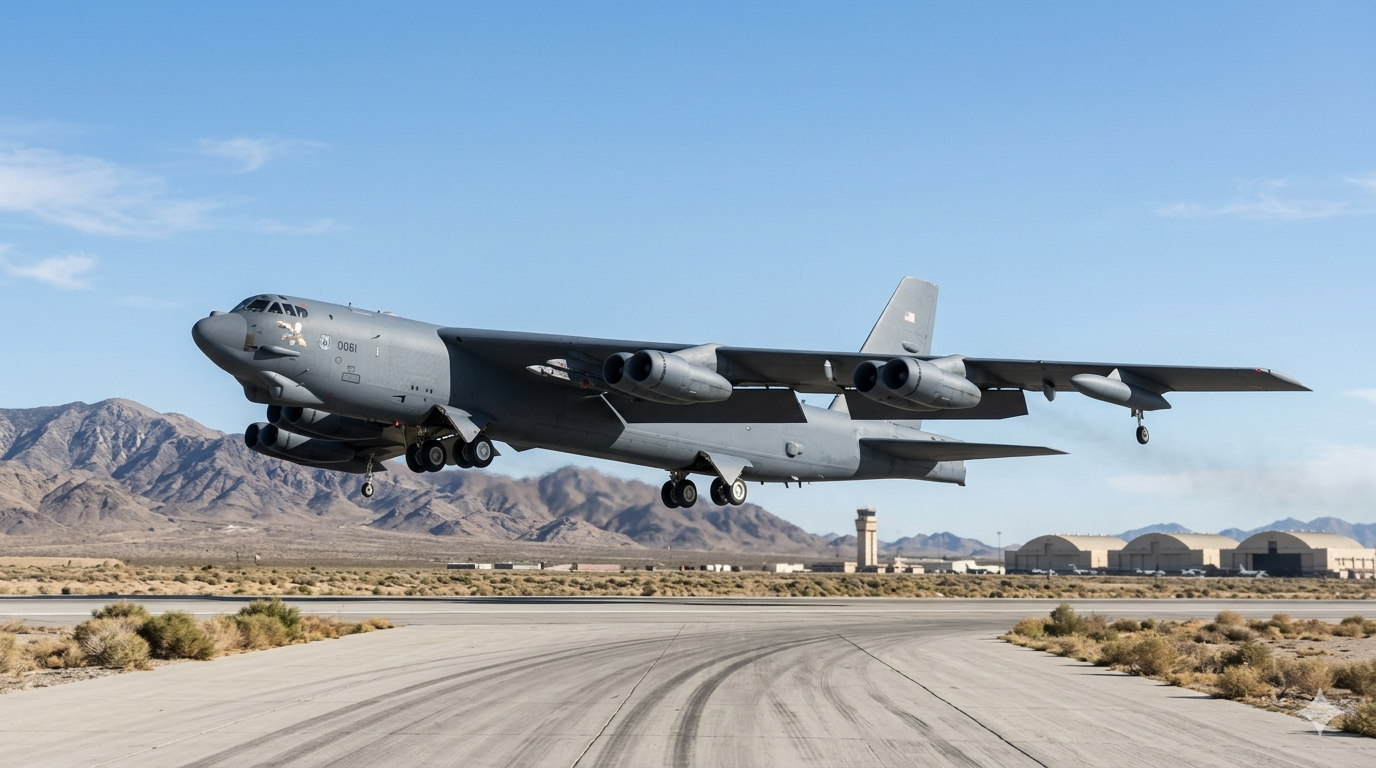
EDWARDS AIR FORCE BASE, California — A U.S. Air Force B-52H Stratofortress strategic bomber crashed shortly after takeoff at Edwards Air Force Base on Monday morning, killing all eight crew members on board. The catastrophic incident occurred at 11:20 a.m. local time during a routine test mission in Southern California’s Mojave Desert, sending shockwaves through the global military aviation community.
Base officials confirmed that the individuals on board comprised a highly specialized team of flight crew and specialists. The manifest included four seasoned U.S. Air Force test pilots and flight engineers, alongside four civilian defense contractors who were managing advanced telemetry and sensor equipment. Air Force officials stated that due to the high-impact nature of the collision, the disaster was entirely unsurvivable.
Emergency rescue services mounted an immediate, massive response within seconds of the impact. Base firefighters, hazardous materials teams, and military paramedics rushed toward the edge of the main runway complex, where a towering plume of thick black smoke had quickly become visible across the desert and to commercial flights operating miles away. Because a B-52 holds tens of thousands of pounds of highly volatile jet fuel, first responders faced intense thermal barriers and secondary explosions as they worked to contain the inferno.
Additional emergency assets from the surrounding Kern County and Los Angeles County fire departments were placed on standby, though base officials managed to secure the immediate perimeter. To facilitate the unrestricted movement of emergency vehicles and secure the sensitive debris field, the entire military installation was immediately locked down, incoming flights were diverted to alternative airfields, and all base visitor privileges were suspended.
A formal military safety investigation board has been established to decipher what caused the iconic, eight-engine bomber to plunge into the desert floor. The investigation is expected to be a grueling, multi-month process as teams carefully sift through a highly fragmented debris field that stretches across a wide swath of the airfield. Investigators are focusing heavily on flight data recorders and the precise mechanics of the aircraft’s takeoff sequence.
Because the B-52 has a unique landing gear configuration and a massive wingspan, the initial climb out is a high-load phase of flight where any sudden loss of thrust or unexpected flight control malfunction can prove impossible to recover from. Teams will also scrutinize the maintenance history of the specific airframe and run simulations to analyze whether aerodynamic or mechanical failures caused the pilots to lose control so close to the ground.
The tragedy casts a harsh light on the intense pressure facing the Air Force’s aging fleets. The Boeing B-52 Stratofortress first flew in the 1950s as a cornerstone of America’s Cold War nuclear deterrence strategy. Over the decades, it transitioned into a conventional workhorse, executing heavy bombing campaigns in Vietnam, Iraq, and Afghanistan. The current fleet relies on the B-52H variant, with the youngest operational aircraft delivered in 1962. This means the downed bomber was roughly 65 years old, highlighting a broader challenge of sustaining geriatric aircraft amid rising global operational demands.
To keep these historic platforms viable, the military relies on a tiny fleet of just four dedicated test aircraft at Edwards to trial comprehensive modernization efforts, including new radar arrays and more efficient commercial engines. This test program is intended to keep the B-52 flying until it marks a full century of active service. As the investigation gets underway, investigators face the daunting task of determining whether this accident was a tragic anomaly of flight testing or a systemic warning sign regarding the material limits of America’s oldest flying fleet.
The Boeing B-52 Stratofortress fleet has a volatile mishap history spanning seven decades. During the Cold War, notable “Broken Arrow” nuclear incidents occurred, including the 1961 Goldsboro structural breakup and the 1966 Palomares mid-air refueling collision, both resulting in the accidental release of unarmed hydrogen bombs.
The specific B-52H variant—delivered in the early 1960s—has suffered fewer fatal mishaps due to its refined engineering. However, it was the focus of the tragic 1994 “Czar 52” crash at Fairchild Air Force Base, where a pilot stalled the aircraft during an unauthorized low-altitude maneuver. Prior to the 2026 Edwards Air Force Base incident, the last total hull loss occurred in 2016 during a routine operational deployment in Guam.