



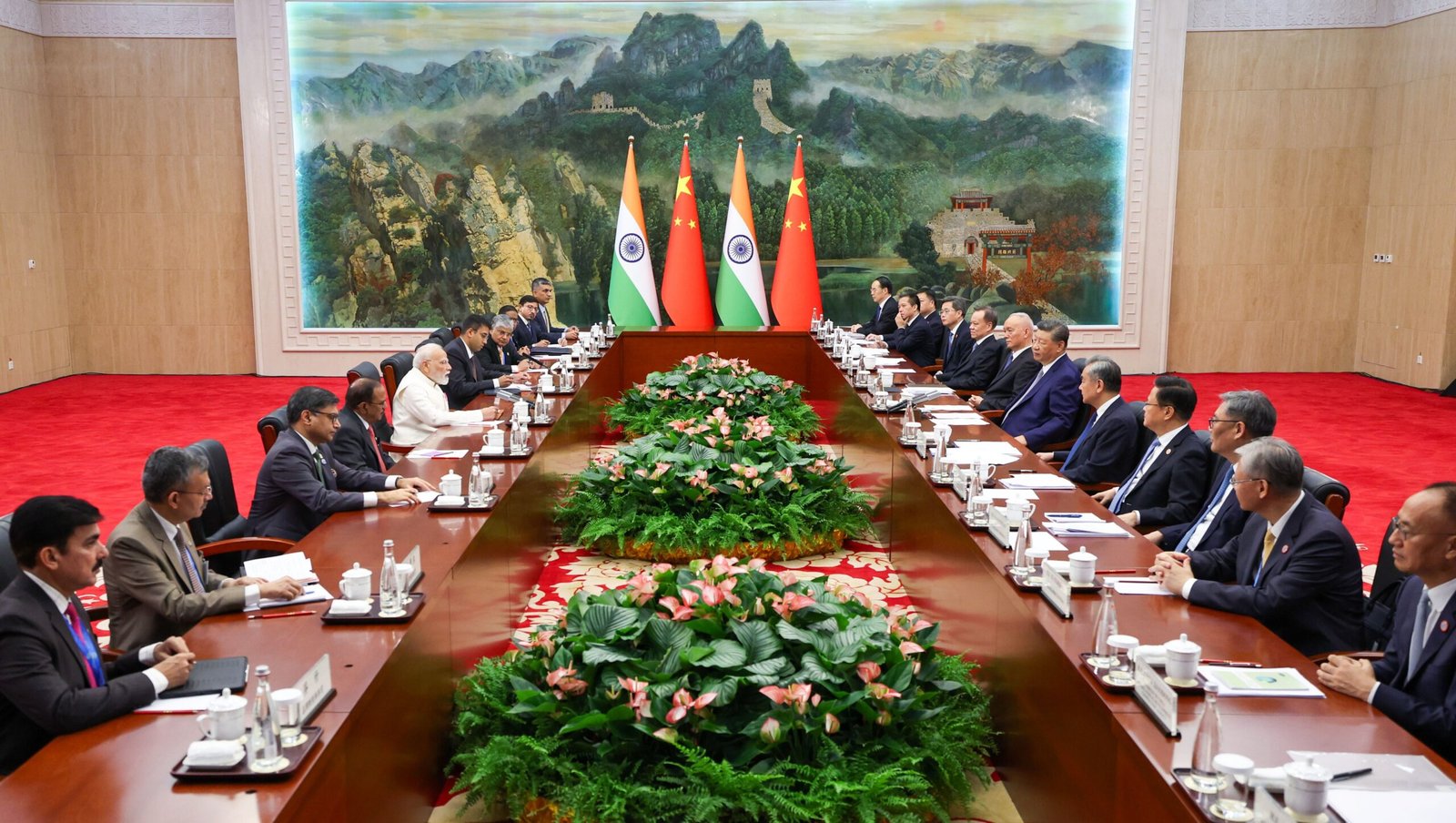
- Modi meets Xi in Tianjin after Washington’s 50% tariffs on Indian exports, signaling a possible India–China thaw.
- Analysts argue Modi’s rapprochement is tactical, driven by economic duress rather than strategic realignment.
- Long-standing disputes over borders, Tibet, and China–Pakistan ties continue to limit trust.
- Beijing sees opportunity but doubts India’s reliability after its past closeness with Washington.
When Indian Prime Minister Narendra Modi met Chinese President Xi Jinping in Tianjin last Sunday, the optics were unmistakable: two Asian giants, long at odds across a frozen Himalayan frontier, suddenly speaking the language of trade, peace, and stability. Smiles, handshakes, and official tweets painted a picture of partnership. Yet, behind the headlines, analysts are asking a piercing question: Can China really trust Modi, especially when his overtures come not in a vacuum but in the shadow of U.S. tariffs, border skirmishes, and decades of rivalry?
This was Modi’s first visit to China in seven years, timed five days after Washington slapped a punishing 50% tariff on Indian exports, retaliation for New Delhi’s continued oil purchases from Russia. For many observers, Modi’s sudden warmth towards Beijing looks less like a strategic pivot and more like a desperate hedge against Western pressure—a diplomatic fire escape built under duress rather than a blueprint for a new Asian century.
A Carefully Choreographed Encounter
The bilateral meeting on the sidelines of the Shanghai Cooperation Organisation summit was draped in symbolism. Xi and Modi spoke of “mutual respect,” “strategic autonomy,” and an “atmosphere of peace and stability” along their disputed 3,800 km border, the very terrain where soldiers from both nations clashed fatally in 2020.
A New Silk Curtain: How Trump’s Tariffs Pushed Eastern Europe Toward China
For Xi, it was a chance to present China as a partner rather than a threat—a necessary narrative amid Western attempts to isolate Beijing over trade practices and its ties with Moscow. For Modi, it was about optics too, but the context was sharper: Washington, once New Delhi’s staunch courtier, had just turned punitive.
India’s decision to keep buying discounted Russian oil despite Western sanctions had angered U.S. officials. Trump’s tariffs, blunt and sweeping, made matters worse for Modi, who faces growing domestic criticism over India’s economic slowdown and the record $99.2 billion trade deficit with China.
READ MORE: India committed to improving ties with China, Modi tells Xi
The Tianjin meeting, therefore, carried a subtle but unmistakable message: If Washington could pressure India, Beijing could offer economic balm—and perhaps geopolitical leverage.
The Trust Deficit Lingers
Yet, beneath the diplomatic smiles lies a deep undercurrent of suspicion. For decades, India and China have been locked in what experts call “cold peace”—a relationship defined by booming trade on one hand and festering strategic mistrust on the other.
China remains India’s largest trading partner, but it is also New Delhi’s most formidable rival. The Himalayan border dispute, Tibet’s political future, Beijing’s alliance with Pakistan, and China’s massive infrastructure projects in the Indian Ocean region all continue to haunt ties.
ALSO READ: A Powder Keg in the Caribbean: Why U.S.-Venezuela Tensions Could Explode into Crisis
Even Modi’s own political trajectory adds to Beijing’s skepticism. Over the past decade, his government has oscillated between embracing the U.S.-led Indo-Pacific strategy aimed at countering China and calling for Asian solidarity free from Western interference. When Washington courted New Delhi as a counterweight to Beijing, Modi gladly reciprocated; now, with U.S. tariffs biting, he appears to be flirting with Xi.
“Both India and China are engaged in what is likely to be a lengthy and fraught process of defining a new equilibrium,” says Manoj Kewalramani, a Sino-Indian relations expert in Bengaluru. “But there’s no guarantee that this thaw will survive the next border incident or trade dispute.”
Economic Temptations vs. Geopolitical Realities
Economic logic suggests the two countries need each other. China’s lifting of export curbs on rare earths, fertilizers, and high-end machinery could ease pressure on Indian industries. Resuming direct flights and expanding tourism links might signal a return to normalcy after years of frosty relations.
Moreover, both nations share grievances against Western trade policies. Trump’s tariffs on India echo Washington’s wider economic war with China, creating what some analysts call a “tariff triangle” where Beijing and New Delhi find common cause against U.S. protectionism.
But structural tensions remain. China’s planned mega-dam in Tibet threatens India’s water security, potentially reducing Brahmaputra River flows by up to 85% during dry months. India’s hosting of the Dalai Lama continues to rankle Beijing. And China’s all-weather friendship with Pakistan—India’s archrival—remains a strategic thorn.
These realities make Modi’s overtures look transactional rather than transformational. Beijing knows New Delhi is seeking short-term relief, not necessarily a long-term alignment.
The Global South Optics
The timing of Modi’s China visit also aligns with a larger diplomatic performance. The SCO summit in Tianjin brought together leaders from Russia, Central Asia, the Middle East, and South Asia—a tableau of Global South solidarity against Western dominance.
By meeting Xi in this setting, Modi signaled that India would not be confined to the role Washington once envisioned for it: a junior partner in a U.S.-led alliance against China. Instead, New Delhi wants to be seen as an autonomous power broker, free to maneuver between rival camps.
Xi, facing Western tech bans, slowing growth, and U.S.-backed alliances in the Pacific, has every reason to encourage this posture. A nonaligned India, or better yet a friendly India, would relieve strategic pressure on Beijing’s southern flank.
A Tactical Thaw, Not a Strategic Shift
For now, the Modi–Xi détente looks tactical, even fragile. The announcement of border “peace” lacked specifics. Economic cooperation was wrapped in vague promises. And neither side addressed the elephant in the room: whether India’s slow drift toward Washington in recent years can ever be fully reversed.
China, with its long memory of geopolitics, will be cautious. India, with its history of nonalignment, will hedge its bets. The result may be what one analyst called “managed engagement”—a relationship of limited cooperation, perpetual suspicion, and frequent recalibration.
For Beijing, the question is not whether Modi wants better ties today but whether he will abandon them tomorrow if Washington dangles new incentives. For New Delhi, the dilemma is whether closer economic ties with China can coexist with its security concerns and democratic self-image.
As the dust settles on Tianjin’s diplomatic theater, one thing seems clear: The road from rivalry to partnership will be long, winding, and riddled with mistrust. The smiles in front of the cameras may hide it, but the doubts remain as vast as the Himalayas that divide them.