



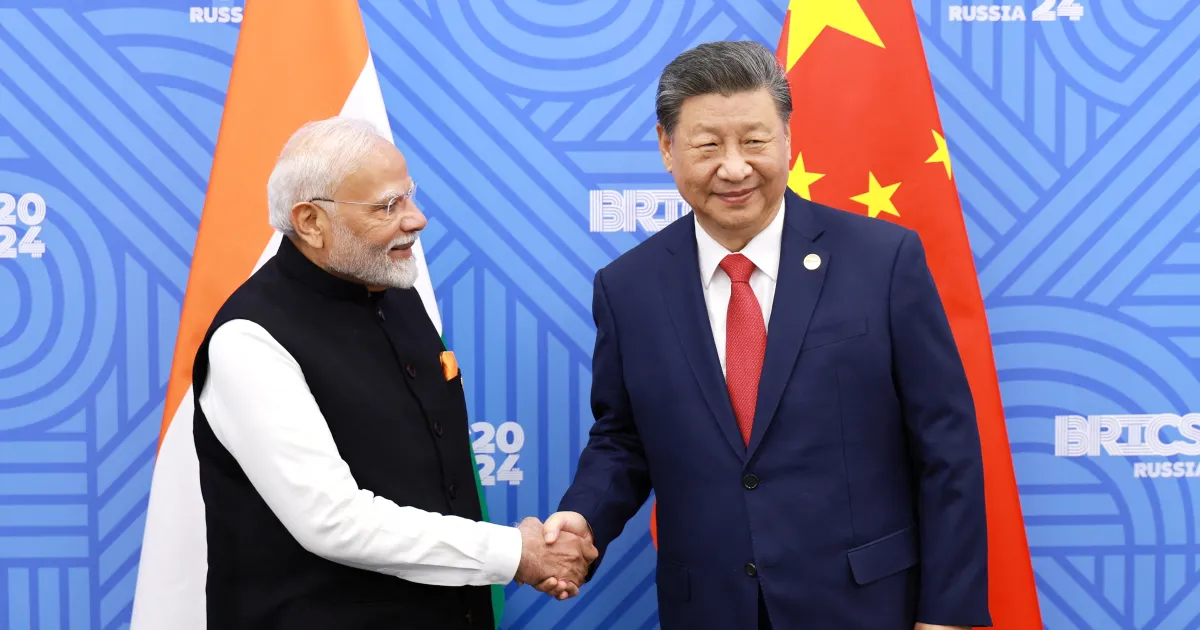
- China-India relations reached a tactical “reset” in 2025 following the disengagement of troops at Depsang and Demchok.
- The Pentagon warns that Beijing’s military support for Pakistan, including J-10C fighters and frigates, creates a permanent two-front challenge for New Delhi.
- Despite border friction, bilateral trade hit a record $136.2 billion in 2025, driven by electronics and pharmaceutical exports.
- The U.S. role remains a wildcard as the Trump administration shifts toward pragmatic deal-making over ideological confrontation.
In the crisp winter air of Beijing on December 25, 2025, Foreign Ministry spokesperson Lin Jian stood before a sea of microphones, his words cutting through the holiday calm like a sharpened blade. Responding to a Pentagon report released just days earlier, Lin accused the United States of deliberately distorting China’s defense policies to sabotage the fragile thaw in China-India relations.
“The border issue is a matter between China and India,” he declared firmly. “We object to any country passing judgment.”
This wasn’t mere rhetoric; it was a pointed warning to Washington: stay out of Asia’s backyard, or risk escalating a geopolitical chess game already teetering on the edge. The Pentagon’s assessment, titled “Military and Security Developments Involving the People’s Republic of China 2025,” claimed Beijing was tactically easing tensions along the Line of Actual Control (LAC) to “prevent the deepening of U.S.-India ties.”
Syria’s New Era of Prosperity fueled by Al-Sharaa’s alliance with MBS and Trump
Most alarmingly, the report noted that China has now elevated its claims over Arunachal Pradesh to the level of a “core interest,” placing the northeastern Indian state alongside Taiwan as a non-negotiable sovereign territory.
The Two-Front Strategic Squeeze
This exchange unfolded against a backdrop of simmering rivalries, where superpowers jostle for influence in the Indo-Pacific. For the U.S., Lin’s statement underscores a growing anxiety: China’s maneuvers could erode America’s strategic pivot toward India, a key counterweight in the Quad alliance. The Pentagon warns that Beijing’s dual-track approach—calming the LAC while arming Pakistan—creates a permanent “two-front” threat for New Delhi.
READ MORE: U.S.-China Relations for the 2030s: Toward a Realistic Scenario for Coexistence
As of late 2025, China’s military support for Pakistan has hit new heights. With the delivery of J-10C multirole fighters and Type 054A/P frigates, China has effectively modernized Pakistan’s ability to pin down Indian resources. This forces India to divide its focus, maintaining a massive readiness posture across both its western and northern frontiers.
The Military Imbalance: 2025 Data
Despite India’s rapid modernization, a significant “capability gap” persists. China’s official defense budget for 2025 stands at $246.5 billion, though analysts estimate actual spending could be 40–50% higher. In contrast, India’s allocation of $79 billion remains heavily skewed toward personnel costs rather than new hardware.
| Military Metric (2025) | China (PLA) | India (Armed Forces) |
| Defense Budget | $246.5 Billion (Official) | $79 Billion |
| Active Personnel | ~2,000,000 | ~1,450,000 |
| LAC Troop Presence | 50,000+ (High-speed surge capacity) | 120,000 (Forward deployed) |
| Stealth Fighters | J-20 (Operational), J-35A (Exporting) | AMCA (Developmental) |
| Naval Fleet | 370+ Warships | ~150 Warships |
The Economic Paradox: Trade vs. Territory
Beneath the military bluster, China-India ties show signs of a “pragmatic peace.” In October 2025, direct flights resumed for the first time in five years, signaling a shift toward normalcy. This connectivity supports a trade relationship that reached $136.2 billion this year, despite India’s record $106 billion trade deficit with Beijing.
ALSO READ: America First Doctrine: Trump Recalls 30 Career Ambassadors
India’s reliance on Chinese electronics and machinery remains a structural challenge. While India launched the National Critical Minerals Mission in 2025 to secure independent supply chains, the current reality is one of profound economic interdependence that acts as a “buffer” against total military escalation.
A Pragmatic “America First” Equilibrium
Meanwhile, the U.S. appears to be downplaying tensions in its own ties with China, opting for pragmatism under President Trump. In 2025, several trade tariffs were rolled back to an average of 20%, signaling a cooling of the trade war to prioritize U.S. domestic stability. Secretary of State Marco Rubio’s July meeting with Wang Yi emphasized “constructive deconfliction,” reflecting an “America First” focus on deals over ideology.
The Future of the Triple-Axe
On social media, the narrative is a mix of solidarity and suspicion. China’s Ambassador to Delhi, Xu Feihong, recently posted that “China will firmly stand with India” against external trade pressures, a subtle dig at U.S. policies. Conversely, India’s S. Jaishankar remains focused on “multi-alignment,” celebrating new trade pacts with Oman and Ethiopia to dilute the China-centric trade model.
As 2025 closes, this triangular drama—China’s warnings, India’s guarded optimism, and America’s pragmatic pivot—hints at a new equilibrium. With the LAC relatively quiet but Arunachal Pradesh now a “core interest,” the “tactical pause” could end at any moment. For now, economic necessity is holding the line, but as the shadows lengthen over the Himalayas, the world watches to see if this fragile peace can survive the next geopolitical tremor.