



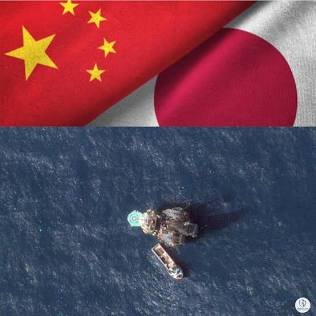
- China-Japan tensions are intensifying as Chinese warships increasingly operate near Japan’s southwestern islands, particularly around Amami-Oshima and the First Island Chain.
- Japan is rapidly expanding its defence capabilities, with record military spending focused on long-range missiles, drones, AI, missile defence and maritime surveillance.
- China retains a major economic and military advantage, making Taiwan, the Senkaku/Diaoyu Islands and maritime encounters potential flashpoints for a wider East Asian crisis.
The waters between China and Japan are becoming increasingly dangerous. Chinese warships are sailing with growing frequency through maritime passages close to Japan’s southwestern islands, while Tokyo is responding with missiles, drones, radar, new naval capabilities and a record defence budget. What was once largely a contest over disputed territory and competing historical narratives is increasingly becoming a military confrontation in slow motion.
The latest warning comes from Amami-Oshima, a Japanese island positioned between the East China Sea and the Pacific. Japanese surveillance has recorded Chinese destroyers passing through the narrow channel near the island at least 10 times this year, compared with zero such transits in 2025 and 15 in 2024. The trend is significant because the channel is only about seven miles wide at its navigable point, creating a potential choke point for naval movements.
READ NEXT: China-Japan Tensions Surge After Takaichi Secures Majority: Taiwan Looms as Trillion-Dollar Flashpoint
The growing maritime activity is part of a broader Chinese military expansion across the Western Pacific. Beijing is seeking to push the People’s Liberation Army Navy beyond the immediate waters surrounding mainland China and increasingly challenge the strategic dominance that the United States and its allies have exercised across the Pacific for decades. Japan, meanwhile, is attempting to turn its southwestern island chain into a defensive barrier against Chinese power projection.
The emerging confrontation was already visible in the Taiwan debate. Japan’s increasingly assertive position on a possible Taiwan contingency has sharpened Chinese suspicions of Tokyo. The dispute is no longer confined to Taiwan or the Senkaku Islands, known in China as Diaoyu. It is becoming a wider struggle over who will shape the security architecture of East Asia.
For a broader assessment of this emerging confrontation, The Islamabad Telegraph previously examined how Japan-China-Taiwan tensions are brewing, highlighting the danger that Taiwan could become the point where Japanese and Chinese strategic interests collide directly.
Takaichi’s Japan Is Rebuilding for a Different War
Prime Minister Sanae Takaichi has accelerated Japan’s transformation from a predominantly defensive military power into a country preparing for a prolonged and technologically sophisticated conflict.
Tokyo’s Defence Ministry has requested a record 8.9 trillion yen, or approximately $55.6 billion, for fiscal 2027. The proposed package includes attack drones, long-range missiles, missile interceptors, artificial intelligence, autonomous systems and enhanced command-and-control capabilities.
READ MORE: Chinese Warships Are Cruising Too Close for Comfort Off Japan’s Shores
The transformation is extraordinary for a country whose post-1945 security policy was shaped by pacifism and Article 9 of its constitution. Japan’s defence spending has now reached approximately 2 percent of GDP, double the level around which its postwar defence policy traditionally revolved.
Japan’s military expenditure reached about $62.2 billion in 2025, according to the Stockholm International Peace Research Institute, making Tokyo one of the world’s major defence spenders. But the Japanese figure remains dwarfed by China’s military expenditure.
The most important change is therefore not simply how much Japan spends, but what it is buying.
Tokyo is investing heavily in long-range stand-off missiles, unmanned aircraft, artificial intelligence and dispersed military infrastructure. Japan is also moving missile systems and surveillance capabilities toward its southwestern islands, including areas much closer to Taiwan and the Chinese mainland.
The Washington Post’s report on Japan’s new defence budget highlights the central logic behind this transformation: Japan is trying to compensate for a shrinking population and manpower shortages through automation, drones and AI.
That demographic problem is serious. Japan has an ageing and shrinking population, making it increasingly difficult to recruit and sustain a large conventional military. Unmanned systems therefore offer Tokyo a way to increase surveillance and striking power without proportionally increasing the number of soldiers.
But Japan is not simply preparing for China. North Korea’s ballistic missiles and nuclear programme, Russian military activity around Japan and uncertainty about future American commitments are all contributing to Tokyo’s strategic anxiety.
China Has the Economic and Military Advantage
The balance of power becomes clearer when China and Japan are compared directly.
China’s economy is now more than four times larger than Japan’s in nominal terms. Beijing has an enormous industrial base capable of producing ships, missiles, drones, aircraft, electronics and other military equipment at a scale Japan cannot easily match.
The military gap is even wider.
China spent an estimated $336 billion on defence in 2025, compared with Japan’s approximately $62.2 billion. Beijing therefore spent roughly 5.4 times more than Tokyo. China’s defence expenditure has increased for more than three decades, creating an enormous cumulative advantage in military infrastructure, weapons production and personnel.
China’s naval expansion illustrates the difference.
The People’s Liberation Army Navy now operates three aircraft carriers, including the Fujian, China’s most advanced carrier and the first Chinese carrier equipped with electromagnetic catapults. Beijing is also producing destroyers, frigates, submarines and support vessels at a remarkable pace.
China’s nuclear arsenal adds another strategic dimension. SIPRI estimated that China possessed approximately 600 nuclear warheads at the beginning of 2025, while its arsenal continues to expand.
Japan possesses no nuclear weapons.
Instead, Tokyo relies on the United States’ extended nuclear deterrence. This creates a fundamental asymmetry: Japan may possess highly advanced conventional forces, but China has a much larger military-industrial base, a rapidly expanding navy, a growing nuclear arsenal and significantly greater financial resources.
The Islamabad Telegraph has previously analysed this transformation in China’s strategic military flex and growing power, particularly Beijing’s effort to convert economic strength into sustained military influence across Asia and beyond.
China-Japan tensions: The First Island Chain Is Becoming a Military Front Line
Amami-Oshima matters because of geography.
Japan’s southwestern islands form part of the First Island Chain, stretching from Japan through Taiwan and the Philippines toward Southeast Asia. For Beijing, this chain represents both a strategic obstacle and a potential military challenge.
For Washington and Tokyo, it is a defensive line designed to constrain China’s ability to project naval power into the Pacific.
The narrow channel near Amami-Oshima is therefore more than a maritime passage. Chinese warships operating there can observe Japanese surveillance patterns, test Japanese reactions and become familiar with the geography of the waters around the island chain.
The Wall Street Journal’s report on Chinese warships operating close to Japan captures the growing anxiety on Amami-Oshima, where local officials are already discussing evacuation plans for a population of roughly 60,000.
Japanese defence planners are also concerned about what they describe as gaps in the country’s Pacific-side defences. Tokyo is consequently expanding radar coverage, military bases, ammunition stockpiles, energy reserves and logistics facilities.
This is the Ukraine lesson entering Japanese strategic thinking: modern wars can become long wars, and countries that lack ammunition, fuel, spare parts and industrial capacity can find themselves strategically exposed.
Japan is therefore preparing not merely to survive the opening days of a conflict but to sustain itself through a prolonged confrontation.
Yet retired Japanese military officials have warned that Tokyo is still not fully prepared for such a war because of manpower shortages and weaknesses in its defence-industrial base.
China-Japan tensions: Taiwan Could Turn Competition Into Conflict
The most dangerous question is what happens if China attacks Taiwan.
For Beijing, Taiwan is a core sovereignty issue. For Japan, Taiwan is geographically and strategically connected to its southwestern islands and sea lanes. Taiwan lies only about 100 kilometres from Japan’s Yonaguni Island.
A Chinese attack on Taiwan could therefore place Japanese territory and American forces based in Japan directly in the path of the conflict.
This is why Japanese statements regarding Taiwan have generated such anger in Beijing.
Japan’s latest defence thinking increasingly assumes that a Taiwan conflict cannot necessarily be separated from Japan’s own national security. China’s military planners, meanwhile, increasingly have to account for Japanese intervention, American bases in Japan and the possibility of a wider regional coalition.
The result is a classic security dilemma.
Tokyo says it is strengthening its military because China is becoming more powerful.
Beijing says it is strengthening its military because Japan is abandoning its pacifist restraints.
Tokyo then points to China’s military expansion as evidence that its own buildup is necessary.
The cycle feeds itself.
The Japan Times’ analysis of Japan’s 2026 defence white paper shows how deeply China’s rise has now entered Japanese strategic planning. Tokyo’s latest defence assessment describes China’s military activity as Japan’s principal security challenge and argues that the response requires broader national strength and closer cooperation with allies.
The Real Danger Is Miscalculation
China and Japan have enormous economic reasons to avoid war.
Their trade relationship remains substantial, their manufacturing systems are intertwined and a military conflict would devastate supply chains across Asia. A war would also threaten shipping through some of the world’s most important maritime routes.
But economic interdependence does not eliminate military rivalry.
History demonstrates that wars frequently begin not because governments deliberately choose catastrophic conflict, but because deterrence fails, an incident escalates or leaders miscalculate the intentions of their opponents.
That is the danger now emerging around the Japanese islands.
A Chinese destroyer passing through an international waterway may be entirely legal. A Japanese surveillance aircraft monitoring it may also be entirely legitimate. A coastguard confrontation around the Senkaku/Diaoyu Islands can begin without either side intending to start a war.
But when military forces operate increasingly close to one another, the probability of an accident rises.
East Asia is therefore entering a dangerous paradox: China and Japan are becoming more economically interdependent while simultaneously becoming more militarily competitive.
Neither Beijing nor Tokyo appears to want a full-scale war. But both are preparing for one.
The coming years will determine whether these preparations create deterrence or produce the very confrontation they are intended to prevent.
The waters around Amami-Oshima may ultimately prove to be a test of that balance. If Chinese and Japanese forces can operate there without dangerous escalation, diplomacy may still contain the rivalry.
If an accident occurs at sea, however, the consequences could reach far beyond one Japanese island.
They could pull Taiwan, the United States and the wider Indo-Pacific into the most serious military crisis East Asia has faced in generations.