


- China Russia North Korea alliance is evolving into a functional strategic alignment reshaping regional security dynamics.
- Beijing and Moscow’s coordinated messaging signals deeper political and military convergence with Pyongyang.
- Informal cooperation allows China to avoid treaty obligations while gaining alliance-level strategic advantages.
- The emerging trilateral alignment challenges Western assumptions about alliances and great-power competition.
China has joined Russia in congratulating North Korea on the latest congress of its ruling party, praising economic progress under Kim Jong-un and reaffirming a commitment to deepen cooperation with Pyongyang in the name of regional stability. Though largely ceremonial in form, the coordinated messages from Beijing and Moscow reflect a deeper strategic reality: North Korea is increasingly embedded within a tightening geopolitical alignment reshaping security dynamics across Northeast Asia.
According to China’s state news agency Xinhua, the Central Committee of the Communist Party of China sent a congratulatory message describing the Workers’ Party of Korea’s ninth congress—the first in five years—as an event of “great significance.” The statement credited the ruling party with advancing economic development and improving living standards, expressing confidence that North Korea would achieve further progress under Kim’s leadership.
The message emphasized that China–North Korea relations have entered a “new historical period,” guided by the strategic direction of both countries’ leaderships. Beijing reiterated that it attaches strong importance to ties with Pyongyang and is prepared to expand exchanges aimed at promoting regional peace, stability, and development.
The congress itself is one of North Korea’s most important political gatherings, convened periodically to define national priorities across defence, diplomacy, and economic planning. According to the Korean Central News Agency, Kim acknowledged the scale of domestic challenges, stating that the country faces “heavy and urgent tasks” in accelerating economic development and improving livelihoods—an implicit recognition of the pressures created by sanctions, economic isolation, and structural shortages.
Russia quickly echoed Beijing’s tone. Dmitry Medvedev, chairman of the ruling United Russia party, sent a congratulatory letter highlighting the “traditional friendship and strategic partnership” between Moscow and Pyongyang. The message framed cooperation as a response to “external pressure,” portraying closer ties as contributing to stability in the Asia-Pacific while emphasizing expanded party-to-party dialogue.
Taken together, the parallel messages illustrate how North Korea has repositioned itself amid intensifying great-power rivalry. Facing sustained Western sanctions over its nuclear and missile programmes, Pyongyang has deepened engagement with both China and Russia, leveraging geopolitical fragmentation to reduce isolation and secure economic and political support.
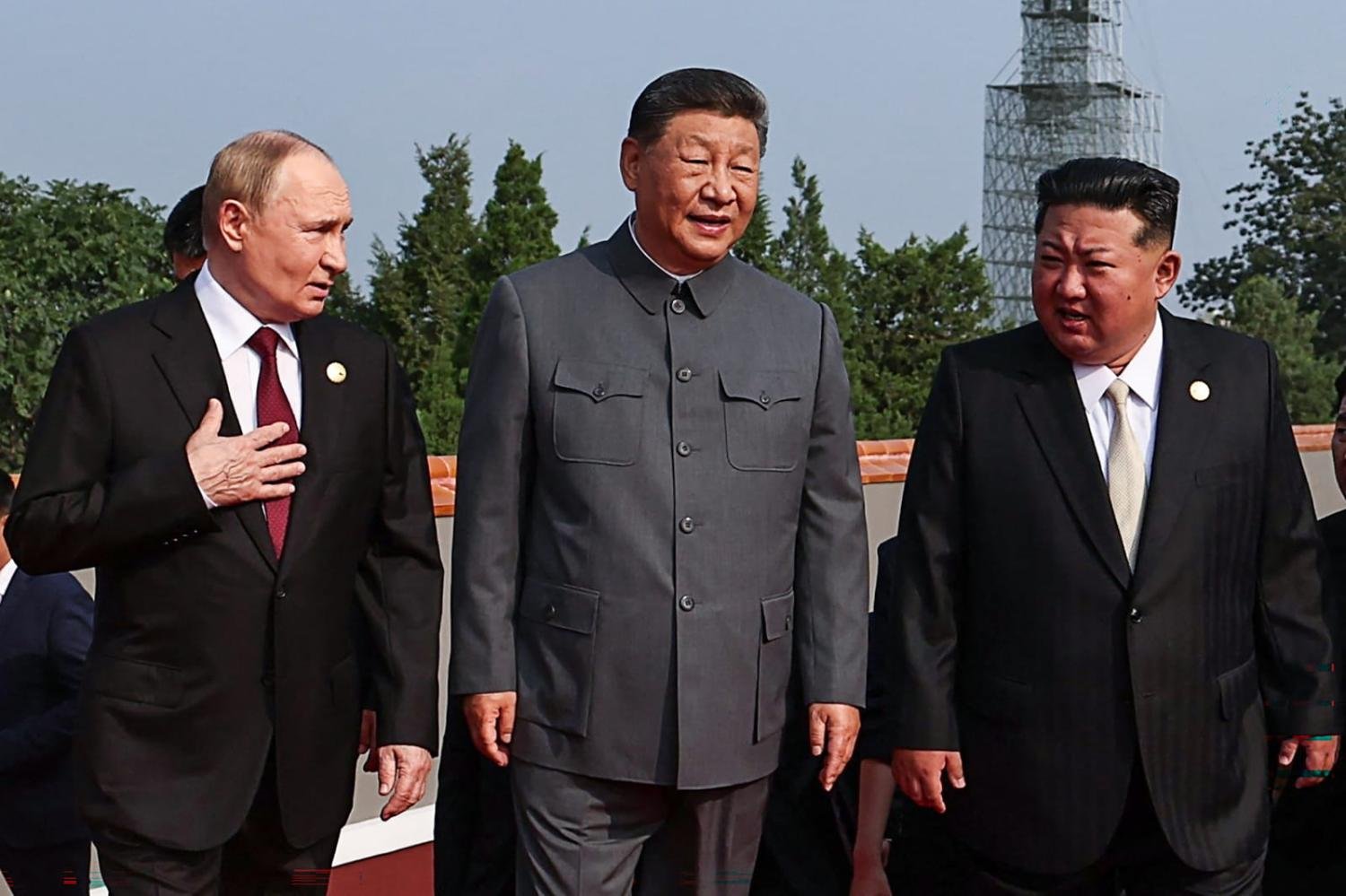
The symbolism of this evolving alignment became particularly visible in September, when the leaders of China, Russia, and North Korea appeared together in Beijing during China’s Victory Day military parade. The joint appearance—the first time all three stood publicly side by side—was widely interpreted as a deliberate signal of political convergence amid growing confrontation between China and the United States.
In bilateral talks following the parade, Chinese President Xi Jinping described China and North Korea as “good neighbours, good friends and good comrades,” reaffirming Beijing’s long-term commitment to the relationship regardless of shifts in the international environment.
For many Western observers, the image of Xi Jinping, Vladimir Putin, and Kim Jong-un together suggested the emergence of an anti-Western bloc. Yet the absence of a formal trilateral summit has led some analysts to argue that Beijing remains cautious about binding alliances.
Such interpretations may misunderstand China’s approach. Rather than reluctance, the lack of institutionalization reflects a deliberate strategy. Since the early reform era, Beijing has favored flexible partnerships over treaty-bound alliances, preserving strategic autonomy while avoiding entanglement in external conflicts. Informal alignment allows cooperation to deepen without the risks associated with formal commitments.
The resulting structure resembles an alliance in function, if not in name. Its cohesion derives from converging interests and mutually reinforcing benefits. For Russia, closer coordination counters narratives of diplomatic isolation and strengthens strategic leverage amid the war in Ukraine. For North Korea, engagement with Moscow and Beijing enhances regime resilience, pairing security cooperation with economic lifelines that ease pressure from sanctions.
Equally significant is a subtle shift in diplomatic signaling. Recent Chinese readouts of high-level engagements have avoided explicit references to denuclearization of the Korean Peninsula, suggesting growing acceptance in Beijing that North Korea’s nuclear arsenal is a durable strategic reality rather than a temporary bargaining tool.
The largest strategic gains, however, accrue to China. The Beijing parade and surrounding diplomacy reflected a broader evolution in Chinese grand strategy—a gradual shift away from expectations of long-term accommodation with Washington toward preparation for sustained systemic rivalry. Cooperation with Russia and North Korea forms a hard-power complement to China’s wider geopolitical ambitions while ensuring the Korean Peninsula remains a persistent strategic challenge for the United States and its allies.
For Western policymakers, the risk lies in viewing alliances through Cold War frameworks. What is emerging is not a rigid bloc but a flexible network built on shared interests, strategic ambiguity, and selective coordination. The alignment may lack a formal name, but its coherence—and its implications for global power politics—are becoming increasingly difficult to ignore.