



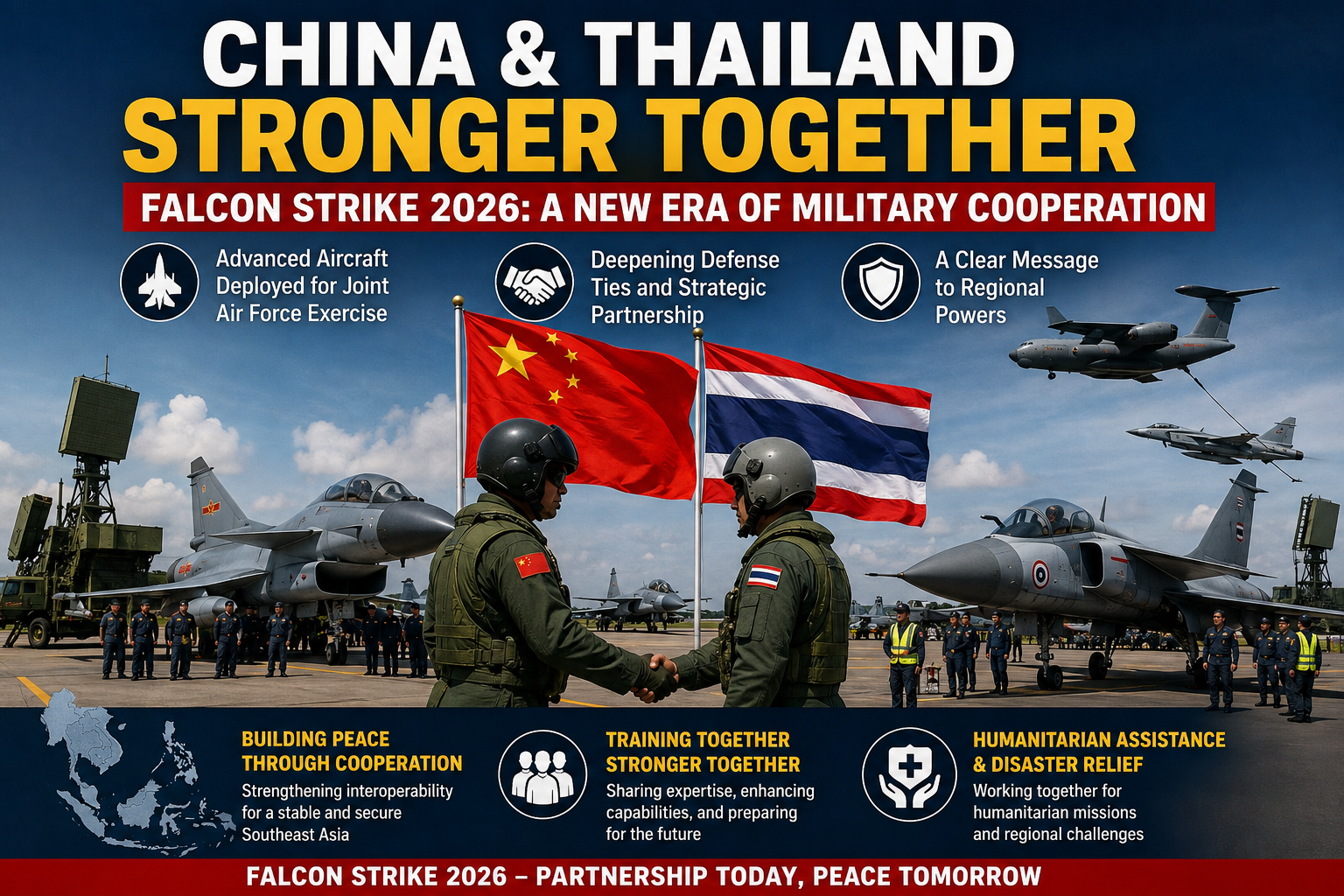
- China-Thailand military cooperation enters a new phase as Falcon Strike 2026 deploys J-10C fighters, Y-20 transport aircraft, air-defense systems and Chinese trainers to Thailand.
- China is expanding its military influence across Southeast Asia by combining advanced weapons, training, joint exercises, defense technology and long-term strategic partnerships.
- Falcon Strike 2026 sends a message to regional powers that Beijing can strengthen the military capabilities of Southeast Asian partners without requiring them to abandon relationships with the United States.
China is bringing some of its most capable airpower, air-defence assets and technical personnel to Thailand for Falcon Strike-2026, turning an annual bilateral exercise into a powerful demonstration of how Beijing is deepening military partnerships across Southeast Asia.
The exercise is not simply another training event. It comes at a moment when Thailand is balancing its longstanding defence relationship with the United States against rapidly expanding economic, technological and military ties with China. With Chinese aircraft, ground-based air-defence units and support elements deploying to Thai territory, Beijing is demonstrating that its partnerships in Southeast Asia are moving beyond trade and infrastructure into increasingly sophisticated defence cooperation.
China’s Ministry of National Defense confirmed that Falcon Strike-2026 would involve multiple types of Chinese aircraft and ground-based air-defence forces, with the two sides training in joint air defence, humanitarian assistance and disaster relief. The exercise is the ninth training event between the two air forces and the fifth consecutive year that the Falcon Strike series has been held in Thailand.
The significance lies in the composition of the Chinese deployment.
The exercise includes the J-10C multirole fighter, J-10S fighter-trainer and Y-20 transport aircraft, alongside Thai JAS 39 Gripen and Alpha Jet aircraft. Chinese early-warning, aerial-refuelling, transport and air-defence capabilities are also part of the broader exercise architecture reported by Chinese state media.
READ NEXT: Thailand’s Central Bank Deepens Cyber Defences as Cross-Border Threats Surge
That combination matters because it resembles a miniature expeditionary airpower package rather than a symbolic deployment.
The J-10C represents China’s modern frontline fighter capability, while the Y-20 provides strategic airlift. Tankers extend the endurance and operational radius of combat aircraft, early-warning platforms provide airborne surveillance and command-and-control, and ground-based air-defence units add another layer to the integrated battlespace.
China is no longer merely seeking influence in Southeast Asia. It is increasingly providing the military capabilities through which regional states can exercise their own strategic power.
Together, these capabilities allow China to demonstrate something more important than the performance of an individual aircraft: the ability to deploy, sustain, coordinate and operate a networked air force outside China’s borders.
For Thailand, the value is equally significant.
READ MORE: J-10C fighter jet takes on latest overseas deployment as China-Thailand joint air force exercise officially begins
The Royal Thai Air Force operates the Swedish-made Gripen alongside American-origin systems, giving Bangkok a deliberately diversified military inventory. Training alongside China’s J-10C and other PLA Air Force assets exposes Thai personnel to Chinese operating procedures, command structures, tactical concepts and air-defence coordination.
That creates familiarity.
And familiarity is one of the foundations of military interoperability.
From weapons sales to military ecosystems
China’s military relationship with Thailand has been developing for decades, but it has increasingly evolved from arms sales into a broader defence ecosystem.
Thailand has purchased Chinese VT-4 main battle tanks and VN-1 armoured vehicles, while its navy has pursued the Chinese S26T submarine programme. In January 2026, Thailand signed another deal for approximately 20 additional Chinese VN-1 armoured vehicles, worth about 1 billion baht, while Thai naval officials continued to monitor the S26T submarine programme.
The significance of such purchases extends beyond the initial delivery of equipment.
Once a military acquires foreign platforms, it also develops relationships involving training, maintenance, spare parts, technical expertise, doctrine and logistics. In March 2026, Thailand and China were reported to be advancing plans for a maintenance, repair and overhaul facility for Chinese military vehicles in Thailand, potentially supporting platforms such as the VT-4 and VN-1.
That is the beginning of a military-industrial relationship.
China’s objective is therefore not necessarily to replace every American or European system in Thailand. Instead, Beijing is steadily creating an alternative defence ecosystem within the country.
That distinction is strategically important.
Thailand remains a US treaty ally and continues to participate in the long-running Cobra Gold exercise. But Bangkok has demonstrated a classic Southeast Asian strategy of hedging: maintaining security links with Washington while expanding economic and defence relations with Beijing.
China appears increasingly comfortable with that arrangement.
China-Thailand Military Cooperation: A relationship built over half a century
The military relationship cannot be separated from the extraordinary expansion of China-Thailand economic ties.
Beijing and Bangkok established diplomatic relations on July 1, 1975. The relationship was elevated to a Comprehensive Strategic Cooperative Partnership in 2012, while the two governments subsequently developed closer cooperation under the Belt and Road framework and their 2022 agreement to build a China-Thailand community with a shared future.
The economic relationship has become enormous.
China is Thailand’s largest trading partner. Bilateral trade reached approximately $153.26 billion in 2025, according to China’s Foreign Ministry, up 14.4 percent from the previous year.
That economic foundation has increasingly been connected to strategic infrastructure, technology and defence.
High-speed rail connectivity, industrial investment, electric vehicles, artificial intelligence, digital infrastructure and supply-chain cooperation are now developing alongside military exchanges.
In July 2026, Thai Prime Minister Anutin Charnvirakul’s visit to China produced 15 agreements and memorandums of understanding covering areas including investment, technology, security and infrastructure. The two governments also agreed to establish a foreign and defence ministers’ 2+2 mechanism and pledged greater cooperation in military exercises, training, information sharing, capacity building, humanitarian assistance, disaster relief and defence science and technology.
Falcon Strike therefore arrives immediately after a major political decision to institutionalise the security relationship.
The timing is difficult to ignore.
Thailand’s neighbourhood makes airpower cooperation more relevant
Thailand’s strategic environment has also changed.
The most immediate example is Cambodia.
Thailand and Cambodia experienced serious fighting in 2025, including artillery, rocket attacks and Thai F-16 operations. The conflict displaced hundreds of thousands of people and demonstrated that conventional military force remains relevant even within mainland Southeast Asia.
Although ceasefire arrangements have reduced the intensity of the confrontation, tensions have not disappeared. Thailand was still dealing with the consequences of the dispute in 2026, including continued military deployments and border-security measures.
For Bangkok, therefore, airpower is not an abstract strategic concept.
The 2025 fighting demonstrated the importance of intelligence, surveillance, precision strike, air defence, command-and-control and rapid mobilisation.
Falcon Strike provides Thailand an opportunity to train these capabilities with one of the world’s fastest-modernising air forces.
Myanmar presents another security challenge.
Thailand shares a long and strategically sensitive frontier with Myanmar, where the conflict that followed the 2021 coup has generated armed groups, refugees, narcotics trafficking and cross-border security risks. Bangkok has increasingly attempted to position itself as a mediator and stabilising actor rather than allowing instability next door to spill deeper into Thai territory.
Thailand also has security interests connected to Laos and the Mekong region, particularly concerning transnational crime, narcotics trafficking and increasingly sophisticated cyber and online fraud networks.
China and Thailand already cooperate with Laos and Myanmar through Mekong-related mechanisms, including patrol and law-enforcement cooperation. Their 2025 joint statement explicitly identified human trafficking, cybercrime, drugs, online gambling and money laundering as areas requiring greater cooperation.
This gives Beijing and Bangkok a broad security agenda extending well beyond traditional warfare.
A message to Southeast Asia
The most important audience for Falcon Strike may not be sitting inside the cockpit.
It is watching from elsewhere in Southeast Asia.
China is demonstrating that it can build deep military relationships with countries that are not formal Chinese allies and that maintain security relationships with Washington.
That is an important distinction.
Beijing does not necessarily need Thailand to abandon the United States.
Instead, China can offer Bangkok additional strategic options.
For Southeast Asian governments, this is increasingly attractive. Countries in the region generally resist choosing between Washington and Beijing. They want American security engagement, Chinese trade and investment, freedom of diplomatic manoeuvre and enough military capability to protect their own interests.
China’s approach increasingly fits that requirement.
By sending advanced aircraft, trainers, air-defence elements and logistical support to Thailand, Beijing is effectively saying that cooperation with China can include access to sophisticated military capabilities without requiring a formal alliance.
That is a powerful proposition.
It also demonstrates China’s growing confidence in operating its military capabilities beyond its immediate borders.
The real transformation is interoperability
The most consequential outcome of Falcon Strike may not be measured by the number of sorties flown.
It will be measured by what happens afterward.
Thai pilots who train repeatedly with Chinese personnel become familiar with Chinese aircraft and procedures. Ground crews gain experience with Chinese maintenance and support systems. Air-defence personnel learn to coordinate with Chinese platforms. Commanders develop personal relationships with their Chinese counterparts.
Over time, exercises create institutional memory.
That is how military influence grows.
The 2026 exercise also reflects China’s broader effort to make its armed forces a provider of regional security capabilities rather than simply a force concentrated inside China’s borders.
Beijing’s July 2026 agreement with Bangkok explicitly calls for greater cooperation in military training, information sharing, capacity building and defence technology.
Falcon Strike is therefore one component of a much larger strategic architecture.
China is empowering partners, not merely selling weapons
The larger geopolitical story is that China’s Southeast Asian strategy is increasingly based on empowerment through connectivity, technology and defence cooperation.
Weapons sales create dependence on equipment.
Training creates dependence on knowledge.
Maintenance creates dependence on technical networks.
Joint exercises create dependence on interoperability.
And infrastructure and trade create the economic foundation that sustains the relationship.
When all four develop simultaneously, a bilateral relationship becomes strategically resilient.
Thailand is unlikely to become a Chinese military ally in the conventional sense. Bangkok has powerful historical, economic and defence relationships with the United States and will continue to preserve strategic autonomy.
But that is precisely why Falcon Strike matters.
China is proving that it can deepen military influence without demanding an exclusive alliance.
For Washington, the message is clear: maintaining Thailand as a treaty ally does not automatically prevent Beijing from becoming a major security partner.
For other Southeast Asian states, the message may be even more significant.
China is offering a model in which regional countries can acquire Chinese technology, train with Chinese forces, integrate Chinese platforms and deepen economic ties with Beijing while retaining their formal sovereignty and diplomatic flexibility.
That is not the creation of a Chinese military bloc.
It is something potentially more subtle—and perhaps more durable.
It is the gradual construction of a China-centred network of defence partnerships across Southeast Asia.
Falcon Strike-2026 shows that Thailand is becoming one of the most important nodes in that network.
And as China’s aircraft operate from Thai bases, its trainers work with Thai personnel and its defence systems integrate into exercises with a US treaty ally, Beijing is sending a message that extends far beyond the runway:
China is no longer merely seeking influence in Southeast Asia. It is increasingly providing the military capabilities through which regional states can exercise their own strategic power.