



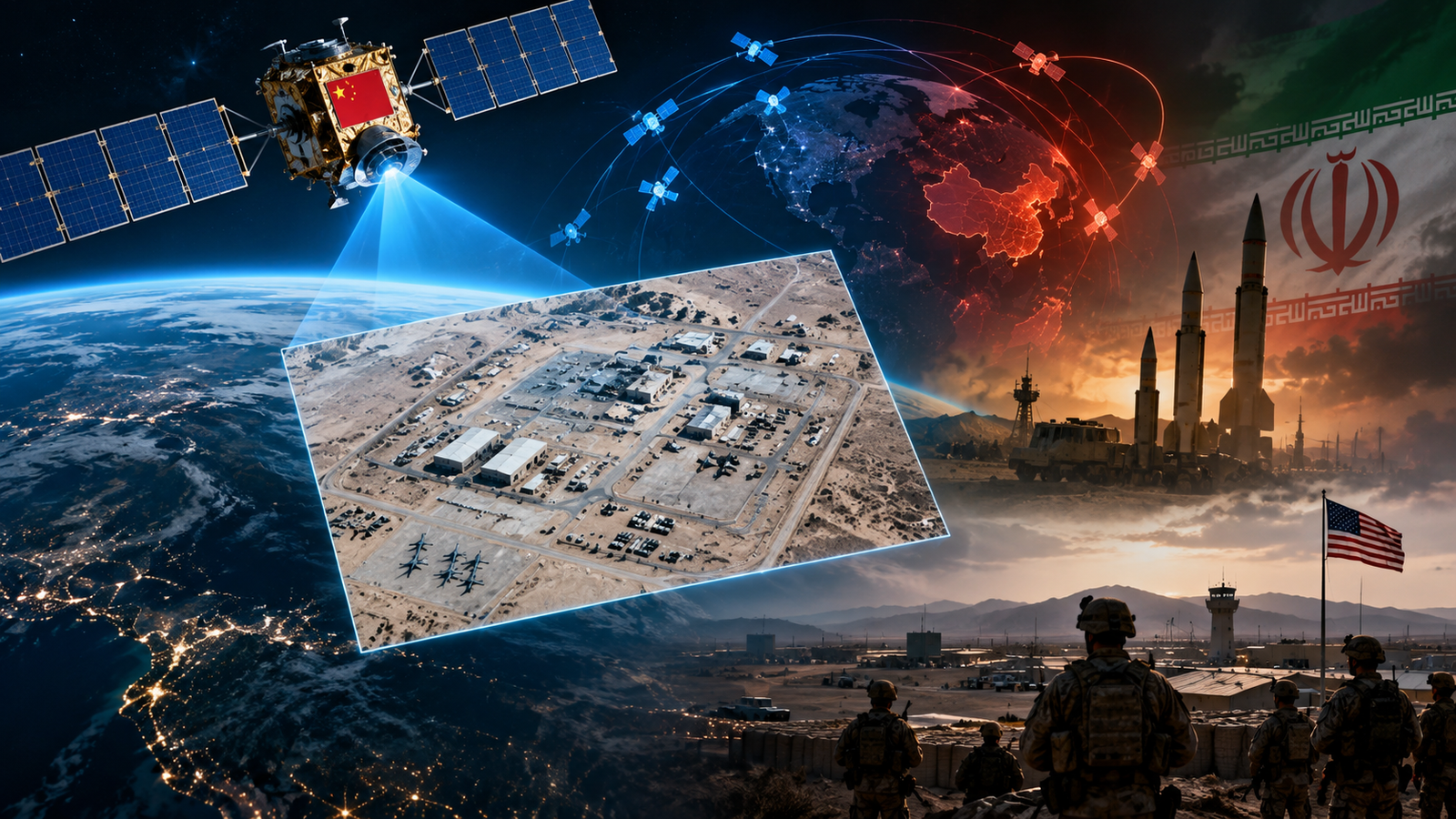
- China’s satellite imagery Iran allegedly provided Tehran with high-resolution intelligence before the deadly July attack on U.S. troops in Jordan.
- China’s rapidly expanding satellite, navigation and remote-sensing capabilities are narrowing the strategic space-technology gap with the United States.
- Washington has heavily squeezed Iran economically but remains cautious about directly confronting Beijing, making the allegations potentially significant ahead of the Trump-Xi summit.
The Iran war has opened a new and potentially explosive front in the U.S.-China rivalry: space.
U.S. officials now say Iran obtained high-resolution satellite imagery from Chinese entities before and after the July 17 Iranian missile attack on Muwaffaq Salti Air Base in Jordan that killed three American troops and wounded four others. The officials have stopped short of accusing the Chinese government itself of ordering or directing the transfer, but they say the imagery was linked to the Iranian operation and could have helped Tehran identify valuable targets with far greater precision.
If confirmed, the allegation would represent one of the clearest examples yet of how China’s rapidly expanding commercial and military space capabilities can influence an active battlefield—and potentially contribute indirectly to American casualties.
The disclosure is particularly sensitive because it comes just days before President Donald Trump is expected to meet Chinese President Xi Jinping in Washington on Sept. 24. The White House has spent months trying to stabilize relations with Beijing while simultaneously confronting China over trade, technology, rare earths and its support for countries opposed to U.S. interests.
The timing therefore raises a larger question: Is Washington preparing the ground for a tougher conversation with Xi?
China’s Satellite imagery becomes a battlefield weapon
According to U.S. officials familiar with the intelligence, Tehran procured high-resolution imagery of the Jordanian base from Chinese sources before the deadly attack and continued obtaining imagery afterward. The imagery could have allowed Iranian planners to identify recent changes at the installation, select more consequential targets and subsequently assess the effectiveness of their strike.
READ NEXT: Iran attacks US targets: Tehran’s Escalation Is About More Than Hormuz — It Is Testing America’s Power
The July 17 attack was particularly significant because Iranian ballistic missiles struck a housing area where U.S. personnel were sleeping. Three American soldiers were killed and four others wounded and evacuated. Iran also targeted manned and unmanned aircraft at the base, according to U.S. officials.
It was one of three missile attacks on the installation within 24 hours and marked the first American military deaths since an April ceasefire. More importantly, it exposed a troubling development: Iran’s ability to find and hit American military assets appeared to be improving even after U.S. strikes had degraded Iranian radar, satellite and battlefield-surveillance capabilities.
Within three days of the attack, Iran itself released high-resolution imagery showing damage to several areas of the base. Publicly available lower-resolution imagery independently showed damage to more than 20 structures.
Jim Lamson, a former CIA analyst specializing in Iran’s military capabilities, has argued that fresh high-resolution imagery could help Iran identify the most consequential targets quickly and then use post-strike imagery to determine whether another attack is warranted.
READ MORE: U.S. Links Chinese Satellite Imagery to Iranian Strike That Killed Three Troops
The satellite pictures, however, should not be viewed as a single-source explanation for the Iranian strike. Tehran has its own intelligence capabilities and has reportedly received intelligence and imagery from Russia as well. The Chinese contribution is important because it could represent one component of a much broader intelligence architecture connecting satellites, navigation systems, artificial intelligence, drones and precision missiles.
U.S. officials say Iran obtained high-resolution satellite imagery from Chinese entities before the July attack that killed three American troops in Jordan. The allegation highlights China’s rapidly advancing space capabilities, Iran’s evolving military intelligence network and Washington’s difficult decision over whether to confront Beijing before the Trump-Xi summit.
That combination is where the strategic danger lies.
U.S. officials have also expressed concern that Chinese or Russian assistance could be helping Iran track American naval assets. Recent Iranian attempts to strike U.S. warships have included attacks on an aircraft carrier and destroyers, with American officials describing some incidents as close calls.
China is closing the space gap
The controversy also exposes something much larger than Iran.
China is no longer simply trying to catch up with the United States in space. It is building an integrated ecosystem capable of combining satellite surveillance, navigation, communications, artificial intelligence and military targeting.
The Pentagon’s latest assessment says China launched 67 ISR-capable satellites in 2024, taking its total number of intelligence, surveillance and reconnaissance satellites above 500. The Pentagon says these systems increasingly allow Beijing to monitor American and allied military assets and support long-range targeting networks.
The significance is enormous.
For decades, America’s military advantage rested partly on an unparalleled ability to see the battlefield from space. Satellites enabled Washington to locate enemy forces, track ships, identify missile launchers and coordinate precision strikes.
China is steadily narrowing that advantage.
Its Jilin-1 constellation has more than 100 imaging satellites, while its broader remote-sensing architecture combines optical and synthetic-aperture radar systems. Its BeiDou navigation network provides China with a global alternative to America’s GPS, while China’s expanding communications constellations could make its military networks increasingly resilient.
CSIS analysts say China has tripled its number of ISR satellites since 2018 and is simultaneously expanding BeiDou and low-Earth-orbit communications capabilities.
This is effectively the construction of a Chinese sensor-to-shooter architecture.
The implications extend well beyond Iran. If commercial Chinese companies can provide imagery that helps a U.S. adversary identify American forces in the Middle East, the same model could eventually be relevant to a confrontation in the Indo-Pacific.
The Pentagon has already warned that China’s commercial space industry is intertwined with military modernization. Commercial companies can provide dual-use technology, while China’s military-civil fusion strategy allows civilian capabilities to contribute to national-security objectives.
That is why Washington sanctioned three Chinese companies—MizarVision, Earth Eye and Chang Guang—in May over alleged provision of satellite imagery that could assist Iranian attacks.
China, however, rejects the broader American narrative.
Beijing has repeatedly accused Washington of politicizing commercial cooperation and has insisted that its cooperation with Iran complies with international law. Chinese officials have also criticized unilateral U.S. sanctions and called for diplomacy rather than military escalation.
Washington has squeezed Iran—but hesitated to squeeze China
The most revealing part of the story may be what Washington has not done.
The Trump administration has aggressively targeted Iran’s economic lifelines. It has imposed more than 1,000 sanctions, targeted oil networks, sanctioned Chinese entities involved in Iranian trade and used military pressure to constrain Tehran.
Yet Washington has so far avoided a direct economic confrontation with China’s largest banks and most strategically important companies.
The reason is obvious: punishing Iran is one thing. Punishing China is something else entirely.
China remains one of Iran’s most important economic lifelines, particularly as a buyer of Iranian oil. Beijing also possesses enormous leverage over American supply chains through rare earths and other critical minerals. Trump has simultaneously sought a more stable relationship with Xi after the two leaders reached a broad framework for economic engagement in May. The White House has described the relationship as one requiring strategic stability, while confirming plans for Xi’s Washington visit.
This creates an extraordinary contradiction.
Washington wants to cripple Iran without provoking China. Beijing wants to maintain its strategic relationship with Tehran without crossing a threshold that triggers a major confrontation with Washington.
The satellite allegations could therefore become bargaining material.
Analysts and former U.S. officials may reasonably view the timing as deliberate—not necessarily because Washington wants to derail the Trump-Xi summit, but because it wants Xi to arrive knowing that the Iran issue has acquired a direct American national-security dimension.
The message is unmistakable: China’s support for Iran may no longer be viewed in Washington as merely economic or diplomatic. It may increasingly be viewed through the lens of American blood.
That distinction matters.
Trump has shown a preference for pressure backed by negotiation rather than uncontrolled escalation with Beijing. Publicly exposing the satellite intelligence before the summit could therefore be a classic pressure tactic: raise the political cost for Beijing while leaving Xi a pathway to change behavior without forcing the United States into immediate confrontation.
The larger strategic lesson is even more profound.
The next U.S.-China contest may not begin with a missile fired at Taiwan or a naval confrontation in the Pacific. It may begin quietly, through a satellite photographing an American base, an algorithm identifying the most vulnerable target and a commercial company selling information that ultimately becomes part of a military kill chain.
The July attack may therefore prove to be more than an Iranian strike on an American base. It may be an early warning that the space race between Washington and Beijing has already become a battlefield—and that America’s adversaries can increasingly buy access to it.