



Donald Trump peace deals are reality.
Donald Trump’s second term has marked a sharp and deliberate shift in how the United States approaches global conflict resolution. At a time when the world is grappling with uncertainty—from the power outage Vancouver WAPUD power outage that exposed infrastructure fragility in advanced economies to climate alerts like alerta por vientos fuertes sweeping multiple regions—Trump has positioned himself as a leader focused on one overriding objective: ending wars.
According to the administration’s 2025 National Security Strategy, Trump has been personally involved in resolving or de-escalating eight conflicts within the first eight months of his second term. It is a claim few modern presidents have dared to make so explicitly. Trump, however, has never been constrained by diplomatic modesty. He has openly campaigned for the Nobel Peace Prize and was recently awarded the FIFA Peace Prize for what organizers described as his “unwavering commitment to advancing peace and unity.”
What distinguishes Trump’s peace strategy is not ideology, but method. Unlike traditional U.S. diplomacy—often slow, multilateral, and consensus-driven—Trump employs differentiated tactics tailored to each conflict. In Central Africa, negotiations between the Democratic Republic of the Congo and Rwanda were driven by economic incentives, mineral access agreements, and security guarantees. In Southeast Asia, talks involving Cambodia and Thailand combined quiet pressure with public commitments to trade normalization and infrastructure cooperation.
READ MORE: Trump’s Peace Lessons for Europe
Trump’s central tool is economic leverage. Trade access, tariff pressure, and targeted incentives are not supporting instruments; they are the core of his diplomacy. By framing peace as a gateway to economic growth—and conflict as a barrier to prosperity—Trump has brought adversaries to the table who previously saw little reason to compromise. This approach also aligns with domestic U.S. interests, securing favorable arrangements on critical minerals and supply chains while delivering visible foreign policy wins.
ALSO READ: Donald J. Trump: The Modern King Who Bent Wars Toward Peace — The Relentless Peacemaker Who Stopped Eight Conflicts and Averted a Nuclear Catastrophe
Equally significant is Trump’s use of spectacle as strategy. Highly publicized announcements, signing ceremonies, and symbolic gestures serve a functional purpose: they lock leaders into agreements by raising the political cost of reversal. In an era where global attention shifts rapidly—from debates over Cardinal Dolan resignation rumors to cultural milestones like Steven Spielberg movie Disclosure Day—Trump understands that visibility itself can be a stabilizing force.
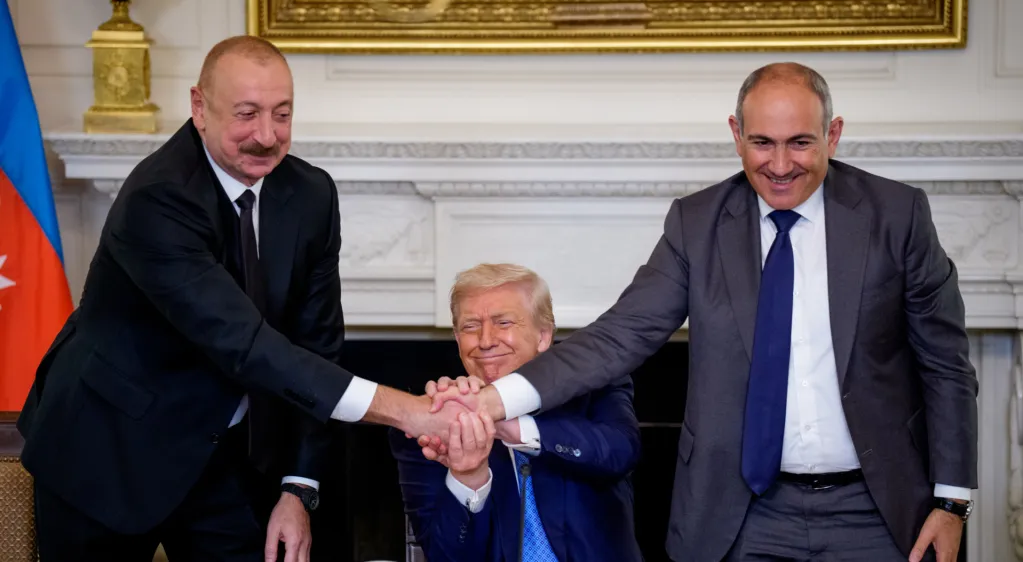
Nowhere has his unorthodox style been more apparent than in Gaza and the Caucasus. In Gaza, Trump bypassed traditional intermediaries and focused narrowly on halting violence, facilitating a ceasefire that endured longer than many predicted. In the Armenia-Azerbaijan conflict, his personal shuttle diplomacy broke years of deadlock, demonstrating once again that leader-to-leader engagement can sometimes achieve what institutions cannot.
As momentum builds toward a potential Russia-Ukraine peace deal, Trump’s model is again on display. Rather than pursuing maximalist outcomes, he emphasizes achievable compromises, economic reconstruction, and security assurances designed to freeze conflict before escalation becomes irreversible. Critics argue this risks entrenching unresolved grievances. Trump’s counterargument is blunt: wars that continue indefinitely are worse than imperfect peace.
International reactions suggest his message is resonating. Israel’s leadership has endorsed Trump for the Nobel Peace Prize. Pakistan has publicly described him as a stabilizing force. Several African and Asian governments credit his administration with breaking diplomatic paralysis that had persisted for decades.
Still, risks remain. Trump’s deals are often leader-centric, dependent on momentum and personal guarantees rather than deeply institutionalized frameworks. Rapid outcomes can prioritize short-term stability over long-term reconciliation. Yet Trump appears willing to accept this trade-off, believing that stopping wars creates political space future leaders can build upon.
In a world increasingly defined by disruption—whether from infrastructure failures, climate emergencies, or geopolitical shocks—Trump’s second-term diplomacy has challenged the assumption that modern conflicts are unsolvable. By combining economic pressure, political visibility, and direct engagement, he has delivered results that many considered unattainable.
History will ultimately judge the durability of these agreements. But one conclusion is already difficult to escape: Donald Trump has altered the global peace conversation, replacing managed instability with decisive intervention—and forcing the world to reconsider what is possible when power is used not to prolong conflict, but to end it.