



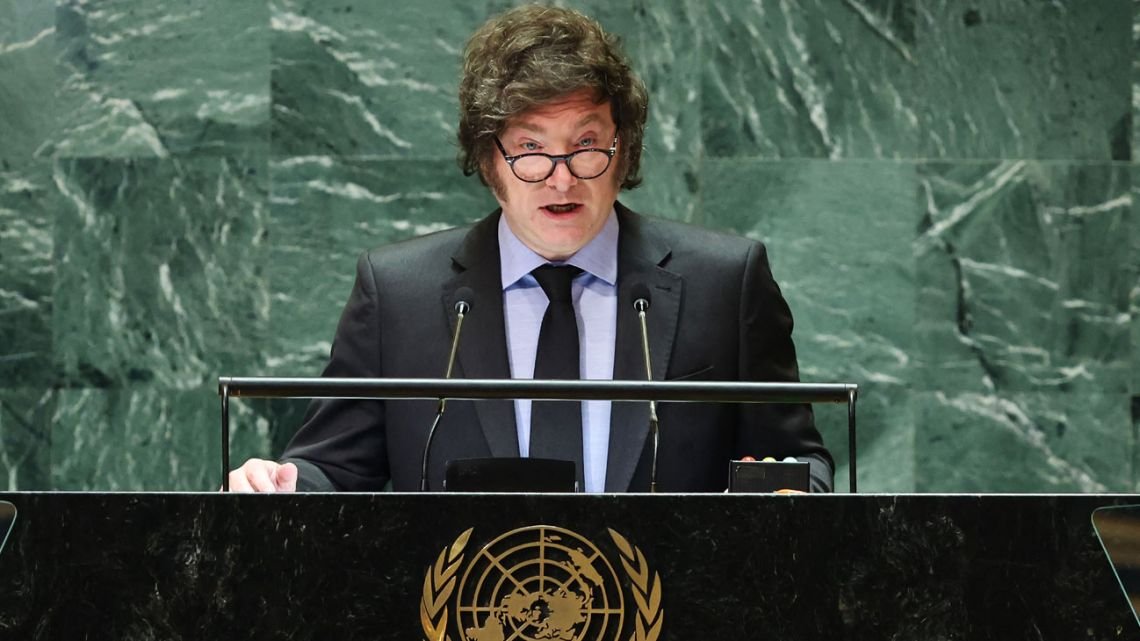
- Falkland Islands crisis deepens following Argentine President Javier Milei’s UN speech threatening unilateral action over South Atlantic sovereignty.
- The territorial row centers on the Sea Lion offshore oil development led by British and Israeli energy firms.
- London pledges to defend islanders’ self-determination as Washington signals a potential shift in its neutral stance.
- A renewed South Atlantic standoff threatens severe systemic volatility across fragile global financial markets.
As global powers struggle to contain the regional fallout from the US-Iran war, a dangerous crisis is quietly coming to a boil in the South Atlantic, threatening to inflict severe systemic distress on an already fragile global economy. The long-simmering sovereignty dispute between Argentina and the United Kingdom over the Falkland Islands—known in Buenos Aires as Las Malvinas—has escalated into an explosive confrontation fueled by massive offshore oil discoveries, assertive nationalist posturing, and shifting transatlantic alliances.
Argentine President Javier Milei used the floor of the United Nations General Assembly in New York to issue an explicit warning to London and the international community, declaring that Buenos Aires is ready to act unilaterally after decades of international inaction.
The catalyst behind this sudden escalation centers on the Sea Lion project, a lucrative offshore oil development located in the North Falkland Basin. Operated as a joint venture between London-listed Rockhopper Exploration and Israel’s Navitas Petroleum, the field is scheduled to begin exploratory drilling in the coming months, targeting full commercial production by 2028.
READ NEXT: Trump Venezuela Blockade: High-Seas Interceptions Spark Regional Flashpoint as U.S. Declares War on Narcoterrorism
For Argentina, the exploitation of these energy reserves constitutes an unlawful theft of sovereign national resources under foreign military occupation. Milei’s administration has already launched aggressive legal and sanction proceedings against more than 60 international companies and individuals tied to the project, asserting that Argentina will no longer tolerate foreign commercial exploitation inside disputed territorial waters.
In a caustic speech that tore into the legitimacy of the United Nations, Milei accused the multilateral body of total impotence, claiming it has consistently looked the other way while British authority over the archipelago remains intact.
Describing the UN as an organization populated by bureaucrats unable to enforce its own resolutions, Milei warned that Argentina will not sit around waiting for international bodies to fulfill their mandates and is fully prepared to take matters into its own hands. For Milei, whose domestic popularity has hovered around 37 percent amid severe fiscal austerity, reviving the historic national cause serves as a potent political mechanism to rally internal support and challenge Western diplomatic norms.
READ MORE: Argentine leader threatens to sanction oil firms and reiterates Falklands claim
The diplomatic friction has taken on a far more unpredictable character due to signals emanating from Washington. US President Donald Trump recently suggested his administration is actively reviewing America’s long-standing policy of neutrality regarding the archipelago. In public comments, Trump questioned the automatic nature of Washington’s military and strategic support for the United Kingdom, citing dissatisfaction with London’s initial reluctance to support US military operations in the Middle East.
Trump’s transactional view of foreign policy has unsettled traditional diplomatic alignments, emboldening Buenos Aires to project greater assertiveness while leaving Downing Street increasingly isolated on the international stage.
The response from London has been swift and unyielding. UK Prime Minister Andy Burnham met directly with US officials to reaffirm that Britain’s posture remains entirely non-negotiable. Burnham insisted that the United Kingdom will stand firm against any external aggression and defend the fundamental right of the Falkland Islanders to self-determination.
That stance remains firmly backed by the local population, who voted overwhelmingly—by 99.8 percent in a 2013 referendum—to remain a British overseas territory. However, with London navigating economic headwinds and domestic fiscal constraints, a sustained military posture in the South Atlantic presents serious strategic challenges for British defense planners.
Should military hostilities or naval blockades erupt in the South Atlantic, the fallout would reverberate rapidly throughout global trade networks and capital markets. A localized confrontation involving a major G7 economy like the United Kingdom could send severe shockwaves through European equity markets, triggering capital flight that would compromise international stock exchanges worldwide.
Beyond equity market panic, naval friction in vital shipping channels would instantly drive up maritime insurance premiums, disrupt global oil supply routes, and spark commodity price surges when global supply chains are already operating at capacity.
The convergence of vast offshore oil wealth, nationalist political rhetoric, and fraying international alliances has transformed the Falkland Islands from a forgotten diplomatic stalemate into an active economic risk zone. With Washington altering its traditional security calculus and multilateral institutions rendered increasingly ineffective, the margin for error in the South Atlantic is shrinking rapidly. The international community, preoccupied with ongoing Middle Eastern conflicts, can ill afford another major crisis that threatens to destabilize global financial architecture.