



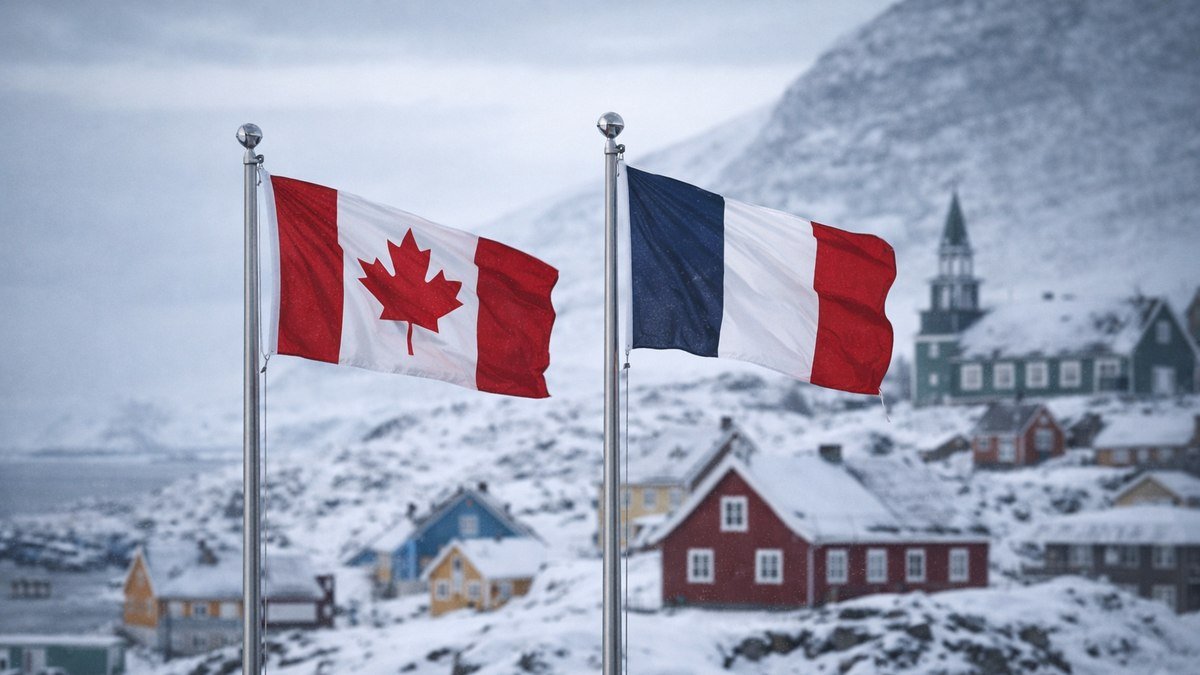
NUUK, Greenland — In a dramatic reconfiguration of Arctic diplomacy, Canada and France formally opened diplomatic consulates in Nuuk, Greenland’s largest city, signaling a widening rift between the United States and key NATO allies over the future of the strategic Arctic island. The move underscores growing European and North American interest in Greenland, a semi-autonomous Danish territory rich in minerals and strategically positioned at the gateway to the Arctic.
Canada raised its maple-leaf flag on Friday as Foreign Minister Anita Anand inaugurated the new consulate. “The significance of raising this flag today and formally opening the consulate is that we will stand together with the people of Greenland and Denmark on many issues,” Anand said, emphasizing collaboration on defense, security, climate change, economic resilience, and Arctic cooperation. Dozens of Canadians living in Greenland joined the ceremony, singing “O Canada” as the diplomatic milestone was celebrated.
France followed suit, appointing Jean-Noël Poirier as the first European Union consul general in Greenland. While France does not yet have a physical consulate in Nuuk, Poirier’s mission is clear: deepen cooperation in cultural, scientific, and economic fields and strengthen political ties with Greenlandic authorities. French officials said the decision follows President Emmanuel Macron’s visit to Greenland in June, signaling Paris’ long-term commitment to Arctic engagement.
The openings of these consulates come against the backdrop of a U.S. push to assert influence over Greenland, which President Donald Trump briefly described as a potential “acquisition” target. Although Trump later softened his rhetoric, the Arctic island became a flashpoint for transatlantic tensions. The U.S. attempted to leverage mineral-rich territories and strategic ports through technical discussions with Denmark and Greenland on Arctic security agreements. However, many European capitals view these moves as overreach, further straining relations between Washington and Brussels.
Analysts argue that France and Canada’s consulates symbolize a broader geopolitical response: an effort to ensure Greenland is not dominated by a single power and to diversify diplomatic channels. For the EU, the French outpost represents an opportunity to assert influence independently of U.S. directives. For Canada, the consulate strengthens its Arctic presence amid a warming climate and rising competition from Russia, China, and now the United States.
The implications are clear: the U.S. is facing a relative decline in its ability to dictate policy in areas once considered firmly under American influence. Greenland, long overlooked except for its strategic Cold War significance, has emerged as a litmus test for U.S.–EU relations. Opening consulates there allows France and Canada to maintain proximity to Greenland’s government and resources while signaling to Washington that its unilateral ambitions will not go unchallenged.
NATO, historically the backbone of U.S.–European security collaboration, now faces an uncomfortable reality. The Greenland consulates underscore cracks in alliance cohesion, revealing that key partners are willing to pursue independent strategies when U.S. policies are seen as confrontational or unpredictable. Observers suggest that the move will complicate ongoing discussions on Arctic security and resource access, particularly in areas where U.S. and EU interests overlap.
For Denmark, the host nation, the influx of foreign diplomatic missions strengthens its leverage with both Greenlandic authorities and Washington. By facilitating France and Canada’s engagement, Copenhagen reinforces its sovereignty over Greenland while balancing strategic interests between the U.S. and its European allies.
As the Arctic becomes an increasingly contested space for climate, economic, and security reasons, the Greenland consulates mark more than ceremonial openings; they are a geopolitical statement. They signal the rise of a multilateral approach to the Arctic that challenges Washington’s traditional dominance and foreshadows a broader recalibration of NATO and U.S.–EU relations in the coming decade.
The question now is whether the U.S. can rebuild its influence in Greenland or whether these consulates will cement a new Arctic order—one in which European and Canadian interests increasingly counterbalance American ambitions. Analysts suggest that Greenland may very well become a bellwether for the fall of U.S. unilateral leadership in NATO and the Arctic.