



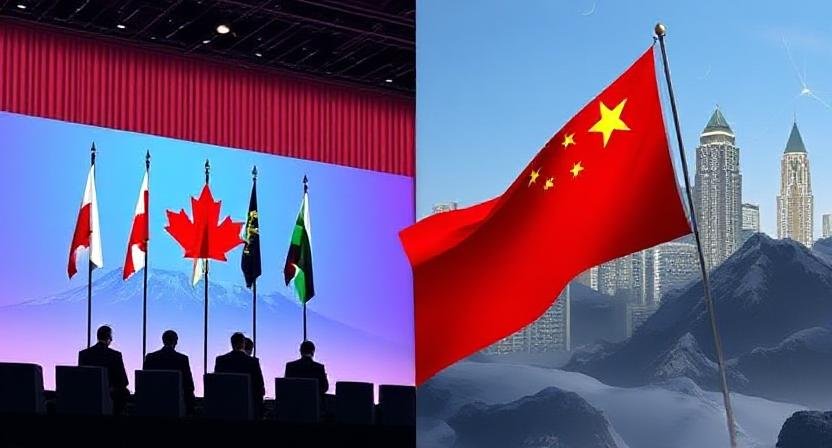
- The 50th G7 Summit in Canada aims to counter China’s growing economic influence and the rise of BRICS.
- President Donald Trump faces resistance from new global leaders amid his push against Chinese manufacturing overcapacity.
- India’s dual alignment with both G7 and BRICS raises trust issues among Western allies.
- The G7’s declining global GDP share reflects the shifting balance of power toward emerging economies.
The G7 summit, a high-stakes gathering of the world’s leading economies, is set to take place at the picturesque Rocky Mountain resort of Kananaskis, Canada, from June 15 to 17, 2025. First held in France in 1975, this year marks the 50th meeting of the Group of Seven (G7), composed of Canada, the United States, France, Italy, Japan, Germany, and Britain.
This year’s G7 Summit summit, hosted by Canada’s newly elected Prime Minister Mark Carney, arrives at a time of mounting global uncertainty and geopolitical complexity.
Originally created as an economic coordination forum, the G7 has gradually evolved to incorporate foreign policy and global security into its agenda. The inclusion of these matters has transformed the group into a strategic platform for aligning democratic powers on matters such as military conflicts, economic sanctions, and international diplomacy.
The Manufactured Rebel: How MEMRI, India & Israel Are Using ‘Mir Yar Baloch’ to Attack Pakistan
While the Soviet Union was once involved in discussions, its presence dwindled over time, and China only briefly attended as a guest. Following Russia’s annexation of Crimea and Beijing’s overt support for Moscow during the Ukraine crisis and COVID-era geopolitical tensions, both Russia and China now remain outside the G7—aligning instead with forums like BRICS.
The G7’s influence, however, is not what it used to be. In 1992, when Russia first attended as a guest, the G7 accounted for about 63 percent of global GDP. Today, that number has dropped to 44 percent. In contrast, the BRICS countries—Brazil, Russia, India, China, and South Africa—have grown significantly, now comprising nearly 25 percent of global GDP.
READ MORE: G7 Leaders Gather in Canada Amid Tariff Tensions, Trump Agenda, and Modi’s Snub
This shifting economic power base signals a rise in influence for non-Western blocs, particularly China, which has aggressively filled the vacuum created by Western nations through trade wars, tariffs, and rigid foreign policies.
In response to these shifts, the 2025 G7 summit has extended invitations to several non-member countries, including Australia, Ukraine, South Korea, Brazil, Mexico, and India. These guest states were chosen for their rising economic clout and potential roles in shaping the future global order.
Yet, not all of them align ideologically with the G7. For example, India has maintained strong ties with both Russia and China through platforms like BRICS, while simultaneously seeking favor with Western powers. This diplomatic balancing act, while strategic, has its consequences—evident in the West’s lukewarm response to the recent India-Pakistan standoff.
The upcoming summit brings with it a series of daunting challenges. U.S. President Donald Trump is expected to push for a unified stance against what he calls China’s “economic coercion” and overcapacity in manufacturing.
READ MORE: UK’s careful diplomacy faces test ahead of G7 meeting
However, Trump may find it difficult to build consensus among leaders with whom he shares strained relationships. Newly appointed leaders such as Germany’s Chancellor Friedrich Merz, Japan’s Prime Minister Shigeru Ishiba, and Canada’s own Mark Carney are expected to be more skeptical of Trump’s confrontational style.
Adding to the complexity is Trump’s own controversial view of U.S. allies. He has repeatedly suggested Canada could become the 51st U.S. state—a comment that has not sat well with Canadian leadership. Similarly, his previous dismissive attitude toward NATO and European alliances may complicate his efforts to forge a united front against China and Russia during the summit. The test for G7 leaders will not just be in formulating a response to BRICS, but in maintaining internal cohesion and trust.
Over the past year, the G7 Summit has focused on three major strategic goals: supporting Ukraine with financial and military aid, responding to China’s aggressive industrial expansion, and sanctioning Russia for its continued military aggression. These priorities remain at the top of the agenda in 2025, but now come under the weight of shifting alliances, emerging economies, and competing ideologies. The real challenge lies in whether the G7 can adapt to the multipolar reality of global politics while maintaining its foundational values.
The bottom line is clear: the geopolitical landscape is no longer unipolar. The emergence of BRICS and China’s growing economic footprint have fundamentally challenged Western dominance. The world will watch closely to see whether President Trump can rally both G7 and guest nations to build a unified strategy—or whether the summit will expose deeper fractures in the West’s ability to lead in a divided world.