



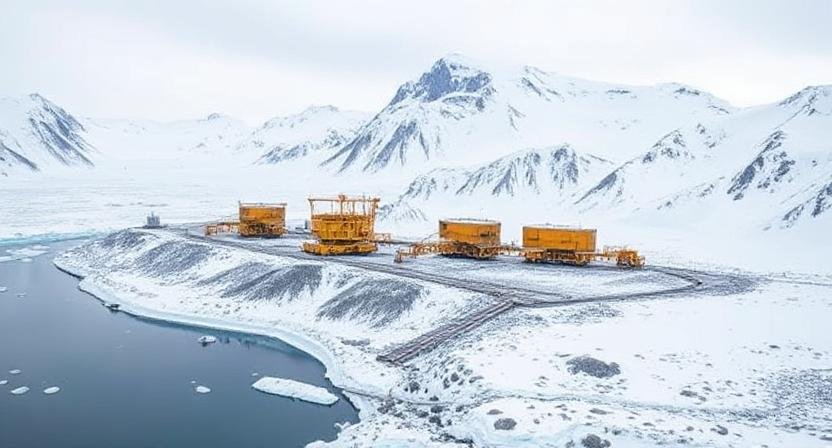
- Greenland holds the 8th largest rare earth reserves in the world, rich in minerals like dysprosium, neodymium, and terbium — essential for defense and green tech.
- China controls 70% of rare earth mining and over 90% of processing, prompting urgent Western efforts to diversify supplies.
- Trump’s aggressive push for Greenland access stems from national security concerns, culminating in U.S. Export-Import Bank financing for Greenland’s Tanbreez mine.
- Environmental and local concerns persist in Greenland, where fishing and farming communities worry about mining’s cost to their traditional way of life.
QAQORTOQ, Greenland — In the icy wilderness where raven shadows sweep over black stone cliffs and waterfalls plunge through silence, a mountain glows with promise. The Tanbreez deposit, sitting at the southern tip of Greenland near the fjord-scarred coast of Qaqortoq, holds one of the world’s largest caches of rare earth minerals — a treasure trove so immense that it’s reshaping geopolitics, rekindling past disputes, and luring global giants into a modern-day mineral gold rush.
At the heart of the interest stands Donald Trump, whose dramatic 2019 offer to “buy” Greenland — then laughed off by Denmark — signaled more than a real estate curiosity. It was a strategic ploy to wrest control over a region critical to breaking China’s grip on rare earth supplies. Today, Trump’s push for U.S. access to Greenland’s rare earths has materialized into policy: loan guarantees, strategic partnerships, and plans to carve an Arctic supply chain out of this frozen frontier.
Greenland Stands Firm: Denmark’s $2.05 Billion Defense Boost Sends a Clear Message to Trump
Key Points:
-
Greenland holds the 8th largest rare earth reserves in the world, rich in minerals like dysprosium, neodymium, and terbium — essential for defense and green tech.
-
China controls 70% of rare earth mining and over 90% of processing, prompting urgent Western efforts to diversify supplies.
-
Trump’s aggressive push for Greenland access stems from national security concerns, culminating in U.S. Export-Import Bank financing for Greenland’s Tanbreez mine.
-
Environmental and local concerns persist in Greenland, where fishing and farming communities worry about mining’s cost to their traditional way of life.
Why Greenland’s Minerals Matter More Than Ever
Rare earth elements power the modern world. These metals — though not rare in absolute terms — are hard to mine and even harder to process. They are used in electric vehicles, wind turbines, iPhones, precision missiles, F-35 fighters, and AI chips. Greenland’s southern mountains, particularly the Tanbreez site, contain 25 of the 34 minerals deemed “critical” by the European Union and more than two-thirds of the 50 metals on the U.S. critical list.
Trump covets rare earth riches, but Greenland plans to mine its own business
While China dominates the market, recent export curbs have reminded Washington and Brussels just how vulnerable they are. Trump’s team, keen to reduce that dependency, seized on Greenland’s strategic location and rich geology.
“Greenland isn’t just an island with ice,” Trump reportedly told aides in 2020. “It’s the Saudi Arabia of rare earths.”
Trump’s Vision: Not Ownership, But Control
Trump’s 2019 proposal to buy Greenland — called “absurd” by Denmark — was ridiculed internationally, but behind the headlines was a serious geopolitical concern. During his first term, his administration quietly engaged with mining companies operating in Greenland, including Australian geologist Greg Barnes, whose Tanbreez project is now at the center of U.S. interest.
READ MORE:Trump’s Greenland Obsession: A Strategic Misfire or Calculated Geopolitical Gambit?
Tanbreez covers 15 square kilometers and reaches 300 meters deep. Independent assessments peg its initial value at $3 billion, with $200 million required for setup. In June, the U.S. Export-Import Bank offered a letter of interest to fund up to $120 million under its Supply Chain Resiliency Initiative — a move insiders say was greenlit by Trump’s direct interest.
Trump’s former Energy Department aide Drew Horn, now CEO of GreenMet, is also involved. “It’s not about owning Greenland,” one U.S. official noted. “It’s about outcompeting China.”
How Greenland Fits Into the Global Rare Earth Puzzle
Greenland’s mineral potential, long overlooked due to harsh conditions and logistical nightmares, is suddenly red hot. The island has issued 67 exploration licenses, yet only eight active mining permits exist. Most past projects have floundered due to high costs and brutal Arctic winters. As Bent Olsvig Jensen of Lumina Sustainable Materials put it, “No modern mine in Greenland has ever reached profitability.”
By comparison:
-
China mines 70% of global rare earths and processes over 90%.
-
The U.S. has one rare earth mine (Mountain Pass, California), but most of its output is processed in China.
-
Europe has no rare earth mines.
-
Australia and Canada are emerging suppliers, but lack scale.
Tanbreez, if operational by 2026, could be the first significant Western rare earth mine outside China to directly supply U.S. and European tech and defense industries.
What Locals Think: Hope vs. Hesitation
The fjords and villages near Qaqortoq are serene but wary. Fishermen like Nuka Mark Nielsen oppose the mine. “The noise, the ships — it’ll scare away the fish,” he says, pointing to cod-rich waters that support ten local families.
Sori Paviasen, a sheep farmer near Qassiarsuk, is ambivalent. “Mining is good for the government, because they want the money,” she said, “but is it good for Greenland farmers?”
The island’s newly elected prime minister, Jens-Frederik Nielsen, insists Greenland is “open for business,” though he acknowledges the challenges. The mining minister, Naaja Nathanielsen, is pragmatic: “We don’t need to be the greatest mining country in the world… just stable income that benefits the people and protects the environment.”
Greenland: A Mining Nation in the Making?
Greenland’s path to becoming a mining power is uncertain, but increasingly inevitable. The island needs economic alternatives to fishing and Danish subsidies if it hopes to achieve full independence. Mining, for all its controversy, could offer that path.
“Maybe in 20 years, we’ll have six or seven working mines,” said Nathanielsen. “That’s enough for Greenland.”
Meanwhile, Trump’s campaign — both political and geological — barrels ahead. With Greenland now on Nasdaq through its partnership with Critical Metals Corp., with backing from Wall Street and EXIM Bank, the U.S. is positioning itself to be the primary benefactor of a Greenland mineral revolution.
Said Tony Sage, head of Critical Metals: “This is a game-changer for the West.”
And, perhaps, for Greenland itself.