



- Hormuz Crisis: Economic Impact Data: Highlights Singapore’s 7% GDP dependency on the maritime sector and its strategic shift toward methanol and LNG bunkering to bypass Persian Gulf oil volatility.
- Geopolitical Conflict: Details the U.S.-Israel strikes on Iran and the resulting 50% surge in Brent crude prices to over $116 per barrel.
- The “Islamabad Track”: Analyzes the “Committee of Four” (Pakistan, Saudi Arabia, Turkiye, Egypt) and why President Trump reposes trust in Pakistani emissaries.
- Technological Resilience: Focuses on the Tuas Megaport and digital bunkering initiatives as a blueprint for “future-proofing” small city-states against global supply chain fractures.
- The Diplomatic Breakthrough: Documents the unique concession where Iran allowed 20 Pakistani-flagged vessels through the blockade as a sign of trust in Islamabad’s neutrality.
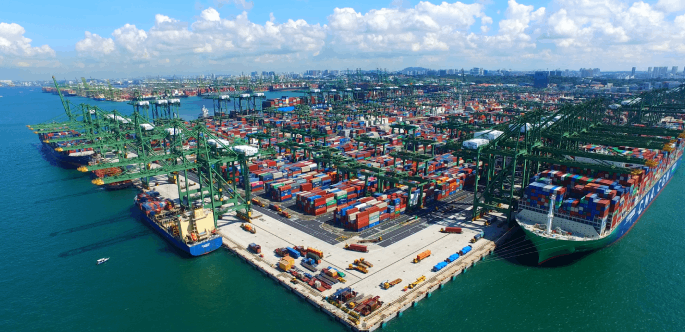
SINGAPORE — As the sun sets over the silent cranes of the Pasir Panjang terminal, the global economy holds its breath. The Strait of Hormuz, the world’s most vital maritime artery, has been effectively severed by the escalating conflict between the United States, Israel, and Iran. While the tremors of this geopolitical earthquake are felt globally, no nation finds its foundational architecture more threatened than Singapore. Yet, in a masterclass of crisis management, the city-state is transforming this existential threat into a “Golden Opportunity” for a total economic diversification.
A City-State on the Edge: The Statistical Reality
For Singapore, the disruption of the Strait of Hormuz is not a distant foreign policy issue; it is a direct hit to the national ledger. The maritime sector is the heartbeat of the nation, contributing approximately 7% of Singapore’s Gross Domestic Product (GDP). In a standard fiscal year, the Port of Singapore handles over 37 million TEUs (twenty-foot equivalent units), making it the world’s busiest transshipment hub.
With the Strait of Hormuz currently blocked, the 80% of global trade by volume that moves by sea is in jeopardy. For a nation that imports over 90% of its food and relies on the Persian Gulf for a significant portion of its crude oil and natural gas, the stakes are binary: adapt or stagnate.
“The challenges we face today are an excellent opportunity to improve the sector’s resilience,” stated Maritime and Port Authority (MPA) Chief Executive Ang Wee Keong at the Asia Pacific Maritime conference. His words reflect a nation that has historically thrived by turning scarcity into a competitive advantage.
The “Golden Opportunity” of Resilience
Singapore is not merely waiting for the warships to depart; it is aggressively “future-proofing” its economy through a three-pronged strategy of digitalization, automation, and green energy.
Strait of Hormuz crisis an opportunity to explore cleaner maritime fuel: MPA chief executive
1. The Digitalization of Trade The crisis has accelerated the adoption of Digital Bunkering. Since April 2025, Singapore has transitioned to digital-only refuelling documentation. This shift alone has saved the industry nearly 40,000 man-days annually. By removing the friction of physical paperwork, Singapore ensures that even during supply chain bottlenecks, its port remains the most efficient “pit stop” in the world.
2. The Tuas Megaport: A $20 Billion Bet The disruption has added urgency to the consolidation of all port operations into the Tuas Port. Once completed in the 2040s, Tuas will be the world’s largest fully automated terminal, capable of handling 65 million TEUs annually. By utilizing AI-driven gantry cranes and driverless automated guided vehicles (AGVs), Singapore is decoupling its economic output from the limitations of its small labor force.
3. The Multi-Fuel Transition With oil prices soaring past $116 per barrel due to the Iran conflict—a 50% increase since February—Singapore is pivoting to alternative energy. In 2025, the MPA awarded three methanol bunkering licenses and opened applications for Liquefied Natural Gas (LNG) bunkering. By positioning itself as the premier hub for low-carbon fuels, Singapore is diversifying its energy dependencies away from the volatile “oil-only” paradigm of the Middle East.
Islamabad: The New Gravity of Global Diplomacy
While Singapore retools its terminals, the diplomatic center of gravity has shifted to Islamabad. In a stunning turn of events, Pakistan has emerged as the indispensable bridge between a belligerent Washington and a defiant Tehran.
Iran US Peace Talks: Strategic Ambiguity Defines Tehran’s Calculated Shift Toward Negotiations
The “Islamabad Track” gained significant momentum this week as the foreign ministers of Saudi Arabia, Turkiye, and Egypt joined Pakistan’s Deputy Prime Minister Ishaq Dar. This “Committee of Four” is working on a structured backchannel to prevent the conflict from spiraling into a “nuclear-triggered catastrophe.”
The Trump-Pakistan Connection
In a rare moment of diplomatic alignment, U.S. President Donald Trump has expressed a profound trust in Pakistani “emissaries.” Despite his characteristic “America First” rhetoric—including public contemplations of seizing Iran’s Kharg Island, which handles 90% of Iran’s crude exports—Trump told reporters on Air Force One, “I do see a deal in Iran… negotiations are going extremely well.”
This optimism is rooted in Pakistan’s unique credibility. As a nuclear-armed nation with a shared border with Iran and a long-standing military partnership with the U.S., Islamabad is the only capital capable of facilitating “unfiltered” communication between the two adversaries.
Tehran Hails the “Bridge of Peace”
In Tehran, the sentiment is one of cautious validation. Iranian President Masoud Pezeshkian held a 90-minute call with Pakistani Prime Minister Shehbaz Sharif, acknowledging Pakistan’s role in creating a “conducive environment for peace talks.”
The most immediate victory for Pakistani diplomacy is Iran’s agreement to allow 20 Pakistani-flagged vessels through the blocked Strait. This move, acknowledged by both Trump and the Iranian Foreign Ministry, serves as a vital Confidence-Building Measure (CBM). It suggests that while the Strait remains closed to most, the “Pakistan Corridor” is the only functioning valve in a pressurized system.
The Spoiler Problem and the Road Ahead
Despite the diplomatic successes in Islamabad, the military trajectory remains perilous. The arrival of the USS Tripoliand an amphibious task force of 3,500 Marines in the region underscores the “escalate-to-deescalate” strategy currently favored by the Pentagon.
Furthermore, Israel remains a wildcard. Ambassador Danny Danon has clarified that Israel is not a party to the U.S.-Iran talks and will continue operations until Iran’s nuclear capabilities are neutralized. This “spoiler” potential is what the Committee of Four in Islamabad is most desperate to contain.
For Singapore, the success of the Islamabad talks is a matter of national security. Every day the Strait remains closed, global trade loses billions, and the “fragility” of the city-state’s supply chain is tested.
The 2026 Middle East crisis has forced a global reckoning. Singapore has chosen to meet this threat with a “Great Reset,” utilizing its massive $1 trillion in sovereign wealth reserves (estimated across GIC and Temasek) to fund a technological leap that would otherwise have taken decades. Simultaneously, Pakistan has stepped into a role of global leadership, proving that the path to peace in the Middle East may very well run through South Asia.
As the “Committee of Four” prepares for their next round of consultations, the world watches with bated breath. The goal is no longer just a ceasefire; it is the construction of a new maritime and diplomatic order—one where Singapore remains the world’s essential port, and Pakistan its essential peacemaker.