



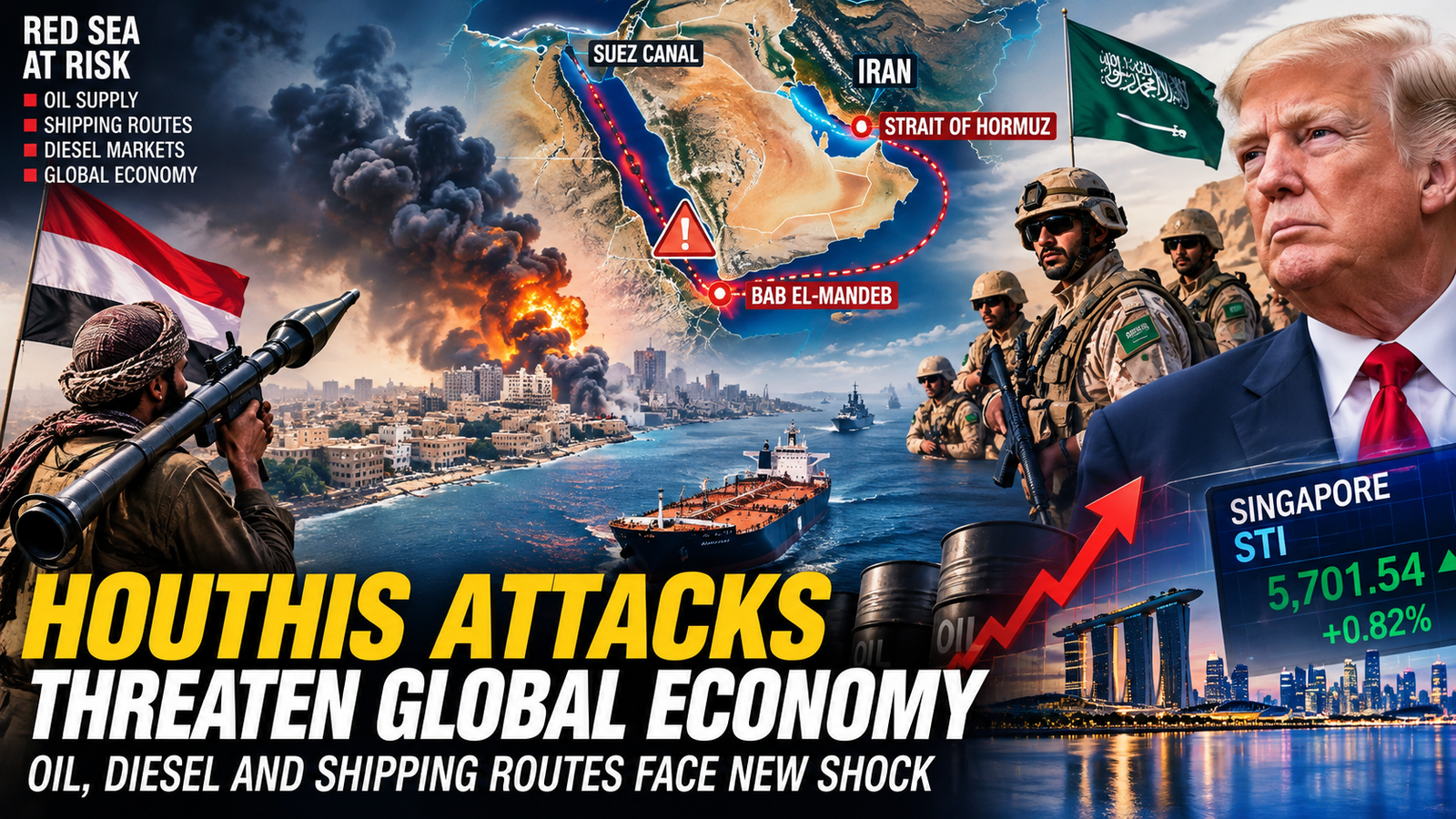
- Houthis attacks are increasing risks to the Bab el-Mandeb Strait, Saudi energy infrastructure and global shipping.
- Oil and diesel markets face prolonged pressure as Hormuz and Red Sea disruptions expose weaknesses in global energy supply chains.
- Trump faces a strategic dilemma between maintaining pressure on Iran and preventing an extended energy shock from reigniting global inflation.
The Houthis attacks in Yemen are turning the Red Sea into a major global economic risk, threatening oil supplies, diesel markets, shipping routes and financial stability as Saudi-backed forces confront the Iran-aligned group.
The Houthis attacks against Saudi Arabia and the continuing fighting along Yemen’s Red Sea coast are creating a geopolitical problem that extends far beyond the Middle East. The conflict is increasingly threatening the energy routes, diesel supplies and shipping networks on which the global economy depends.
Saudi-backed Yemeni security forces are attempting to reclaim territory from the Houthis near the Bab el-Mandeb Strait, while the Iran-aligned group has responded with missiles and drones targeting Saudi airports, military facilities and energy infrastructure.
The result is a dangerous new reality: both sides are fighting for territory while simultaneously threatening one of the world’s most important energy corridors.
Houthis Attacks Threaten Red Sea Energy Routes
The strategic importance of Yemen has changed dramatically.
The Bab el-Mandeb Strait connects the Red Sea with the Gulf of Aden and provides a critical maritime route between Europe and Asia. Any prolonged disruption forces shipping companies to consider longer routes around Africa, increasing fuel consumption, insurance costs and delivery times.
The problem becomes considerably more serious because the Strait of Hormuz remains heavily disrupted by the wider Iran conflict.
Mecca Defence Alliance Shift: Saudi-Led Ground Offensives Force Houthi Retreat
The combination of Hormuz and Bab el-Mandeb creates a potential double choke point for global energy supplies.
Brent crude has consequently remained around or above $100 a barrel during periods of intense fighting. Even when prices temporarily fall below that level, the underlying risk has not disappeared.
The market is increasingly pricing geopolitical uncertainty rather than simply calculating available barrels.
Saudi Arabia Faces a New Security Test
Saudi Arabia is now confronting a particularly difficult strategic equation.
Riyadh wants to protect its cities, energy infrastructure and export routes while avoiding a conflict that could expand into a wider regional war.
Saudi-backed Yemeni forces have therefore become an important part of the kingdom’s forward defense strategy.
Houthis’ Repeated Attacks on Saudi Arabia Put Mecca Pact to Real Test
The fighting around Yemen’s Red Sea coast is not simply about recovering territory. Control of the coastline and approaches to Bab el-Mandeb could determine whether Saudi Arabia can protect its western export infrastructure and prevent the Houthis from establishing a permanent ability to threaten international shipping.
The Houthis understand this vulnerability.
Their strategy does not necessarily require them to defeat Saudi-backed forces militarily. Maintaining the ability to launch missiles and drones may be enough to keep insurance premiums high, shipping companies cautious and energy markets nervous.
That is strategically cheaper than controlling an entire coastline.
Diesel Could Become the Next Global Problem
The biggest economic danger may not be crude oil itself.
It could be diesel.
Trump announces agreement for diesel fuel release from G7 reserves
European economies have already become increasingly dependent on imported refined petroleum products. The disruption of Middle Eastern production and shipping has tightened diesel markets while forcing governments and energy companies to reconsider the amount of fuel they keep in reserve.
Gulf producers are now arguing that Europe must invest in storage infrastructure closer to consumers.
This represents a fundamental change in the global energy model.
For decades, efficiency meant minimizing inventories and moving fuel through highly optimized supply chains. The Middle East conflict has demonstrated the weakness of that model.
Energy security now means maintaining spare capacity, alternative export routes and strategic storage even when those facilities appear economically inefficient during peacetime.
G7 Strategy Shows the New Energy Reality
The Group of Seven has responded by preparing emergency crude and diesel releases to prevent shortages from turning into a broader economic shock.
But strategic reserves can only buy time.
They cannot replace damaged refineries, rebuild pipelines or guarantee the safety of tankers passing through contested waters.
That is why the current crisis is likely to produce a wave of investment in energy infrastructure.
Saudi Arabia is examining alternative crude export routes and increasing overseas storage capacity. Kuwait is discussing additional refined-fuel storage with European partners.
The economic consequences could therefore extend well beyond the current war.
Billions of dollars may eventually flow into pipelines, storage terminals, ports, refineries, tankers and alternative shipping corridors.
Singapore Stocks Reveal the Market’s Adaptation
Singapore offers an important indication of how financial markets are interpreting the crisis.
The Straits Times Index has remained comparatively resilient despite the energy shock and wider geopolitical instability.
That may initially appear surprising.
But Singapore is not simply a consumer of energy. It is one of Asia’s most important maritime, financial and refining centers.
Companies connected to shipping, logistics, energy infrastructure and regional trade can benefit from the very restructuring that threatens traditional supply chains.
The Singapore market is therefore providing an early indication of a broader shift: investors are beginning to distinguish between companies exposed to geopolitical disruption and companies positioned to profit from the enormous investment required to make supply chains more resilient.
Trump Faces a Difficult Choice
The most consequential variable remains President Donald Trump.
Trump’s strategy toward Iran combines military pressure, economic pressure and negotiations. But prolonged disruption of Hormuz and Bab el-Mandeb creates an economic contradiction for Washington.
The United States wants to weaken Iran’s strategic position without allowing energy prices to remain elevated for long enough to reignite inflation.
Oil above $100 is therefore not simply a Middle Eastern problem for Trump.
It is an American economic and political problem.
Higher fuel prices feed directly into transportation, food and manufacturing costs. They also make it harder for central banks to reduce interest rates.
Trump consequently has an incentive to seek a settlement once the United States believes sufficient strategic leverage has been achieved.
The question is whether Tehran reaches the same conclusion.
The Next Phase Could Be More Dangerous
The immediate forecast is therefore mixed.
If Saudi-backed forces consolidate their positions along Yemen’s Red Sea coast and shipping security improves, the geopolitical premium in oil could fall rapidly.
But if the Houthis retain the ability to strike Saudi infrastructure while Hormuz remains constrained, the world could enter a prolonged period of structurally higher energy prices.
That would create a particularly dangerous combination of inflation, higher interest rates and rising government debt costs.
Artificially suppressing oil prices through emergency reserves may delay the economic impact, but it cannot eliminate the underlying geopolitical risk.
The most important lesson from the Houthis attacks is therefore not simply that another Middle Eastern conflict is threatening oil.
It is that the global economy has entered an era in which energy security, maritime security and financial stability are becoming inseparable.
The next major shock may not come from the battlefield itself.
It could come from the moment markets decide that the world’s critical energy corridors can no longer be assumed to remain open.