



- I Phone18 Price Set to Surge as Apple Faces AI Chip Crisis and Global Cost Pressures
- Tim Cook warns of unavoidable increases due to soaring DRAM and NAND costs
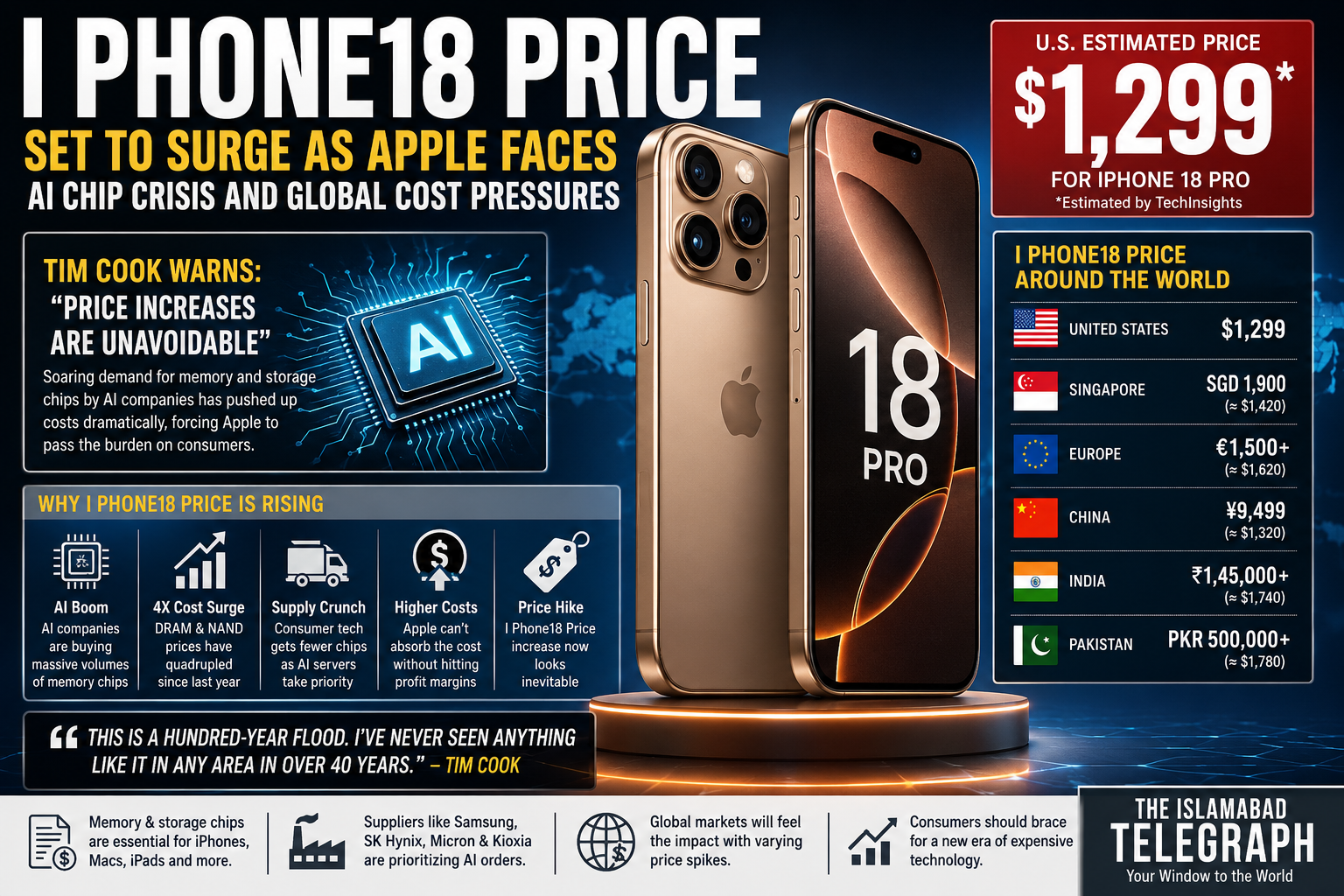
- iPhone 18 Pro could hit $1,299 in the U.S. with sharper spikes in India and Pakistan
- AI giants like Microsoft and Google disrupting supply chains and pricing power
A quiet but consequential shift is unfolding inside the world’s most valuable tech giant. In a rare and candid conversation with The Wall Street Journal, Tim Cook delivered a warning that could ripple across global markets: Apple is preparing to raise prices—and this time, the reason isn’t marketing strategy or premium positioning. It is survival.
“Price increases are unavoidable,” Cook admitted, signaling what may become one of the most significant pricing resets in consumer tech in recent years. Behind this looming shift lies an invisible but powerful force—the artificial intelligence boom, which is rapidly consuming global supplies of memory and storage chips.
At the heart of the issue is Apple Inc.’s struggle to secure DRAM and NAND components, critical for powering devices from iPhones to MacBooks. As AI giants like Microsoft, Google, Amazon, and Meta pour billions into data centers, they are effectively outbidding traditional hardware makers for chip supply. The result is a market distortion that even Apple—long known for its supply chain dominance—cannot escape.
Cook described the situation as unprecedented, calling it a “hundred-year flood.” Prices for memory and storage chips have reportedly quadrupled since last year, driven by demand for high-bandwidth memory used in AI servers. This has squeezed supply for consumer electronics, forcing Apple into a difficult balancing act: absorb the costs or pass them onto consumers.
Middle East Brinkmanship & The $1.8 Trillion Spark: Why This Week Will Define the Global Economy
Analysts suggest the latter is inevitable. According to industry estimates cited by The Wall Street Journal, maintaining Apple’s margins could push the price of the next iPhone Pro model up by roughly $270, potentially placing the anticipated iPhone 18 Pro near the $1,299 mark in the United States.
Globally, however, the impact could vary significantly.
In the United States, where Apple’s base pricing is typically lowest, consumers may see the iPhone 18 Pro start at around $1,299. In Europe, where taxes and regulatory costs inflate prices, the same device could exceed €1,500. Singapore, often a premium electronics hub, may see pricing slightly above U.S. levels, hovering near SGD 1,900.
Apple to Raise Prices Due to Memory Chip Crunch, Tim Cook Says
China presents a more complex scenario. While Apple has historically maintained competitive pricing there to defend market share against domestic brands, rising geopolitical tensions and supply chain restrictions could narrow its flexibility. Prices may climb closer to U.S. equivalents, potentially weakening Apple’s position in a fiercely competitive market.
India and Pakistan, however, are likely to experience the sharpest consumer pain. In India, where import duties already push flagship iPhone prices above $1,600, the new increases could widen the affordability gap further. In Pakistan, where heavy taxation and currency volatility already make Apple products luxury items, the iPhone 18 Pro could cross PKR 500,000, placing it firmly out of reach for most consumers.
This widening global price disparity highlights a deeper shift: Apple is no longer fully in control of its pricing destiny. For years, the company leveraged its scale to pressure suppliers and maintain margins. Today, it finds itself competing with AI hyperscalers willing to sign multi-year deals with massive upfront payments—terms Apple has historically avoided.
Even more striking is Cook’s openness to rethinking supply strategies. While he stopped short of endorsing any specific policy changes, he hinted that “everything needs to be on the table,” including potential adjustments to geopolitical restrictions affecting chip sourcing.
Yet Apple has drawn a clear line. It will not build its own memory factories. “We can’t do everything,” Cook said—a rare acknowledgment of limits from a company often seen as omnipotent.
The broader implications are profound. As AI continues to reshape global supply chains, the cost of everyday technology may increasingly reflect industrial competition rather than consumer demand. Devices that once became cheaper with scale may now become more expensive with innovation.
For consumers, the message is clear: the era of predictable smartphone pricing is ending. For markets, the signal is even louder—AI is not just transforming software; it is rewriting the economics of hardware itself.
And as AAPL navigates this storm, the question is no longer whether prices will rise—but how much consumers are willing to pay in the age of artificial intelligence.