



- Middle East Security: Qatar’s warning signals a growing Gulf desire for security self-sufficiency beyond exclusive reliance on the United States.
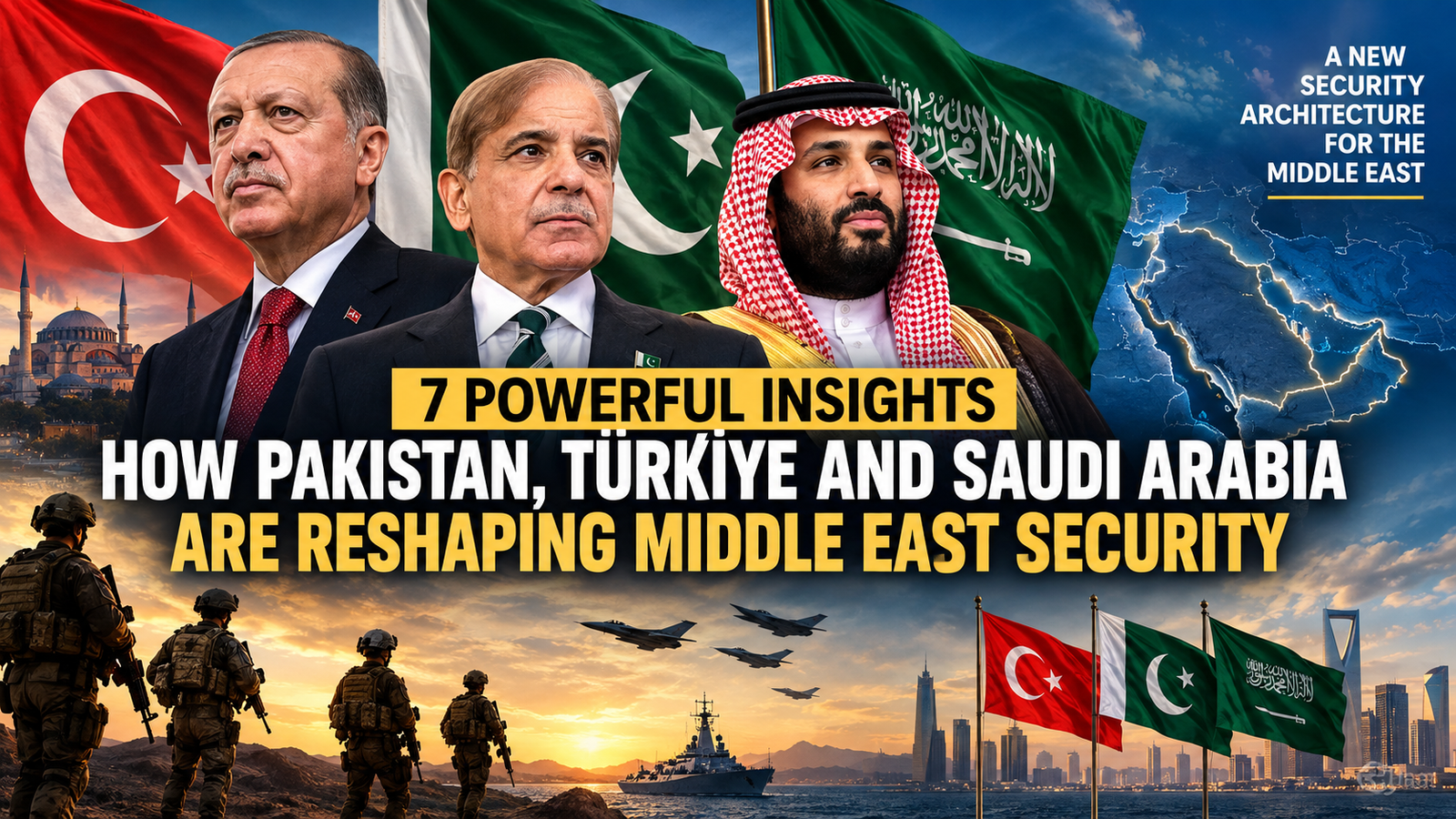
- Pakistan, Türkiye and Saudi Arabia are institutionalising a defence partnership that combines military, technological, economic and strategic strengths.
- The Makkah Defence Pact could become the foundation of a broader regional security architecture linking the Gulf, Türkiye and South Asia.
ABU DHABI/ISTANBUL — The Middle East is entering a new security era, and perhaps the clearest sign of the change came not from Washington, Riyadh or Ankara, but from Doha. Qatar, one of America’s closest military partners in the Gulf and home to the largest US military base in the region, has acknowledged that American protection alone can no longer provide the security the Gulf needs.
Speaking at the Hili Forum in Abu Dhabi on Monday, Qatar’s Foreign Ministry spokesman said Gulf countries must become more self-sufficient in security. International forces and strategic alliances with Washington remain important, he said, but “are not enough.” The conclusion is striking: after decades of dependence on an American security umbrella, one of the United States’ closest Gulf partners is openly arguing that the region needs to build its own security capacity.
That is precisely where the emerging partnership between Pakistan, Türkiye and Saudi Arabia becomes strategically significant.
The Makkah Joint Defence Agreement, signed by Saudi Crown Prince Mohammed bin Salman, Turkish President Recep Tayyip Erdogan and Pakistani Prime Minister Shehbaz Sharif on August 7, was initially viewed as a major bilateral-to-trilateral defence development. But events since then suggest something larger is taking shape: an attempt by regional powers to construct a Middle Eastern security architecture in which Muslim states possess greater responsibility for their own defence.
The agreement stipulates that an armed attack against one of the three countries will be regarded as an attack against all, while providing for broader defence cooperation and collective deterrence.
1. The American security model is facing its biggest test
Qatar’s warning matters because it comes from a country deeply integrated into the US security system. Doha hosts the enormous Al Udeid Air Base, yet Qatar has simultaneously endured Iranian attacks during the US-Iran conflict and has been forced to navigate the dangerous space between Washington and Tehran.
READ NEXT: The World Turns Against Iran as Strait of Hormuz Becomes a Global Flashpoint
Qatar has also emerged as a key mediator. Its prime minister travelled to Tehran last month as efforts continued to manage the crisis around the Strait of Hormuz.
The message from Doha is therefore not anti-American. It is pragmatic: alliances remain valuable, but countries cannot outsource their survival.
The UAE is moving in a similar direction, seeking alternative energy and trade routes to reduce dependence on Hormuz after repeated disruptions.
2. Pakistan, Türkiye and Saudi Arabia offer complementary strengths
The strategic attraction of the Makkah framework is that its three members bring different capabilities.
Türkiye provides one of the region’s most powerful conventional militaries, a sophisticated and rapidly expanding defence industry, drones, naval capabilities and extensive operational experience.
READ MORE: Qatar says Gulf cannot rely on US alone for security
Pakistan brings a large battle-tested military, an advanced missile capability and, crucially, the strategic weight of being the only nuclear-armed Muslim-majority state.
Saudi Arabia contributes enormous financial resources, energy power, geographic importance and a growing indigenous defence industry.
Individually, each country has limitations. Together, they create a much more formidable strategic equation.
3. Istanbul has already transformed the pact from declaration into institution
The most important development came on August 31, when senior foreign, defence and military officials from all three countries gathered in Istanbul for the first meeting of the Strategic Political and Defence Committee created under the Makkah agreement.
This was not simply another diplomatic meeting.
The three states agreed to further institutionalise their cooperation, including the creation of a permanent secretariat in Saudi Arabia. Pakistan will initially head that secretariat for three years.
That matters because security alliances become meaningful not when leaders sign documents, but when bureaucracies, military planners and commanders begin working together.
4. Pakistan’s role is expanding beyond the original alliance
The emerging architecture is already moving beyond the three Makkah signatories.
On August 27, Pakistan and Kuwait signed the Protocol Agreement-2026, substantially strengthening their existing military cooperation framework. The agreement covers training, capacity building, border management and other areas of defence collaboration.
Kuwait’s decision is significant because it demonstrates that Gulf states increasingly see Pakistan as a practical security partner rather than simply a traditional friend.
This could eventually create a network linking Pakistan with multiple Gulf security structures, while Türkiye provides a powerful northern strategic anchor and Saudi Arabia supplies the financial and geographic centre.
5. The Gulf may be moving from dependence to partnership
For decades, Gulf security was structured around a relatively simple formula: American military power would provide the ultimate deterrent while Gulf monarchies financed their own defence and purchased sophisticated Western weapons.
The emerging model is different.
The Gulf states increasingly want partnership rather than dependence.
That does not mean the United States is disappearing from the Middle East. American bases, intelligence, air power and naval capabilities will remain important for years.
But regional governments are increasingly preparing for a world in which Washington may not always respond exactly as they expect.
The Makkah pact therefore fits a much broader strategic trend: regional powers building the capacity to act independently.
6. Türkiye and Pakistan could become the military backbone of a new regional system
Saudi Arabia is uniquely positioned to lead politically and financially, but Türkiye and Pakistan provide something equally important: military depth.
Türkiye connects the Middle East to NATO, Europe, the Black Sea and the Mediterranean. Pakistan connects the Gulf to South Asia, the Arabian Sea and China.
Their partnership with Riyadh therefore creates a geographic triangle extending from the Mediterranean to the Arabian Sea.
That could eventually become the foundation for joint exercises, defence production, intelligence cooperation, air-defence coordination, maritime security and counterterrorism operations.
7. The Middle East is beginning to build security without waiting for outsiders
The most important change is psychological.
For decades, Middle Eastern security was largely discussed in terms of what Washington, Moscow or other external powers would do. The emerging Makkah framework reverses the question: what can regional powers do themselves?
Qatar’s call for security self-sufficiency, the UAE’s search for alternative trade and energy routes, Pakistan’s expanding defence relationships with Gulf states and the institutionalisation of the Makkah pact all point in the same direction.
The Middle East is not abandoning the United States. It is preparing for a future in which America is one pillar of regional security rather than its sole foundation.
And at the centre of that transformation stands an increasingly consequential partnership: Saudi Arabia providing strategic and economic weight, Türkiye providing military-industrial power, and Pakistan providing military depth and nuclear deterrence.
If this architecture expands, the Makkah pact may eventually be remembered not merely as a defence agreement among three Muslim powers, but as the first serious attempt by regional states to construct a security system of their own.