



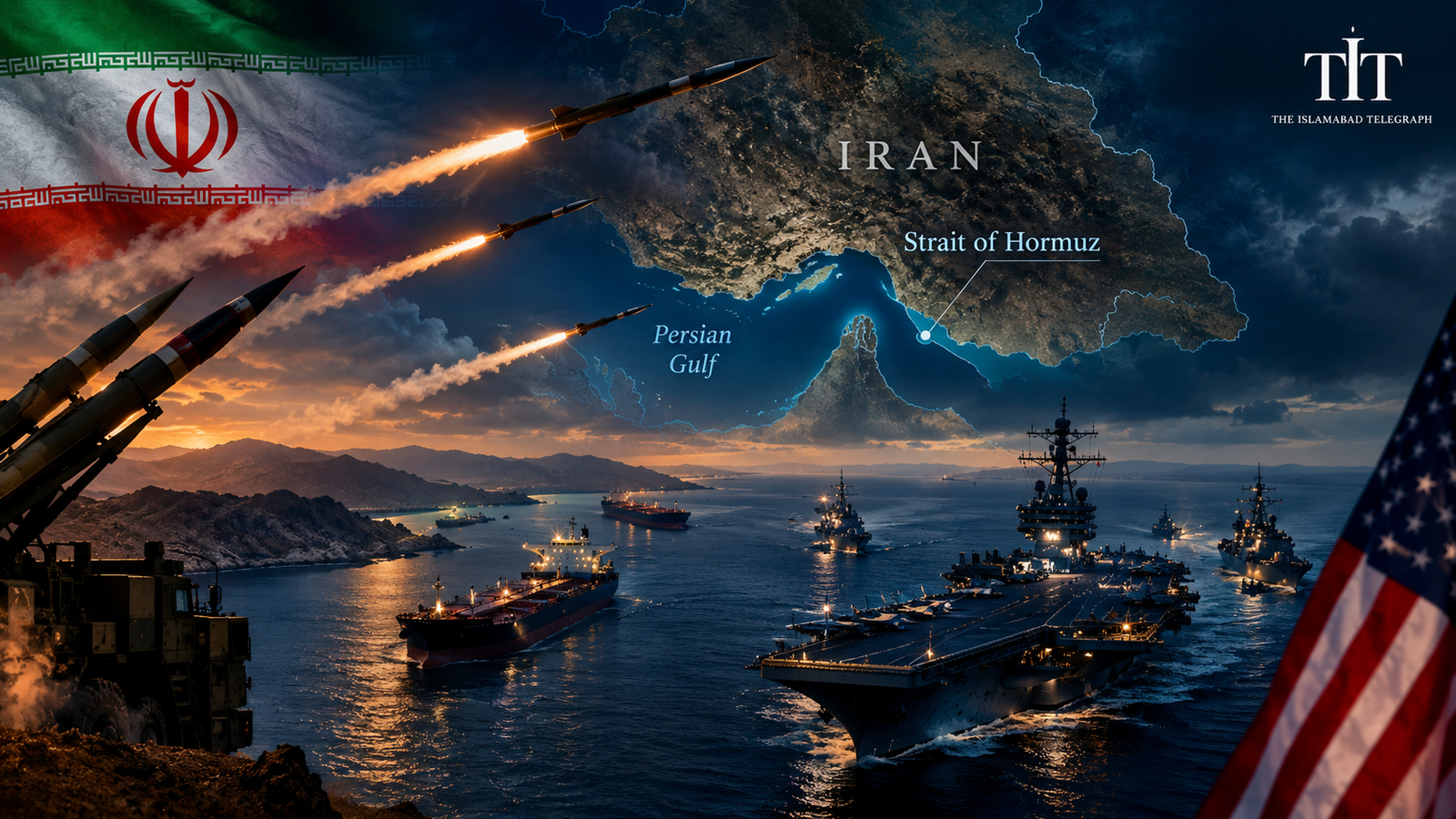
- Iran attacks US targets to make Washington’s blockade of Iranian oil exports increasingly costly and difficult to sustain.
- Tehran is exploiting the Strait of Hormuz to pressure U.S. military forces, regional allies and global energy markets.
- Trump’s ability to win the midterms has become strategically important to America’s credibility and influence in the Middle East.
Iran’s decision to intensify attacks against U.S. military targets at sea and across the Middle East marks a dangerous new phase in the conflict. Tehran is no longer simply retaliating against American strikes or trying to protect its shrinking oil exports. It is testing whether the United States can sustain military pressure, protect its forces and allies, and preserve its credibility in the Middle East while President Donald Trump approaches the 2026 midterm elections.
The escalation is unmistakable. Iranian forces have repeatedly fired ballistic missiles toward U.S. warships, including an aircraft carrier, while also launching a major missile attack against American forces in Jordan. The attacks have come even after Washington struck Iranian oil tankers, demonstrating that Tehran is prepared to absorb further American retaliation rather than return to the restrained pattern that characterized earlier phases of the conflict.
The Wall Street Journal has reported that Iranian missiles targeting American warships have produced increasingly close calls, with maneuverable warheads making them more difficult to defend against. That development matters because Iran does not need to defeat the U.S. Navy to change the strategic equation. It only needs to make American naval operations increasingly expensive and dangerous.
READ NEXT: Gulf States Consider Retaliation To Iranian Attack: Middle East War Enters Dangerous New Phase
The central battlefield remains the Strait of Hormuz.
For Tehran, Hormuz is simultaneously an economic lifeline, a military lever and a negotiating weapon. The American blockade has sharply restricted Iran’s ability to export oil and generate foreign currency. But the blockade has also created a strategic paradox for Washington: the more aggressively the United States attempts to enforce maritime control, the more exposed its warships become to Iranian missiles, drones, mines and asymmetric attacks.
Iran therefore has an incentive to make the American blockade increasingly difficult to sustain.
The objective is not necessarily to sink an aircraft carrier. It is to force Washington to spend more on missile defence, move its ships farther from Iranian territory, deploy additional military assets and continuously calculate whether the next Iranian attack warrants another major American response.
That is a classic asymmetric strategy.
Iran cannot compete with the United States ship-for-ship or aircraft-for-aircraft. But it can exploit geography, proximity and political pressure. The Strait of Hormuz gives Tehran something that few other battlefields can provide: the ability to threaten a waterway through which a significant share of the world’s energy supplies moves.
READ MORE: With Close Calls on U.S. Warships, Iran Shows New Appetite for Escalation
The economic consequences are already spreading beyond the Gulf. Oil prices have moved above $100 a barrel as the conflict disrupts shipping and raises fears about energy supplies. The Guardian has reported that the latest escalation is feeding inflationary pressures and increasing concerns about higher interest rates.
This is precisely where Iran’s military strategy intersects with American domestic politics.
Tehran appears to understand that President Trump faces a different kind of battlefield at home. The 2026 midterms are approaching, and the political consequences of prolonged war, expensive fuel and economic uncertainty could become as important as battlefield developments.
Trump has already said that he expects the conflict to end after the midterm elections. That statement, regardless of its political intention, gives Tehran a strategic timetable.
Iran can now calculate that every additional week of fighting before November has the potential to increase political pressure on Washington.
The question for Tehran is therefore not simply whether it can hurt the United States militarily. It is whether it can create a political environment in which Washington begins to doubt the cost of continuing the conflict.
That explains the increasing attacks on U.S. targets beyond Iran itself.
Iran’s missile attacks against American forces in Jordan, along with pressure on U.S. military positions and maritime assets around the Gulf, broaden the battlefield without necessarily crossing into a direct attack on the American homeland. Tehran is effectively reminding Washington that the U.S. military footprint across the Middle East is also a network of vulnerabilities.
The Islamabad Telegraph has previously examined how the widening conflict is increasing pressure on U.S. military deployments and reshaping the strategic calculations of Gulf states. That regional dimension is becoming increasingly important.
Iran’s calculation is that American power depends not only on military capability but also on perception.
If Gulf governments begin wondering whether the United States can guarantee the security of their waters, bases and energy infrastructure, Washington’s influence begins to weaken even without a military defeat.
That is the real prize for Tehran.
Iran wants the Middle East to see a United States that possesses overwhelming military power but is increasingly constrained by political, economic and logistical realities. Every intercepted Iranian missile still consumes an American interceptor. Every threatened warship requires additional protection. Every disrupted tanker raises insurance costs. Every increase in oil prices creates political pressure inside the United States and elsewhere.
The strategy is therefore attritional rather than conventional.
And Iran is playing a particularly dangerous game because it believes time may be working against Washington.
The BBC has also maintained extensive coverage of the wider Iran conflict and its impact on regional security and energy markets. The broader picture is increasingly clear: this is no longer a narrowly confined confrontation between two militaries. It is becoming a contest over economic resilience, regional confidence and political endurance.
Yet Tehran’s strategy carries enormous risks.
If an Iranian missile seriously damages or sinks an American warship and causes substantial U.S. casualties, Trump could face overwhelming domestic pressure to retaliate. The resulting escalation could destroy much of Iran’s remaining military infrastructure and eliminate the diplomatic space Tehran hopes to preserve.
But that risk does not necessarily discourage Iran. Tehran may believe that the alternative—accepting an American blockade while its economy deteriorates—is even more dangerous.
This is why the coming weeks will be critical.
Trump must demonstrate that American military power can protect U.S. forces without becoming trapped in an endless regional war. At the same time, he must prevent rising energy prices and prolonged military operations from becoming a political liability at home.
The midterm elections have therefore become an unexpected strategic deadline in the Iran conflict.
Trump must win the midterms to preserve American political authority and demonstrate that U.S. power remains resilient at home and credible abroad. A Republican defeat would not automatically end American influence, but an electoral setback amid a prolonged Middle Eastern conflict could encourage Iran, China, Russia and other adversaries to conclude that sustained pressure can constrain Washington’s foreign policy.
Iran does not need to defeat America militarily.
It needs to convince the Middle East that American power has limits—and that those limits can be exploited.
That is why Tehran is escalating.
The battle is being fought around Hormuz, but the larger contest is over something much bigger: who controls the perception of power in the Middle East.