



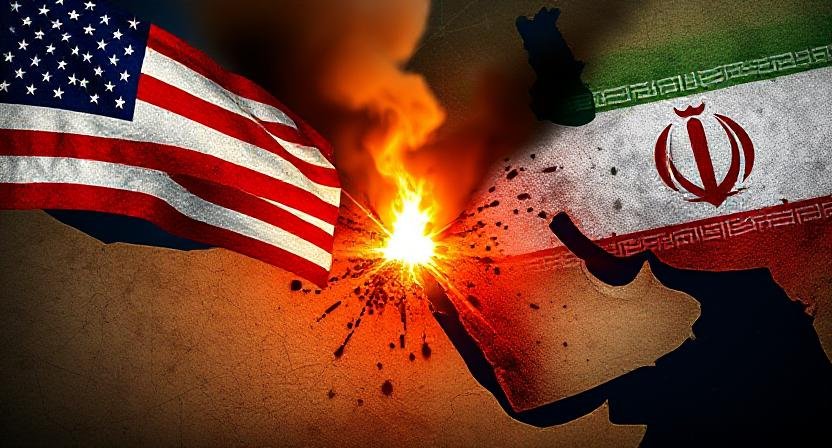
- Energy Jitters: Brent and TTF gas prices surged before stabilizing as the Strait of Hormuz remains open, but fears persist of a major supply disruption if Iran retaliates.
- Europe’s Risk: Analysts warn European natural gas prices could double if LNG flows through the Gulf are halted, exposing the continent’s heavy dependence on Middle Eastern routes.
- Military Uncertainty: Iran’s response remains measured for now, but any escalation—especially via proxies—could spiral into a broader regional conflict.
- Global Market Impact: Stock markets show restraint, gold falls, and Bitcoin rebounds as investors weigh geopolitical risks against economic fundamentals.
When the U.S. struck three core Iranian nuclear sites over the weekend, the world held its breath. In an already fragile Middle East, the targeted airstrikes have redefined regional fault lines, raised energy price alarms, and triggered a cascade of cautious market reactions. Yet, beneath the surface of restrained trading and modest diplomatic commentary, lies a deeper uncertainty: What happens next?
The Pentagon called the operation a “preemptive strike,” citing intelligence that Iran was accelerating its nuclear ambitions after months of backroom escalation with Israel. For Iran, the strike was nothing short of a red line. While Tehran’s response has so far been muted, analysts agree the real danger lies in the weeks ahead—especially if retaliation disrupts the Strait of Hormuz, the vital energy artery for nearly 20% of global oil flows.
Oil & Gas Markets React—But Not in Panic
In the immediate aftermath of the strikes, Brent and WTI crude surged nearly 3% in early Asian trading. But by the European morning, both benchmarks had settled to modest gains—0.6% for Brent to $77.47 and 0.4% for WTI to $74.10 per barrel.
As Iran Prepares Retaliation, Middle East Fears the Seventh War Could Be the Worst Yet
Market experts point to one key reason for the calm: nothing has actually stopped flowing—yet.
“The Strait of Hormuz remains open. Iranian crude production sites were untouched. That’s what’s keeping traders relatively cool-headed,” said Priyanka Sachdeva of Phillip Nova in a morning note.
Gas markets, particularly in Europe, are more jittery. Goldman Sachs warned that any credible Iranian threat to shipping in Hormuz could push the Dutch TTF benchmark to €100/MWh, up from around €42. On Monday morning, the TTF rose 2.1% to €41.80.
Read More: Breaking: Iran Launches Missile Strikes on U.S. Bases in Syria in Retaliation for American Bombing of Nuclear Sites
“For LNG, there is no alternative route. A disruption in Hormuz would be catastrophic,” said Minna Kuusisto of Danske Bank.
Still, many believe Iran will avoid closing the Strait for now. “It would hurt their own economy and alienate China, their biggest customer,” said Ipek Ozkardeskaya of Swissquote Bank. “They’re likely to retaliate in more subtle ways.”
Iran , Israel War: A New Energy Calculus for Europe
Europe is arguably the most exposed to this geopolitical tremor. Having weaned itself off Russian gas post-Ukraine, the continent turned to LNG shipments, many of which pass through Hormuz from Qatar. That vulnerability is now center stage.
Also Read: Oil Stays Volatile as Markets Weigh U.S. Attacks on Iran
Goldman Sachs’ projection of a near-doubling in Dutch gas prices underscores the fragile balance Europe maintains. Already struggling with inflation and a cautious ECB, energy shocks could spell political instability, particularly in Germany, France, and Eastern Europe.
“There’s no way to sugarcoat it,” said an energy diplomat in Brussels. “We’ve traded dependence on Russia for exposure to the Gulf.”
Stock Markets: Jittery, Not Panicked
Global equity markets responded cautiously. The Stoxx Europe 600 dipped 0.3%, with the oil & gas sub-index climbing 0.8%—a clear indicator of sector-specific hedging. In Asia, indexes opened lower but rebounded: Shanghai Composite ended up 0.65%, while the Hang Seng added 0.6%.
In the U.S., futures hovered flat. The Nasdaq and S&P 500 saw narrow fluctuations, with the Dow slipping 0.1%. The DXY dollar index rose 0.3%, reflecting a shift to safe-haven demand.
Meanwhile, Bitcoin, after hitting a six-week low post-strike, rebounded 2.2% to over $101,000. Gold, the traditional geopolitical hedge, ironically fell 0.4% on the back of a stronger dollar—further signaling that markets remain uncertain, but not yet fearful.
Military Posturing: Watching Hormuz
Behind the market movement lies a more ominous concern: military escalation. U.S. forces across the Gulf have been placed on heightened alert. Israeli warplanes remain airborne over northern Iraq and parts of Syria. Tehran’s Revolutionary Guard, while quiet in public, is believed to be preparing contingency operations across multiple regional fronts—Lebanon, Iraq, and the Red Sea.
A Pentagon official, speaking on condition of anonymity, confirmed that CENTCOM has contingency plans if Iran retaliates directly or via proxies. “We’re watching not just the Strait of Hormuz, but Houthi movements in Yemen and Hezbollah in Lebanon,” he said.
A miscalculation could ignite a wider war, something no side wants—but no side is fully avoiding either.
Iran’s Calculus: Retaliate or Restrain?
So far, Tehran’s response has been surprisingly measured. No missiles have been launched. No tankers harassed. This may reflect internal debate in Iran’s ruling elite. As much as the strike was a humiliation, Tehran understands that escalation risks a war it may not be ready to fight.
“Iran wants to preserve its nuclear capability and avoid full-blown conflict,” said Ali Vaez of the International Crisis Group. “But it also needs to show strength. Expect cyber retaliation, proxy attacks, or sabotage—not necessarily a direct strike.”
The Shadow of China and Russia
Complicating the picture is the broader geopolitical chessboard. China, heavily reliant on Gulf energy, is pushing for restraint. Russia, locked in its own war with Ukraine, may use the crisis to pressure the West or expand its regional influence. Moscow’s foreign ministry called the U.S. attack “reckless,” while Beijing urged “maximum restraint by all parties.”
Backchannel diplomacy is intensifying. A Pakistani-Turkish initiative at the UN Security Council is in the works, backed by China and Russia, calling for an unconditional ceasefire and energy infrastructure protections.
Final Word: Calm Before a Possible Storm
For now, the world has avoided a catastrophic spiral. But the calm is deceptive. If Iran retaliates in ways that hit oil or LNG flows, the tremors felt on Monday could become earthquakes. Prices would soar, diplomacy would stall, and a new era of Middle East volatility would begin.
Until then, investors, diplomats, and generals alike are all asking the same question: What will Iran do next?