



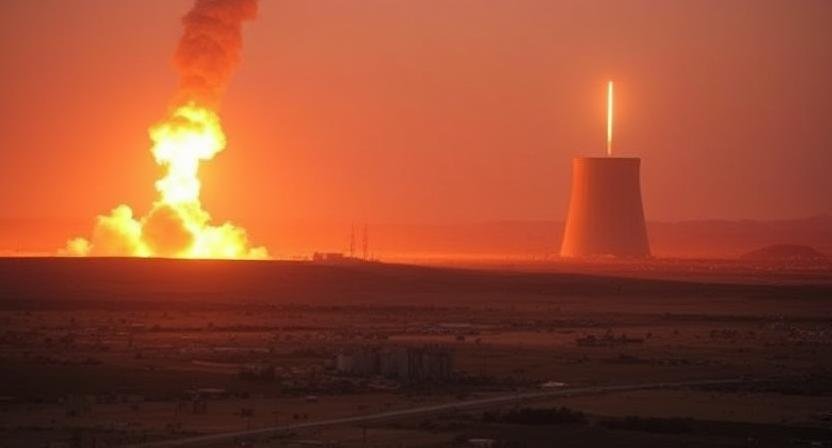
- U.S. strikes dealt severe damage to Iran’s nuclear sites, but uranium stockpile may have been moved before the attack.
- No radiation detected, fueling speculation that Iran had prior knowledge and relocated enriched material.
- IAEA and U.S. officials uncertain about the location of near-weapons-grade uranium, raising global non-proliferation concerns.
- Trump administration claims strategic success, saying Iran’s nuclear weaponization timeline has been pushed back 2–5 years.
The Trump administration’s unprecedented aerial bombardment of Iran’s nuclear infrastructure has sent geopolitical shockwaves around the globe—but as dust settles over the mountains of Fordo and the ruins of Natanz, a far more haunting mystery has emerged: Where is Iran’s highly enriched uranium?
On Friday night, American B-2 bombers and Navy warships unleashed a punishing wave of bunker-busting bombs and Tomahawk missiles on three of Iran’s most critical nuclear sites—Fordo, Natanz, and Isfahan—in what President Donald J. Trump hailed as the “total and irreversible obliteration” of Iran’s nuclear capabilities. But less than 48 hours later, questions are swirling not about the success of the operation—but about what was not destroyed.
Speculations of a Vanishing Stockpile
Sources in Tehran, speaking on condition of anonymity, have confirmed that no radioactive leaks or incidents have been recorded post-strike—a curious revelation given the massive volume of enriched uranium Iran was known to possess. That absence of radiation adds fuel to a growing theory: Iran may have moved its stockpile before the attack, suggesting foreknowledge of U.S. plans.
Trump’s Gamble: After Airstrikes on Iran, the Middle East Teeters on the Edge of Escalation
Satellite images taken in the days before the attack, obtained by Maxar Technologies, show a line of 16 cargo trucks parked near the Fordo uranium enrichment plant, one of the main targets of the U.S. strikes. Experts now believe those trucks may have carried up to 400 kg of 60%-enriched uranium—a quantity close to weapons-grade—to an unknown location.
READ MORE: Shifting Views and Misdirection: How Trump Decided to Strike Iran
Rafael Mariano Grossi, Director General of the International Atomic Energy Agency (IAEA), admitted that the last confirmed location of this material was deep within the Isfahan nuclear facility, roughly a week before Israeli and U.S. forces began their coordinated strikes. “Iran has made no secret that they have protected this material,” Grossi told CNN on Sunday. When pressed via text on whether the stockpile had been moved, he replied tersely: “I do.”
Did Iran Know the Strike Was Coming?
This revelation has triggered a firestorm of speculation among Western intelligence services and diplomats: Was Tehran tipped off? And if so, how?
The Iranian government has already accused Washington of betrayal during nuclear negotiations, claiming the U.S. used diplomacy as a smokescreen for war preparations. That narrative gains traction in light of the uranium’s relocation just days before the attack.
MUST READ: Alarming Signs the World Is Entering a New Nuclear Arms Era
Vice President JD Vance, speaking to ABC’s This Week, was noticeably cautious: “We are going to work in the coming weeks to ensure that we do something with that fuel… but the equipment required to weaponize it has been decimated.” In other words, the uranium may still be intact, but Iran’s ability to turn it into a bomb is—at least temporarily—crippled.
Damage Assessment: Military vs Political Outcomes
At the Pentagon, Defense Secretary Pete Hegseth and Chairman of the Joint Chiefs Gen. Dan Caine offered a more measured assessment, saying the Fordo facility sustained “severe damage and destruction.” Yet Israeli officials, analyzing post-strike reconnaissance data, concluded that while the Fordo mountain fortress was badly hit, it was not completely annihilated.
Natanz, meanwhile, appears to have fared worse. The Israelis reportedly destroyed the aboveground enrichment center and disrupted the power grid, which likely caused a cascade failure in the delicate centrifuge networks below. But Natanz was never the deepest or best-fortified of Iran’s sites—the real prize was Fordo, and what was—or wasn’t—inside it.
Strategic Victory or Tactical Mirage?
Trump’s pronouncement of “mission accomplished” may prove premature. Former CIA official Mick Mulroy said the scale and sophistication of the U.S. strike could delay Iran’s nuclear ambitions by two to five years—a significant, but not permanent, setback.
More troubling is the question of Iran’s long-term nuclear trajectory. History has shown that military strikes only delay, not eliminate, nuclear ambitions. After the U.S.-Israeli cyberattack on Natanz in the late 2000s, Iran came back stronger—installing more centrifuges and enriching at higher levels.
This time, Tehran may also take its program deeper underground, potentially reviving construction of a secret site near Natanz that the IAEA confirms has not yet been opened.
Diplomatic Fallout and Uncertain Oversight
All IAEA inspections have been suspended for the duration of wartime, and it is unclear if inspectors will ever regain access to Fordo’s wreckage or Natanz’s ruined centrifuge halls. That leaves the global community—particularly the UN Security Council and non-proliferation experts—in the dark about the true extent of the damage and the status of Iran’s nuclear program.
Iran’s official denial of seeking nuclear weapons continues. But recent rhetoric from Tehran, coupled with the strategic relocation of fissile material, may signal a shift in posture toward deterrence-building, rather than diplomacy.
And while the world debates the success of America’s bombs, Iran may already be laying the groundwork for the next phase of its nuclear evolution—underground, dispersed, and even harder to reach.