



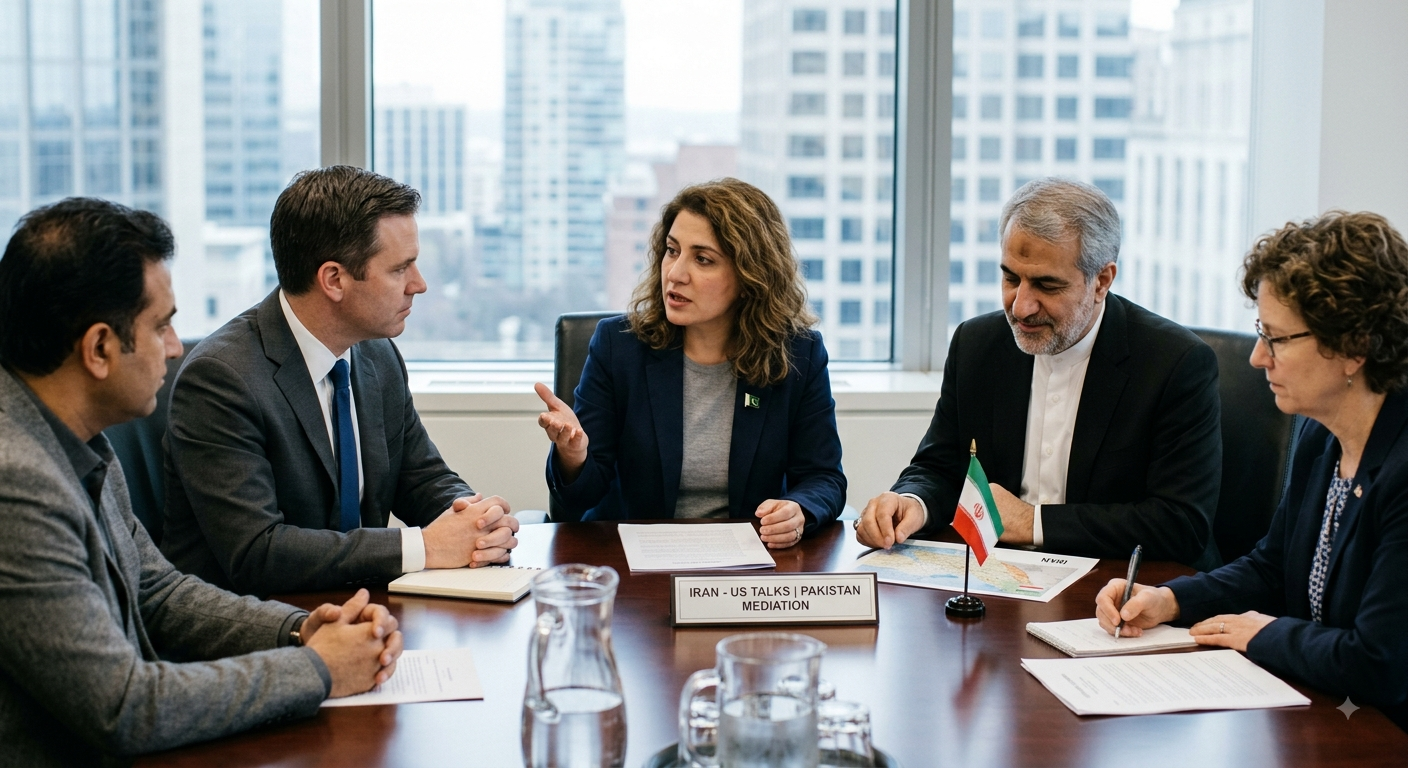
- Iran-US talks are on the verge of restarting following intensive back-channel shuttle diplomacy led by Islamabad and key regional partners.
- Pakistani Defence Minister Khawaja Asif confirmed that constructive signals over recent days indicate both parties are approaching a formal arrangement.
- Interior Minister Mohsin Naqvi met Iranian leadership in Tehran with fresh proposals to address complex terms, including freedom of navigation in the Strait of Hormuz.
- The diplomatic push comes immediately after U.S. President Donald Trump demanded economic compensation from Tehran, adding urgency to mediation efforts
ISLAMABAD — In a historic geopolitical development that could alter the trajectory of the Middle East, Pakistan has achieved a major diplomatic breakthrough by successfully convincing the United States and the Islamic Republic of Iran to resume direct and indirect peace negotiations. Sources familiar with the high-stakes developments revealed that representatives from Washington and Tehran are preparing to negotiate formal terms and conditions aimed at establishing lasting peace in the region very soon.
Islamabad’s renewed diplomatic push gained momentum directly on the heels of hardline rhetoric from Washington, where U.S. President Donald Trump demanded financial compensation and reparations from Tehran over damages linked to ongoing regional hostilities.
Rather than allowing negotiations to collapse under the weight of escalating demands, Pakistani mediators stepped in to bridge the dangerous divide between the two adversarial powers.
A Diplomatic Triumph Amid High Stakes
Confirmation of the positive movement came directly from top government officials in Islamabad. Speaking on the diplomatic momentum, Pakistan’s Defence Minister Khawaja Asif revealed that intense back-channel coordination has yielded tangible results.
“Things are shaping up again in favor of a peace arrangement or a deal,” Defence Minister Asif stated in an interview. “The signals in the last two to three days are that we are close to some sort of an arrangement.”
The diplomatic breakthrough was further reinforced on the ground in Tehran.
Pakistan’s Interior Minister Mohsin Naqvi arrived in the Iranian capital for critical consultations with senior leadership, including Iranian President Masoud Pezeshkian and Foreign Minister Abbas Araghchi. According to regional diplomats, Naqvi delivered fresh procedural proposals backed by Pakistan’s civil-military leadership—including Prime Minister Shehbaz Sharif and Chief of Army Staff Field Marshal Asim Munir—designed to bypass previous diplomatic stalemates.
Bridging the Trump Demands and Iranian Conditions
The urgency of Pakistan’s intervention was underscored by the sharp escalation in political discourse earlier in the week. President Donald Trump had doubled down on Washington’s strategy of maximum economic pressure, characterizing Iran’s economy as severely strained under soaring inflation and currency devaluation. Trump publicly escalated U.S. leverage by asserting control over Iranian assets abroad and demanding compensation for historical and wartime damages.
“We’re going to ask for money for the damage they’ve done over a 50-year period,” Trump stated, adding that any final accord would need to account for U.S. losses.
Simultaneously, Tehran presented a formidable list of prerequisites for restoring stability, particularly regarding the strategic Strait of Hormuz—the narrow waterway through which roughly one-fifth of global petroleum supplies flow.
READ MORE: Trump Warning to Iran: Pakistan and MBS Align After Red Sea Attacks on Saudi Tankers
Mohammad Bagher Zolghadr, Secretary of Iran’s Supreme National Security Council, emphasized that any opening of the maritime corridor required an absolute end to aggressive U.S. military postures, the complete lifting of illegal economic sanctions, the unfreezing of Iranian foreign assets, and reparations for military actions against Iranian territory.
Navigating these contradictory mandates required delicate middle-power diplomacy.
READ MORE: Trump Was Secretly Transferred to Military Jet Amid Threats to Air Force One
Leveraging its unique “geo-positional capital”—a 900-kilometer border with Iran alongside a strategic security alliance with Washington—Pakistan positioned itself as a credible facilitator capable of holding trust on both sides. Combined with parallel diplomatic channels managed by Qatar and Oman, Islamabad’s intervention created a viable political exit for both capitals.
Volatile Energy Markets and Regional Urgency
The geopolitical significance of the impending talks has reverberated across global financial and energy markets. Crude oil prices experienced notable volatility as traders balanced ongoing security risks against the sudden prospect of a diplomatic breakthrough. International benchmark Brent crude traded near $88.62 a barrel, while West Texas Intermediate (WTI) hovered around $83.15. However, prices pared earlier gains as news spread that Islamabad had successfully guided the two sides back toward the negotiating table.
The economic stakes extend far beyond energy prices. Extended blockades and sporadic shipping attacks in the Gulf of Oman and the Red Sea have disrupted supply chains, inflated global maritime insurance premiums, and threatened regional economic stability. For Pakistan, securing peace in its immediate neighborhood is directly tied to national security, energy stability, and the welfare of millions of Pakistani workers residing in the Gulf region.
The Path to Lasting Peace
While previous diplomatic attempts faced setbacks due to deep-seated mistrust, observers note that the current environment reflects a structural recognition in both Washington and Tehran that prolonged military standoff carries unsustainable costs.
For Washington, resolving the conflict mitigates severe economic risks and domestic political pressure ahead of crucial midterm elections. For Tehran, an organized peace process offers a structured pathway toward sanction relief and economic normalization.
Islamabad’s success in convincing both nations to resume talks marks a historic diplomatic achievement for Pakistani foreign policy. By stepping forward at a moment of maximum geopolitical friction, Pakistan has reaffirmed its vital role as a anchor of stability and a trusted mediator in international diplomacy. As technical teams prepare to convene for formal negotiations, the world watches attentively, hopeful that this Islamabad-brokered breakthrough will translate into durable peace and stability across the region.