



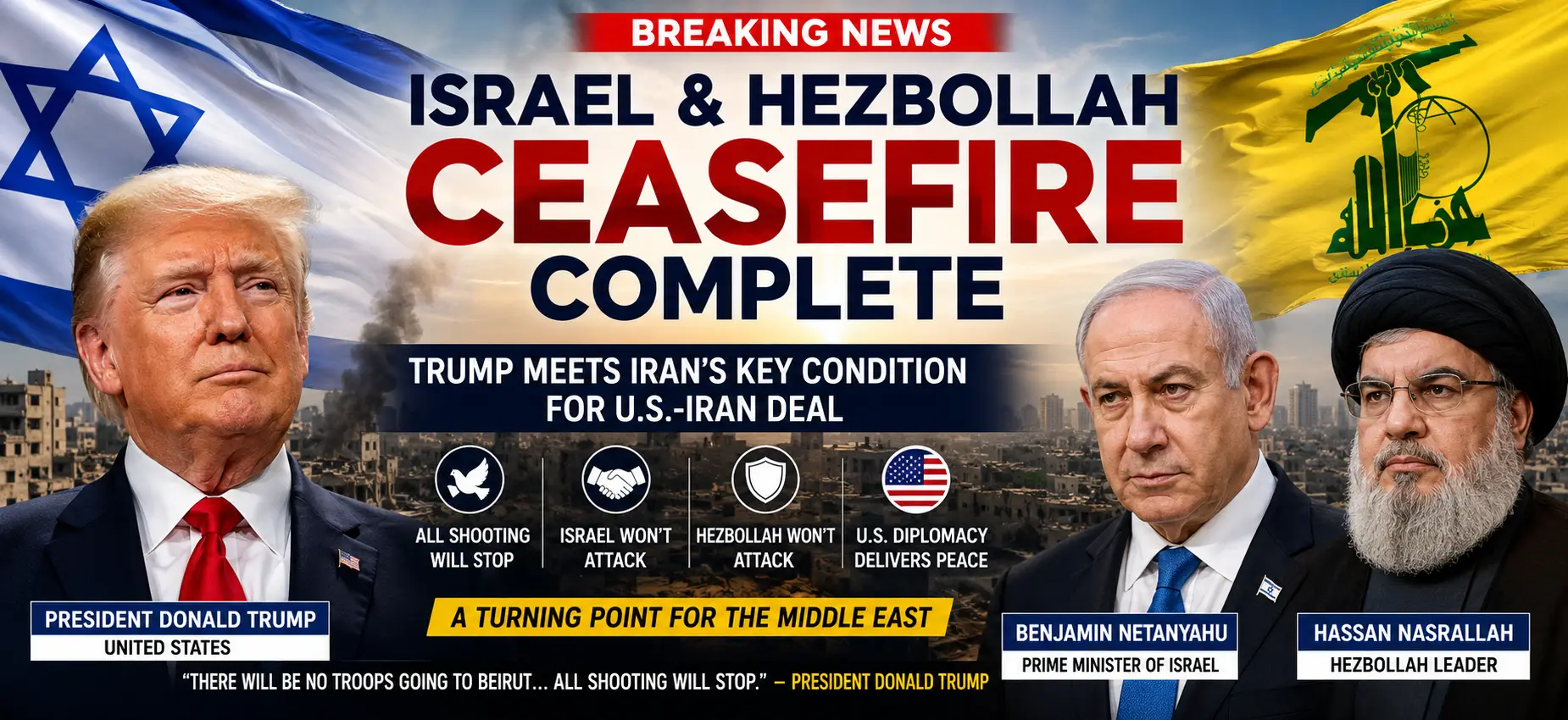
- Israel Hezbollah ceasefire marks a major diplomatic breakthrough led by Trump
- Iran’s key demand fulfilled, accelerating U.S.–Iran peace negotiations
- Israel halts planned strikes on Beirut while Hezbollah agrees to stop attacks
- Regional tensions ease after days of U.S.–Iran military escalation
In a dramatic and unexpected diplomatic breakthrough, U.S. President Donald Trump announced that Israel and Hezbollah have agreed to a complete cessation of hostilities, declaring that “all shooting will stop” in what could mark a निर्णning moment in the wider Middle East conflict. The announcement, delivered via Trump’s Truth Social platform, followed direct communication with Israeli Prime Minister Benjamin Netanyahu and indirect engagement with Hezbollah through what he described as “highly placed representatives.”
The ceasefire, if sustained, represents the most significant de-escalation between Israel and the Iran-backed Lebanese militant group in years—halting a conflict that had threatened to spiral into a full-scale regional war. According to Trump, the agreement includes firm assurances: Israel will refrain from launching further strikes, including any planned operations targeting Beirut, while Hezbollah has committed to an immediate halt to cross-border attacks.
Crucially, this development is not an isolated diplomatic achievement. It is deeply tied to ongoing negotiations between Washington and Tehran, where the Lebanon front had emerged as a central sticking point. Iranian officials had repeatedly insisted that any comprehensive deal with the United States must include a durable ceasefire between Israel and Hezbollah—viewed in Tehran as both a strategic necessity and a symbolic assertion of influence across the “Axis of Resistance.”
Israel Attack on Lebanon Escalates Into Most Ferocious Offensive in Decades
By securing this ceasefire, Trump appears to have met one of Iran’s core conditions for advancing a broader U.S.–Iran agreement. Diplomats familiar with the talks say the Lebanon file had become inseparable from discussions on sanctions relief, nuclear constraints, and maritime security in the Strait of Hormuz. The ceasefire thus removes a major obstacle, potentially accelerating progress toward a wider framework aimed at ending direct and proxy hostilities.
Behind the scenes, U.S. Secretary of State Marco Rubio played a pivotal role in shaping the de-escalation plan. In coordinated calls with Netanyahu and Lebanese President Joseph Aoun, Rubio proposed a phased approach: Hezbollah would halt its attacks first, followed by reciprocal Israeli restraint, particularly in densely populated areas such as Beirut. This sequencing appears to have been accepted by both sides, creating the foundation for Trump’s announcement.
Trump Says Israel and Hezbollah Have Agreed ‘All Shooting Will Stop’
The timing of the ceasefire is especially notable. It comes just days after a dangerous escalation between the United States and Iran, including American airstrikes on Iranian radar and drone installations and retaliatory Iranian missile and drone attacks targeting U.S. positions in Kuwait. The rapid pivot from confrontation to diplomacy underscores the fragile and fluid nature of the current geopolitical landscape.
For Israel, the agreement offers a temporary reprieve from a multi-front security challenge, allowing it to recalibrate its military posture. However, concerns remain within Israeli strategic circles that a ceasefire could provide Hezbollah with time to regroup and rearm. Hardliners in Washington and Tel Aviv have also expressed skepticism about the broader U.S.–Iran talks, warning that premature concessions could embolden Tehran without securing lasting guarantees on its nuclear ambitions.
For Iran, the ceasefire is a diplomatic win that reinforces its regional leverage while easing pressure on its allies. It also signals that Tehran can extract tangible concessions through indirect negotiations, even amid military confrontation.
Trump, for his part, has framed the development as evidence of his deal-making prowess. “Just sit back and relax, it will all work out well in the end,” he wrote, projecting confidence as negotiations with Iran continue “at a rapid pace.”
Whether this ceasefire holds remains uncertain. The history of Israel–Hezbollah relations is marked by cycles of escalation and fragile truces. Yet, for now, the guns have fallen silent—and in that silence lies the possibility of a broader peace, one that hinges not only on battlefield restraint but on the success of a complex and high-stakes diplomatic gamble between Washington and Tehran.