



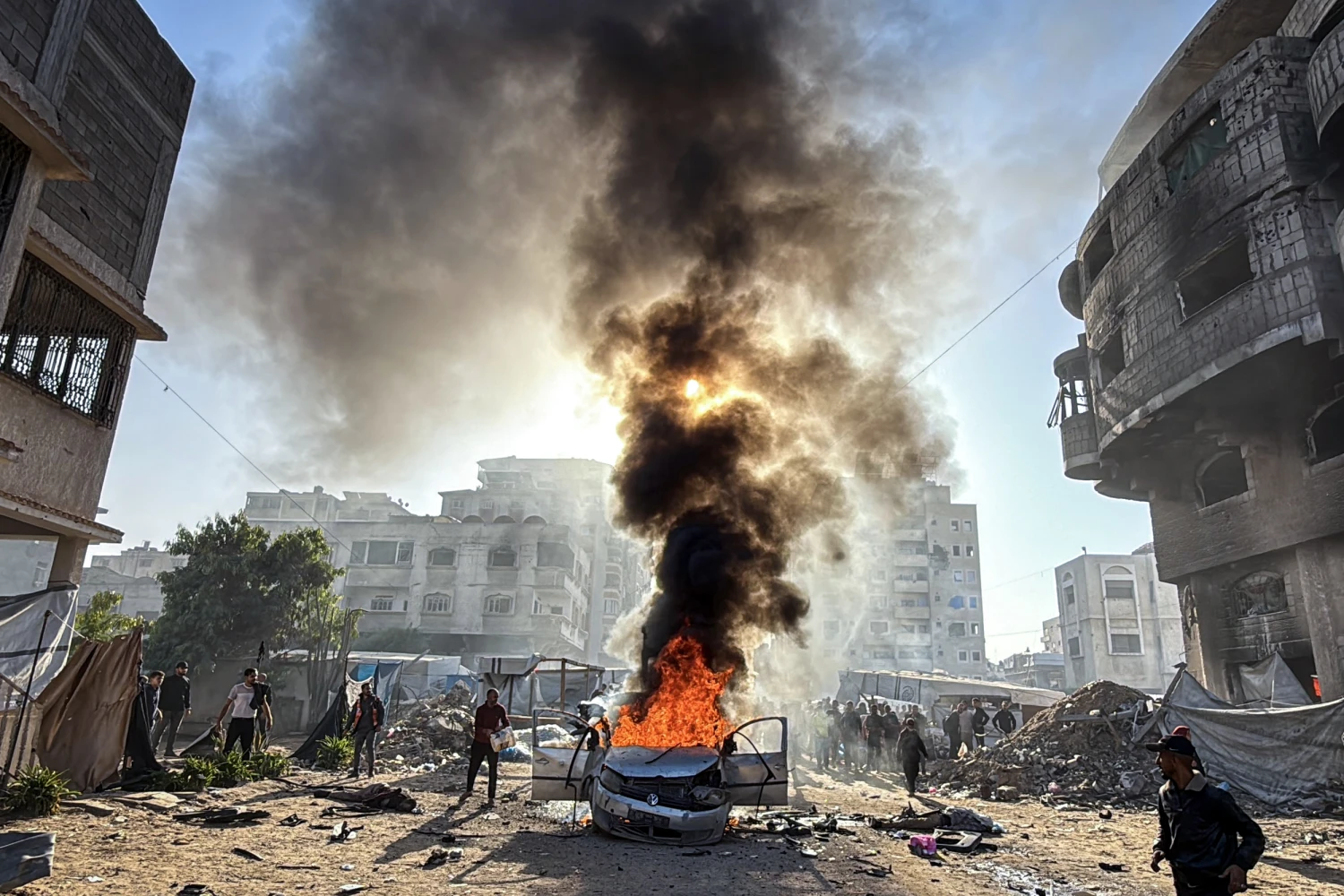
At least nine Palestinians were killed on Sunday in Israeli airstrikes across the northern and southern Gaza Strip, Palestinian civil defence and health officials said, marking one of the deadliest incidents since the ceasefire brokered under U.S. President Donald Trump came into effect. The latest violence has renewed fears that the fragile truce may be steadily unraveling, even as international mediators struggle to preserve calm in the war-ravaged enclave.
According to Palestinian medics, four people were killed when an Israeli strike hit a tent encampment sheltering displaced families in northern Gaza — a grim reminder of the humanitarian crisis that continues to define life in the territory months after major hostilities subsided. In a separate attack in Khan Younis in southern Gaza, health officials reported five additional deaths following another airstrike.
The Israeli military said the strikes were conducted in response to what it described as “blatant violations” of the ceasefire agreement by Hamas fighters near Beit Hanoun. An Israeli military official claimed armed militants emerged from a tunnel east of a demarcation boundary known as the “Yellow Line,” an area agreed upon under the truce to separate Israeli and Hamas-controlled positions.
“Crossing the Yellow Line while armed is an explicit ceasefire violation,” the official said, adding that Israeli forces carried out “precise strikes” consistent with international law. The military also stated that Hamas had committed more than six violations since the October ceasefire began, including the movement of armed fighters near Israeli troops.
Hamas has not publicly confirmed the specific allegations but has repeatedly accused Israel of breaching the ceasefire through continued military operations and territorial expansion. The competing narratives underscore how fragile the agreement remains, with both sides accusing each other of undermining a deal widely viewed as a cornerstone of Trump’s broader effort to halt the Gaza war.
Despite the ceasefire, Gaza’s health ministry says at least 600 Palestinians have been killed by Israeli fire since the agreement took effect. Israel, meanwhile, reports that four of its soldiers have been killed by militants during the same period, highlighting the persistent volatility on the ground.
The humanitarian situation inside Gaza continues to deteriorate. Israeli forces now control more than 53 percent of the territory, according to Palestinian officials, forcing nearly the entire population of over two million people into a narrow coastal strip. Many families remain displaced, living in makeshift tents or damaged buildings with limited access to food, medical care, and clean water.
International aid organizations argue that supplies entering Gaza remain insufficient despite ceasefire provisions promising increased humanitarian access. Israel rejects accusations that it is restricting aid, insisting that deliveries are continuing under security supervision.
Global activism around Gaza also appears to be intensifying. Organizers of the Global Sumud Flotilla — a civilian maritime initiative aimed at delivering aid — announced plans for a renewed mission later this year, potentially involving up to 100 boats and 1,000 medics and volunteers. The previous flotilla was intercepted by Israeli forces last October, resulting in the detention of hundreds of activists, including prominent climate campaigner Greta Thunberg.
Activists say the mission seeks to draw global attention to Gaza’s isolation rather than provoke confrontation. Israeli officials, however, have dismissed such efforts as publicity stunts, maintaining that maritime restrictions are necessary for security reasons.
Beyond Gaza, developments in the occupied West Bank are further complicating prospects for peace. Israel has recently taken steps to facilitate settler land acquisitions and expand administrative authority in areas where Palestinians exercise limited self-rule. Critics argue these measures risk undermining the long-standing international vision of a two-state solution — the creation of an independent Palestinian state alongside Israel — first formalized during the 1993 Oslo peace process.
The expansion of settlements, disputes over borders, the status of Jerusalem, and the unresolved fate of Palestinian refugees remain among the most contentious issues blocking negotiations. Analysts warn that continued territorial changes on the ground could make a viable Palestinian state increasingly difficult to achieve.
Looking ahead, the latest airstrikes may prove more consequential than their immediate toll suggests. Each violation allegation erodes trust between the parties and weakens diplomatic momentum behind the ceasefire. If violence continues at a lower but persistent intensity, the truce risks becoming a temporary pause rather than a pathway to peace.
For international stakeholders, the challenge now is whether the ceasefire can evolve into meaningful political negotiations. Many diplomats argue that without renewed commitment to a two-state framework — backed by enforceable guarantees, economic reconstruction, and credible security arrangements — cycles of escalation will continue to define Israeli-Palestinian relations.
As Gaza mourns yet more lives lost, the question facing the world is no longer only how to maintain a ceasefire, but whether a political horizon still exists that can transform fragile truces into lasting peace.