



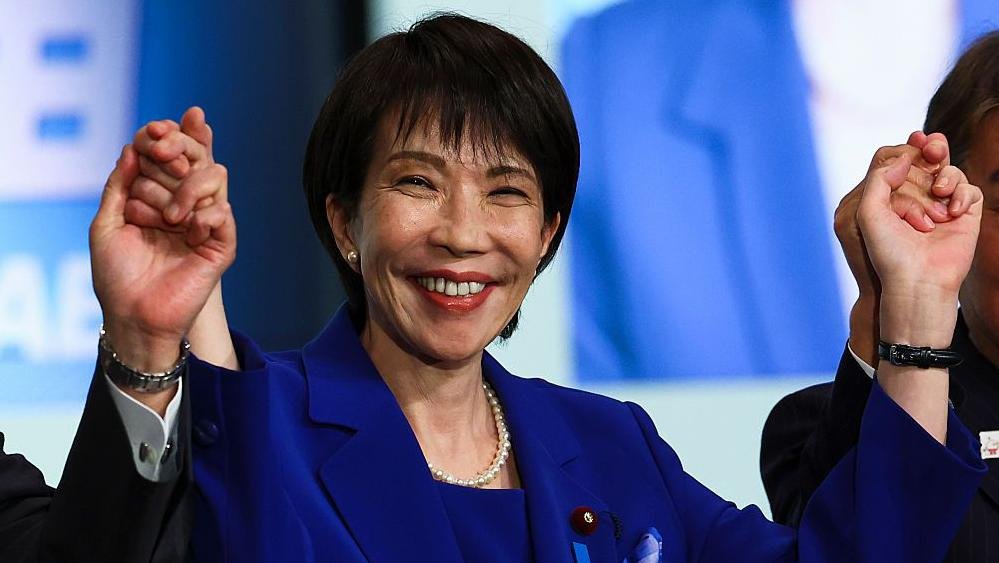
U.S. President Donald Trump’s public endorsement of Japanese Prime Minister Sanae Takaichi and her ruling coalition has grabbed international headlines ahead of Sunday’s election. Trump hailed it as “my complete and total endorsement,” portraying Takaichi’s victory as a win not just for Japan but for a broader geopolitical agenda. Yet while her political prospects appear strong, Japan’s economic challenges suggest that this election is unlikely to mark a turning point for the country’s faltering financial trajectory.
At the center of Japan’s economic malaise is the weakening yen. Once viewed as a benign backdrop to export competitiveness, yen depreciation is increasingly a political liability. Consumers face higher import costs, while exporters reap benefits—creating stark distributional consequences. Ahead of the election, the government and Bank of Japan (BoJ) attempted to manage market optics. Speculation about foreign exchange intervention kept the dollar-yen rate below 160, but with the election concluded, this artificial restraint is unlikely to persist. Analysts warn that Japan’s next phase may see renewed yen weakness, particularly if Takaichi’s coalition consolidates power, potentially undermining consumer confidence and household spending.
The structural problem lies in Japan’s fiscal framework. The BoJ remains a dominant buyer of Japanese government bonds (JGBs), suppressing long-term yields despite Japan’s gross debt exceeding 240 percent of GDP. These artificially low yields prevent markets from accurately pricing fiscal risk, shifting the burden to currency markets where depreciation pressure accumulates. Japan’s 30-year yields, now comparable to Germany’s, fail to reflect the true risk posed by the nation’s debt load. Until the BoJ reduces its bond purchases or the government begins liquidating some financial assets to pay down debt, the yen will continue to face downward pressure—a reality that Takaichi’s administration will confront immediately.
Politically, Takaichi has executed a highly effective campaign strategy. Dissolving parliament just three months into office, she framed this election as a personal mandate. Approval ratings for Takaichi herself have soared into the 70–80 percent range among young voters, creating the so-called “Sanae-mania” phenomenon. The opposition, fragmented and ideologically incoherent, offers little meaningful resistance. Even Trump’s unusual foreign endorsement may have lent an added aura of invincibility, reinforcing perceptions that Takaichi’s LDP-Japan Innovation Party (JIP) coalition could secure a supermajority and advance constitutional amendments, including formal recognition of the Self-Defense Forces and a state-of-emergency clause.
However, political momentum does not automatically translate into economic competence. Takaichi’s economic package—dubbed “Sanae-nomics”—includes temporary tax relief, energy tax suspensions, and a 21-trillion-yen stimulus. Critics argue these measures are largely cosmetic and unlikely to address Japan’s structural problems: an aging population, stagnating productivity, and entrenched fiscal imbalance. Without meaningful reform of public debt management, monetary policy, and labor-market flexibility, the yen’s weakness may intensify, import costs will rise, and consumer sentiment could deteriorate—creating the conditions for social and political friction even as Takaichi consolidates power.
Internationally, Takaichi’s victory carries implications for U.S.-Japan relations and regional security. Hardline stances on China, accelerated defense spending, and potential discussions on nuclear sharing signal a more assertive Tokyo. Yet economic vulnerability could constrain her government’s capacity to fund these initiatives sustainably, raising the specter of a security–economy tradeoff. In essence, Takaichi’s win is a political triumph built on optics, charisma, and security-focused messaging, but Japan’s economic underpinnings remain fragile, and monetary risks loom large.
Ultimately, voters may deliver Takaichi a personal mandate, but the yen and Japan’s fiscal reality will serve as a sobering reminder: political victory cannot mask structural economic stagnation. In the long term, Japan’s greatest challenge may not be constitutional amendments or military modernization—it may be balancing ambition with economic pragmatism in a highly leveraged, currency-sensitive environment.