



- Kathy Kelly World BEYOND War leader shares field-level insights from conflict zones.
- Highlights systemic failures of U.S. militarism and global humanitarian consequences.
- Calls for sustainable peace frameworks rooted in diplomacy, justice, and accountability.
- Emphasizes that her views are personal and not reflective of The Islamabad Telegraph’s official position.
Israel’s expanding military and settler operations have pushed #Gaza into humanitarian freefall while destabilizing the West Bank. The unfolding crisis—now described by activists and global observers as an urgent #FreePalestine moment—has turned Palestinian towns into battlegrounds where violence is carried out with near-total impunity.
Settler militias—some including active-duty Israeli soldiers—roam Palestinian villages, frequently carrying out attacks that human rights monitors say amount to state-enabled vigilantism. Palestinians face mass displacement, property seizures, and life-threatening daily incursions.
Despite repeated UN warnings of unlawful population transfer, major powers remain silent or complicit. The absence of accountability has only intensified a global call for #CeasefireNOW and recognition that #PalestinianLivesMatter.
A Gaza Struggling to Breathe
Israel’s assault on Palestinians has entered a new and unforgiving phase, grinding through Gaza while seeping with equal ferocity into the West Bank. What began as a relentless military campaign in the aftermath of October 7, 2023, has hardened into a system of confinement, dispossession, and displacement—conditions that many describe as the bleak face of engineered catastrophe.
READ MORE: MBS visits USA: How Trump and MBS Are Redrawing the Map of the Middle East — And Securing Gaza’s Future
Today, more than two million people trapped in what is now being called “East Gaza” endure starvation-level shortages, unburied bodies, untreated wounds, and a collapsing medical system. Online, the cry #GazaIsStarving trends relentlessly, fueled by images of children with empty bowls and aid trucks stalled at sealed checkpoints.
Their suffering deepened after the UN Security Council voted on November 17, 2025, to adopt President Trump’s plan for Gaza—a move critics argue effectively shields Israel and Washington from accountability for alleged atrocities and ongoing ethnic cleansing.
A West Bank on the Brink
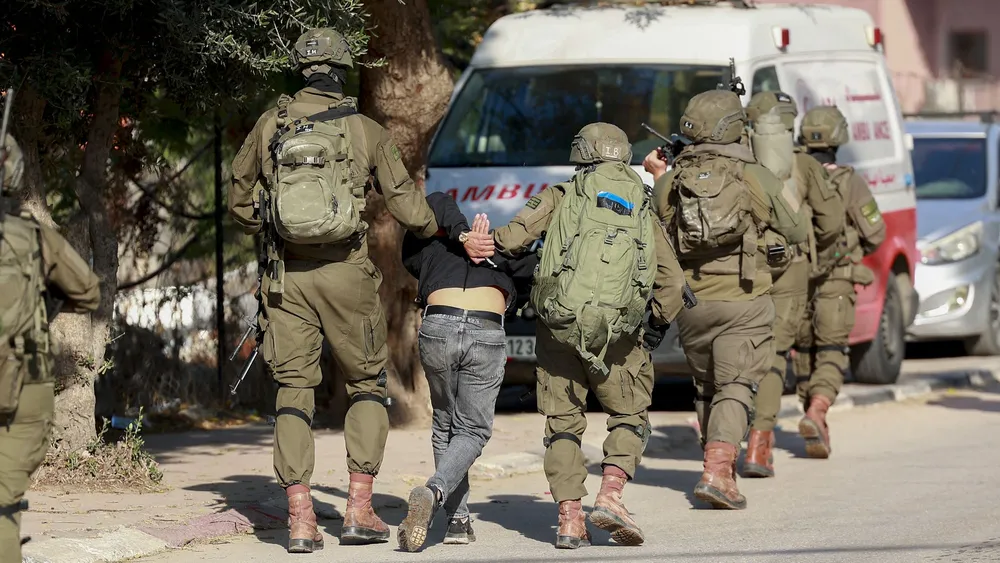
The dread shared by humanitarian groups—that the West Bank may soon undergo full “Gazafication”—is already materializing. In recent weeks, Israeli forces stormed neighborhoods in the Tubas governorate, forcing families from the Al-Far’a refugee camp. The scenes resembled Gaza’s war-ravaged districts: bulldozers plowing through courtyards, armored jeeps circling homes, and families fleeing with only what they could carry.
ALSEO READ: Gaza ceasefire – A pause by name, while atrocities continue unabated
Settler militias escalate the terror. Masked and armed, they drive state-issued vehicles—jeeps, ATVs, and bulldozers—into Palestinian communities. They tear through olive orchards, torch cars, smash doors, steal livestock, and tear down homes. The military often claims its hands are tied, but many settlers are reservists or active-duty soldiers who move seamlessly between uniformed operations and off-duty violence.
This is not random chaos. It is an organized system of pressure—one that corners Palestinians into impossible choices: abandon land, or face unending siege. As activists across the world post #StandWithPalestine, residents of the West Bank face the harsh reality of a state that criminalizes their very presence.
Under Israeli law, a Palestinian child can serve three years in prison for picking up a stone. Meanwhile, Israeli youths with behavioral problems are sent to settler outposts, where extremist mentors teach them that attacks on Palestinians are both permissible and divinely sanctioned.
History Repeating, with Greater Purpose
The settler movement’s objective is clear. In 1999, Ariel Sharon declared that Israel must seize every strategic hilltop across Palestinian territory. Today’s “Hilltop Youth”—born from his vision—operate with near-total impunity. They erect outposts overnight, burn Palestinian fields until they glow red, and aggressively claim new land as “facts on the ground.”
For these groups, such acts are not crimes—they are a mission. “Settler terror is part of the state project,” says an independent journalist embedded with unarmed protection teams. “These youths are frontline soldiers, not fringe actors.”
The UN High Commissioner for Human Rights has condemned these expulsions as violations of international law. The forced transfer of Palestinians—or settlement of Israelis in occupied areas—meets the definition of a war crime under the Geneva Conventions. Yet the condemnations remain toothless.
Frontline Stories of Life Under Siege
International unarmed protection teams working with Palestinians describe a reality the world never sees.
Jonas, one such volunteer, recalls being attacked by a teenage settler during Rosh Hashanah. Stones flew down the hillside as Jonas attempted to de-escalate the situation. One rock struck so hard he required hospitalization. “He could have been a perfect shortstop,” Jonas noted, “if he hadn’t aimed for my head.”
For Palestinians, similar injuries often end with arrest—or worse—instead of medical care.
Villages have created emergency WhatsApp networks to alert protection teams when settlers descend with their herds. In many cases, settlers force their goats into Palestinian courtyards—sometimes even inside homes—before claiming the animals as “strays” and marching them back to the outposts. It is organized theft, repeated weekly, devastating families whose survival depends on livestock.
International volunteers who object risk deportation. Israeli citizens who file complaints face indifference. The Israeli army seldom intervenes—and when it does, settlers sometimes threaten them too. One reportedly boasted, “The weapons in my house aren’t for Palestinians—they’re for the IDF if they come for me.”
A Nuclear-Armed State, an Expanding Conflict
As settlements expand and the occupation deepens, Israeli officials continue reminding the world—sometimes subtly, sometimes bluntly—that Israel is a nuclear-armed state. These gestures, often delivered at key political moments, cast a long nuclear shadow over efforts to restrain the conflict or enforce accountability.
In Gaza, the current calm is the calm of mass graves. Heavy machinery cannot begin to retrieve the dead because Israel blocks access. Airstrikes continue. Snipers fire sporadically. Humanitarian corridors remain controlled and frequently closed.
Jonas, who has worked in conflict zones from Iraq to Afghanistan, describes the cruelty in Gaza and the West Bank as unlike anything he has ever seen.
When Silence Becomes Complicity
Global leaders—from Washington to Brussels—are recalibrating policies, but Palestinians remain alone in the dark. Nations continue trading with Israel; corporations expand investments; diplomats issue statements that evaporate within hours.
Meanwhile, millions across the world continue to rally behind hashtags that echo through every major platform:
#Gaza #FreePalestine #StandWithPalestine #CeasefireNOW #PalestinianLivesMatter #GazaIsStarving
Yet silence still prevails in the halls of power.
If world powers fail to act—or choose to preserve relationships rather than principles—the consequences will not remain contained to the hills of the West Bank or the ruins of Gaza. Violence this systematic, this unrestrained, and this unpunished has a way of reshaping entire regions.
For Palestinians trapped under siege or bombardment, silence is already a daily companion. For the global community, silence may soon become complicity—etched into the record of a conflict that demanded action, not words.