



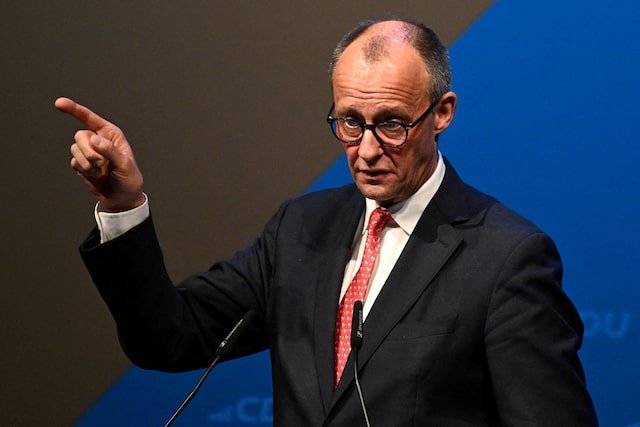
- The Merz China visit brings Germany’s leading CEOs to Beijing to negotiate multi-billion-dollar trade and industrial deals.
- Major MOUs expected across automotive, green technology, AI, and advanced manufacturing sectors.
- Germany emphasizes cooperation and risk-reduction, signaling pragmatic engagement with China over ideological decoupling.
- Chinese President Xi Jinping aims to expand strategic partnership with Europe’s largest economy, reinforcing global trade stability.
In a world reshaped by trade frictions, industrial realignments, and geopolitical uncertainty, German Chancellor Friedrich Merz has embarked on a mission that could redefine Europe’s economic trajectory. The Merz China visit, accompanied by a delegation of Germany’s leading industrial figures, underscores a pragmatic recognition: decoupling from China is not just unfeasible — it would be economically self-defeating.
For Berlin, China has evolved from a vital trading partner into an indispensable strategic partner. In 2025, Beijing surpassed Washington to become Germany’s principal trading partner, cementing a relationship that now spans automotive innovation, advanced manufacturing, chemicals, and high-tech R&D. The Merz China visit is designed to institutionalize this dependence into a durable framework of billion-dollar agreements.
Billion-Dollar Diplomacy in Motion
The delegation traveling with Chancellor Merz represents Germany’s industrial elite, including executives from automotive giants, chemical conglomerates, and high-tech manufacturing firms. Analysts anticipate the signing of multiple memorandums of understanding (MOUs) encompassing electric vehicles, AI-enabled automation, green energy technologies, and next-generation materials.
The Merz China visit is as much a demonstration of German industrial clout as it is a diplomatic exercise. German firms are arriving in Beijing not as passive observers but as architects of a renewed economic architecture, signaling to both domestic and global audiences that Germany intends to anchor its industrial future in China.
Chinese President Xi Jinping is expected to leverage the visit to expand bilateral strategic cooperation, consolidating China’s position as the stabilizing economic partner for Europe amid rising tensions with the United States.
Germany’s Economic Pivot East
The strategic calculus behind the Merz China visit is clear. Germany’s exports to China now exceed $200 billion annually, and Chinese consumers account for a substantial share of global demand for German automobiles, chemicals, and industrial equipment. New German direct investment in China reached approximately €7 billion in 2025, up from €4.5 billion the year before — a testament to corporate confidence in the Chinese market.
Despite growing debates in Europe about “de-risking” and supply-chain diversification, German industry has overwhelmingly chosen engagement over retreat. Surveys by the German Chamber of Commerce in China show that 93 percent of firms plan to maintain or expand operations, with more than half intending to increase investment over the next two years. This consensus was a key message conveyed by the Merz China visit.
Deepening Industrial Integration
Germany and China’s economic relationship has matured over the past two decades from a simple buyer-seller dynamic to deep industrial integration. German engineering expertise has fueled China’s industrial modernization, while Chinese demand has sustained Germany’s export-driven prosperity.
Companies such as BASF and Merck have established R&D and production clusters in China, transforming the country into a global innovation hub. The Merz China visit, including stops in Hangzhou’s robotics and AI ecosystem, underscores Berlin’s recognition that China is no longer solely a manufacturing hub but a global center of technological advancement.
Pragmatism Over Ideology
Perhaps the most consequential insight of the Merz China visit is geopolitical: Germany is consciously pivoting toward China despite ongoing U.S. pressure to reduce reliance on Beijing. Berlin’s strategy emphasizes “risk reduction rather than decoupling,” maintaining economic engagement while safeguarding critical strategic sectors.
Merz outlined five guiding principles for engagement: European unity, balanced partnership, fair competition, risk management, and global cooperation. These principles reflect Germany’s commitment to pragmatic, rules-based collaboration over ideological confrontation — a stance that reinforces both economic and diplomatic credibility.
China’s Global Leadership Opportunity
From Beijing’s perspective, the Merz China visit is a chance to solidify its role as a driver of globalization. Deepening cooperation with Germany stabilizes Europe’s industrial landscape and counters transatlantic pressures, reinforcing China’s position as a central actor in shaping global trade, climate technology, and advanced manufacturing.
Merz’s invocation of a Chinese proverb — emphasizing cooperation over competition — set the tone for discussions that prioritize mutual growth and industrial symbiosis over unilateral advantage.
A Defining Partnership for the 21st Century
The Merz China visit is more than a diplomatic gesture. It signals Germany’s intent to embed China at the core of its economic future, with billion-dollar agreements expected to solidify industrial cooperation and global supply chain integration.
As Europe navigates a multipolar economic landscape, the visit underscores a broader truth: prosperity, innovation, and strategic stability are increasingly forged through engagement, not isolation. For policymakers, investors, and industrial leaders, the Merz China visit offers a clear signal — Germany’s economic center of gravity is shifting decisively eastward.