


- Middle East war expands into Yemen, opening a dangerous new front in regional conflict
- Pakistan leads urgent diplomacy to revive U.S.-Iran talks with China’s backing
- Global economy at risk as oil routes face disruption and escalation intensifies
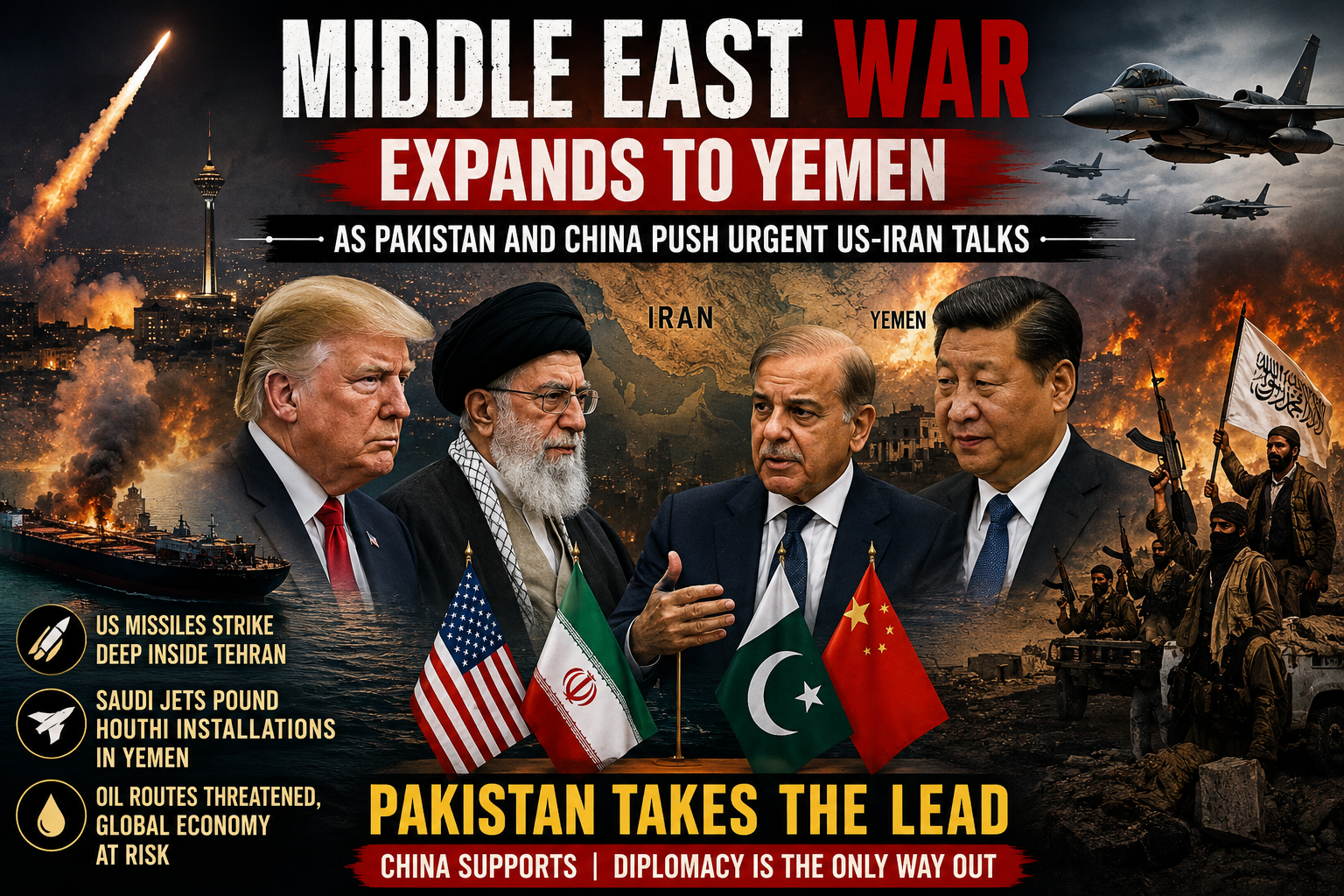
ISLAMABAD — The Middle East war has entered a dangerous new phase, expanding into Yemen as the intensifying U.S.-Iran conflict pushes the region—and the global economy—to the brink of collapse. On the 15th consecutive day of sustained strikes, U.S. missiles pounded targets deep inside Tehran while Saudi jets launched coordinated attacks on Houthi installations, signaling a widening Middle East war with no immediate end in sight.
The expansion of the Middle East war into Yemen marks a critical escalation, transforming a bilateral confrontation into a full-scale regional crisis. With global oil routes under threat and tensions spiraling, Pakistan—backed by China—is making a renewed push to bring Washington and Tehran back to the negotiating table.
Middle East War Expands Into Yemen
The Middle East war is no longer confined to U.S.-Iran hostilities. Yemen has become a key battleground, with Iran-backed Houthi forces escalating attacks on Saudi Arabia, a close ally of Pakistan.
Saudi airstrikes have intensified in response, targeting Houthi military infrastructure after attacks on oil tankers and maritime routes. The Houthis have declared a naval blockade, threatening global shipping lanes and deepening the Middle East war crisis.
Kuwait Bahrain Iran Strikes: Middle East on Brink as War Explodes Across Gulf
This escalation risks creating a second major chokepoint alongside the Strait of Hormuz, amplifying fears of a global energy shock.
Pakistan Leads Diplomatic Push Amid Middle East War
Amid the expanding Middle East war, Pakistan is actively working to revive stalled U.S.-Iran negotiations. According to multiple sources, exploratory discussions were held during the recent visit of Iran’s Interior Minister Eskandar Momeni to Islamabad—his second trip in 10 days.
Momeni met senior Pakistani leadership, including Army Chief General Asim Munir, in high-level talks focused on de-escalation. These efforts reflect Islamabad’s growing urgency to contain the Middle East war before it spirals further.
READ NEXT: Iran Missile Attack on Muwaffaq Salti Air Base Exposes US Defense Failure and Signals Major War Escalation
However, officials caution that significant obstacles remain, with both Washington and Tehran deeply entrenched.
China Backs Pakistan’s Middle East War Mediation
China has stepped in as a key supporter of Pakistan’s diplomatic initiative. Alarmed by the economic fallout of the Middle East war, Beijing is increasingly concerned about disruptions to critical trade and energy routes.
During a recent visit to China, Pakistan’s Foreign Minister Ishaq Dar discussed the crisis with Chinese officials. Beijing has publicly endorsed Pakistan’s mediation role, signaling a coordinated effort to stabilize the Middle East war situation.
READ MORE: Pakistan, Iran explore path towards new talks with US in a China-initiated push, sources say
China’s dependence on Gulf energy supplies and trade corridors makes de-escalation a strategic priority.
Strait of Hormuz Crisis and Global Economic Impact
The Middle East war has severely disrupted the Strait of Hormuz, through which nearly 20% of global oil supplies pass. Combined with instability in the Red Sea, the crisis is pushing global markets toward volatility.
Energy experts warn that prolonged disruption could trigger a major economic downturn, with oil prices surging and supply chains under strain. The widening Middle East war is now seen as a threat not just to regional stability but to the global economy.
Talks Conditional on De-escalation
Pakistan has conveyed a clear message: a halt in attacks is essential for any negotiations to resume. A Pakistani official emphasized that stopping strikes on Saudi Arabia and Gulf states is a prerequisite to restarting dialogue amid the Middle East war.
This position reflects Islamabad’s delicate balancing act—maintaining ties with Saudi Arabia while engaging Iran diplomatically.
A Region on the Brink
The Middle East war continues to intensify, with Yemen now firmly part of the battlefield. As missiles strike Tehran and air raids expand across the region, the risk of a broader conflict grows by the day.
Pakistan, supported by China, is attempting to open a narrow diplomatic window. But with tensions at their peak, the success of these efforts remains uncertain.
What is clear, however, is that the Middle East war is no longer a contained conflict—it is a regional inferno with global consequences.