



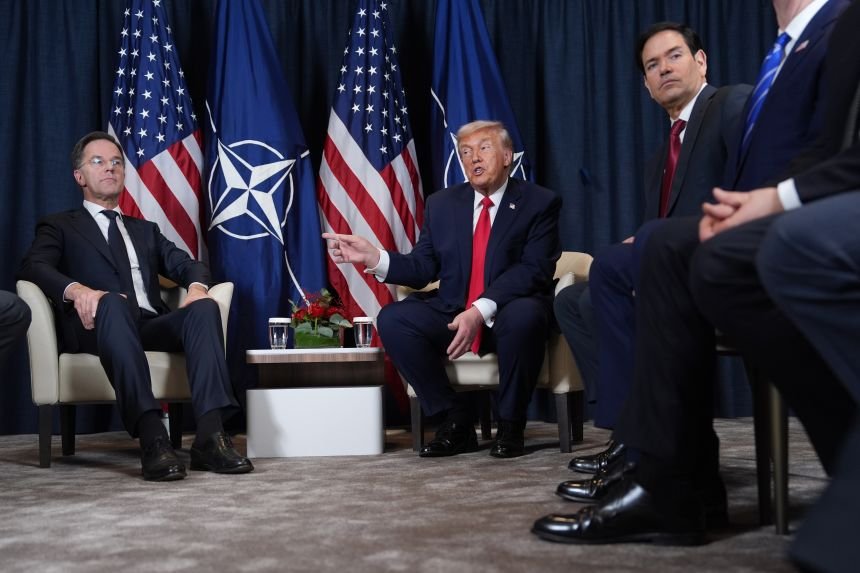
- NATO NATO-U.S. Alliance In jeopardy: Negotiations centered on a new “5% Pledge” agreed upon in The Hague, with 3.5% allocated to core defense and 1.5% to security-related innovation like AI and drones.
- Trump’s recent pursuit of Greenland and threats of tariffs against allies—including the U.K.—were leveraged to extract “material commitments” to American arms manufacturers.
- European allies, while “dumbfounded” by the President’s rhetoric, have begun to view the U.S. as a “strategic risk,” prompting a rush for independent command-and-control capabilities.
- The “Golden Dome” missile defense system has emerged as a key bargaining chip, with Trump suggesting it as a central pillar of the Arctic security deal involving Greenland.
The current round of NATO Negotiations is no longer just about meeting the 2% floor; it is a battle over the soul and solvency of the alliance. By 2026, the geopolitical landscape has shifted from “burden sharing” to “strategic survival.”
The 5% spending target, once dismissed as unfeasible, has become the centerpiece of the 2026-2035 roadmap. This shift represents a double-edged sword: it strengthens Europe’s ability to defend itself, but it does so under the shadow of a U.S. administration that treats mutual defense as a transactional service rather than a treaty obligation.
The Greenland Leverage
The Greenland saga has introduced a bizarre new variable into traditional defense talks. By threatening 25% tariffs on allies like the U.K., Denmark, and Germany unless they “cooperate” on Arctic security, Trump has successfully linked trade policy with military posture.
Although the tariffs were recently paused following a meeting with Rutte, the damage to trust is widespread. European diplomats now negotiate with the awareness that the U.S. may prioritize territorial acquisition or commercial “material commitments” over the collective security of Article 5.
The Rise of the “Defense Dividend”
Secretary General Mark Rutte’s defense of the “Trump effect” highlights a pragmatic, if uncomfortable, reality for the alliance.
He argued in Davos that without the President’s blunt pressure, major economies like Spain, Italy, and France would never have moved toward the new 5% benchmark. This “defense dividend” is expected to re-energize European industrial bases, but at a massive fiscal cost. Nations are now being forced to choose between social safety nets and the rapid expansion of fighter jet fleets and “Golden Dome” missile interceptors.
A Fragmented Future
As the 2026 negotiations progress toward the July Summit in Ankara, the “irreparable cracks” are manifesting in how capabilities are built.
Europe is increasingly investing in “enablers” that were previously the sole domain of the U.S.—such as space-based surveillance and high-end command networks. The message from London and Brussels is clear: they will pay the 5%, but they will do so to ensure they are never again “hostage” to the volatility of a single partner.
The Irreparable Fracture?
The recent verbal broadside from Washington has led many veteran diplomats to a sobering conclusion: the “marriage” between the U.S. and NATO is no longer just strained—it is in jeopardy.
Analysts suggest that by publicly questioning the bravery of allied troops and doubting the very commitment of Article 5, President Trump has effectively introduced the first major, irreparable crack in the post-WWII security architecture. While previous disputes were often over “burden-sharing” (dollars and cents), this latest rift is over “blood-sharing,” a far more sacred and harder-to-mend bond.
A New Strategic Reality
For decades, the deterrent power of NATO rested on a psychological certainty: that the United States would always be the “defender of last resort.” Trump’s remarks in Davos have dismantled that certainty. By suggesting the U.S. has “never needed” its allies and that they “stayed back” while Americans fought, the President hasn’t just insulted the past; he has signaled a future of strategic abandonment.
This “America First” posture, coupled with the pressure to acquire Greenland and the threat of “economic coercion” through tariffs, has forced European capitals to view the U.S. not as a protective partner, but as a volatile neighbor whose protection comes with an unacceptable price tag.
The “European Pillar” Emerges
The shift is already visible. In the halls of Brussels and London, the talk has pivoted from “how to please Washington” to “how to survive without it.” The emergence of a dedicated European defense pillar—one that can operate autonomously when the U.S. chooses to “stay back” from European interests—is no longer a theoretical exercise.
Analysts point to the 5% spending pledge as the “divorce settlement” of the transatlantic alliance; Europe is paying for its own security precisely because it can no longer trust the U.S. to honor its treaty obligations. The marriage may still exist on paper, but the partners are now living in separate rooms, building separate lives, and preparing for a world where the “Special Relationship” is a relic of the past.