



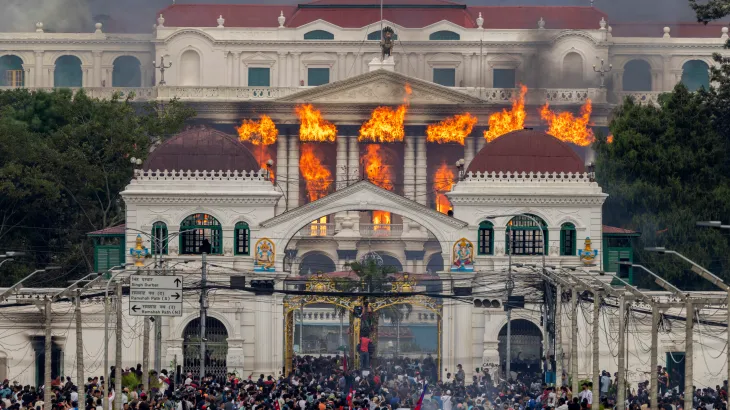
- 30 dead, 1,000+ injured: Nepal reels from its deadliest protests in decades.
- Ruling elite humiliated: Reports suggest senior parliamentarians were beaten and thrown into canals.
- Army steps in: Soldiers patrol Kathmandu, mediating talks for an interim leader.
- Geopolitical stakes: India, China, and the U.S. fear Nepal’s unrest could shift Himalayan power balance.
The smoke hung low over Kathmandu, heavy and acrid, as if the city itself were exhaling its fury. The majestic temples of Durbar Square stood untouched, their centuries-old bricks defiant against time, but around them the symbols of modern power—parliament buildings, ministerial homes, luxury hotels—smoldered in ruin. Soldiers in olive fatigues paced silently through the empty avenues, rifles slung across their shoulders, eyes scanning for the next spark.
Somewhere beyond those cordons, the once-mighty lawmakers of Nepal’s ruling class were in hiding. Those who failed to flee in time paid a different price. Witnesses told stories—half rumor, half horror—of parliamentarians dragged from their convoys, beaten with sticks, and paraded through jeering crowds before being hurled into the city’s canals. For decades they had sat above the people, dictating laws and reaping privilege. Now they were flotsam in a river of rage.
It was the capital’s worst unrest in a generation. And it began with a single decision: a ban on social media.
The Spark In Nepal
On Monday morning, the government abruptly announced restrictions on TikTok, Instagram, and Facebook, claiming they were fueling misinformation and unrest. For a nation whose youth live online—where memes replace manifestos and political debate thrives in 30-second videos—it was not just an inconvenience. It was a silencing.
Within hours, students poured into the streets. What began as chants and slogans escalated by nightfall into skirmishes with riot police. Officers fired tear gas, rubber bullets, and even live rounds into the air, but the crowds did not disperse. Instead, they grew larger—tens of thousands of young people, angry not only at the ban but at years of corruption, unemployment, and broken promises.
“They wanted to take away our voice,” said Sujit Kumar Jha, a 34-year-old protester whose forehead still bore the scar of a rubber bullet. “Instead, they gave us something to fight for.”
The U.S. House of Representatives Passes $892.6 Billion Defense Bill Amid Deep Partisan Divisions
By Wednesday night, the protests had turned into an inferno. Government buildings were set ablaze. Hotels linked to political patrons, including the prestigious Hilton Kathmandu, went up in flames. In Pokhara, Nepal’s beloved tourist hub, the fire consumed not just businesses but the fragile sense of order.
The death toll rose rapidly. By Thursday, the Health Ministry confirmed at least 30 dead and over 1,000 injured—a number that seemed destined to climb.
The Collapse of Power In Nepal
Prime Minister K.P. Sharma Oli, once seen as a shrewd survivor of Nepal’s messy political scene, resigned under the weight of chaos. His resignation came not with dignity from the parliamentary floor but as an act of desperation, delivered in a letter while protesters stormed through Kathmandu’s avenues.
Yet his fall did not bring calm. If anything, it unleashed the people’s fury on the rest of the ruling elite. Cabinet ministers vanished from public view. The ruling family, long accused of pulling strings behind the scenes, fled their opulent residence. The once-grand parliament, built as a monument to democracy after the monarchy’s abolition in 2008, stood desecrated—graffiti scrawled across its walls, windows shattered, chambers looted.
READ MORE: France in Flames: Is Macron’s Presidency in Shambles?
The most shocking reports, however, were of lawmakers captured and tortured by mobs. Eyewitnesses described one former minister, stripped of his suit jacket and shoved headfirst into a canal after hours of humiliation. Another, an elderly parliamentarian who had served multiple terms, was dragged through the dirt as young men shouted: “This is for the jobs you stole from us!”
For Nepal’s ruling class, the humiliation was total. For the protesters, it was catharsis.
The Army’s Gamble
Into this vacuum stepped the Nepali Army—not with the iron fist of martial law, but with the tentative hand of mediation.
On Thursday morning, army spokesperson Raja Ram Basnet confirmed talks had begun with protest leaders to appoint an interim head of government. “Initial talks are on and would continue today,” he told reporters. “We are trying to normalize the situation slowly.”
ALSO READ: Nepal’s young protesters, army in talks to decide interim leader
The most prominent candidate to emerge is Sushila Karki, the country’s first female Chief Justice, appointed in 2016 and remembered for her fierce independence. At 73, she is no social media star, but her name carries weight with protesters who see her as untarnished by corruption.
“We see Sushila Karki for who she truly is—honest, fearless, unshaken,” said Jha, the protester. “She’s the right choice. When truth speaks, it sounds like Karki.”
Karki has reportedly consented to serve as interim leader, but legal experts are scrambling to find a constitutional path for her appointment. Meanwhile, divisions within the protest movement remain: some want Karki, others demand a younger face from their own generation.
The army, wary of being seen as seizing power, walks a tightrope. Too much delay risks further chaos. Too much force risks another bloodbath.
Kathmandu Between Giants
What makes Nepal’s crisis even more combustible is its geography. Sandwiched between India and China, the Himalayan republic has long been a pawn in a larger geopolitical contest.
In New Delhi, officials watched the burning streets of Kathmandu with growing alarm. India has always considered Nepal part of its strategic backyard. Any prolonged instability could send refugees spilling across the porous border into Bihar and Uttar Pradesh, inflaming domestic politics. Worse still, if the vacuum pulls Nepal deeper into Beijing’s orbit, India’s northern frontier would feel suddenly vulnerable.
China, meanwhile, has invested billions in Nepal under its Belt and Road Initiative, building highways, hydropower dams, and telecommunications links. Beijing fears that a government born of youth-led protests could tilt back toward India—or worse, toward Western influence. Chinese state media has already warned against “foreign interference” in Nepal’s internal affairs.
The United States, too, has a stake. Washington has quietly expanded its presence in Nepal in recent years, funding development projects and strengthening military-to-military ties as part of its strategy to counterbalance China in South Asia. For American diplomats, the uprising represents both risk and opportunity: a chance to align with Nepal’s restless youth, but also a danger of Nepal collapsing into prolonged instability that China could exploit.
Thus, while the protesters chant against corruption in Kathmandu’s squares, the tremors of their uprising ripple far beyond the valley, shaking the calculus of Beijing, New Delhi, and Washington alike.
A City Under Lockdown
For ordinary residents, life has been reduced to survival. Schools, shops, and markets remain shut under prohibitory orders, with only essential services functioning. International flights continue, but the airport is under heavy guard.
The city that once bustled with tourists, pilgrims, and traders is eerily silent—its streets patrolled by soldiers, its nights broken by the distant crackle of fire and the chants of protesters that refuse to die down.
Yet beneath the fear lies a strange sense of possibility. To many Nepalis, this feels like a turning point—an uprising not only against a government but against decades of disappointment since the monarchy fell.
“Democracy was supposed to bring prosperity,” said Anisha Thapa, a 22-year-old student. “But all it brought us was corruption and the same old faces. Now we are saying: enough.”
What Comes After the Fire
The resignation of Oli marks only the first act in what could be a long and turbulent transition. If Karki is appointed, she will inherit a fractured state, a wounded economy, and a restless youth who will accept nothing less than systemic reform.
The risks are immense. Without a clear plan, Nepal could slide into prolonged instability, even civil conflict. Already, whispers circulate of opportunistic factions—old royalists, disaffected Maoists, foreign actors—seeking to exploit the chaos.
But for now, the streets belong to the young. And their message is unmistakable: the old order is finished.
As soldiers patrol the ashes of Kathmandu, the image that lingers is not the flames but the sight of lawmakers, once untouchable, cast into the canals by those they ruled. It is an image that will define this moment in Nepal’s history—a generation drowning the sins of its leaders, demanding to rise in their place.
And over the ruins of the capital, a question hangs like the smoke: will Nepal’s future be forged from these flames—or consumed by them, as India, China, and the U.S. wait anxiously at the edge of the fire?