



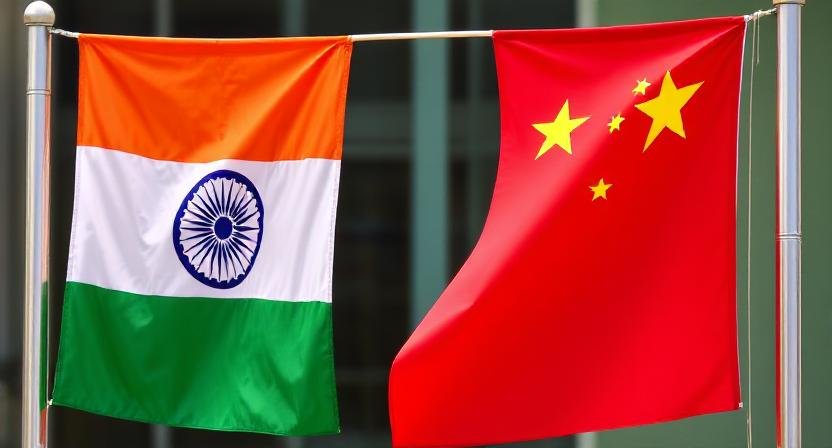
- India and China move toward a pragmatic reset with high-level talks, resumed flights, and eased trade curbs.
- U.S. tariff pressure pushes New Delhi to diversify partnerships, opening doors to Beijing.
- Challenges remain over border disputes and India’s deep defence ties with Washington.
- Pakistan may gain from regional stability, CPEC spillovers, and potential triangular diplomacy.
A thaw that once seemed improbable is now unfolding across South Asia. In quick succession this August, New Delhi and Beijing signaled a pragmatic reset: India’s prime minister is due in China for the Shanghai Cooperation Organisation (SCO) summit and bilateral talks with President Xi Jinping; direct passenger air services that were suspended in 2020 are being readied for resumption; and Beijing has eased restrictions on urea shipments to India. These moves come against the backdrop of a fractious relationship with the United States and shifting regional alignments — and they carry implications well beyond bilateral courtesies.
Narendra Modi’s planned trip to China, his first visit in several years, marks both symbolism and strategy. Modi is expected to attend the SCO summit in late August and hold a bilateral meeting with Xi on the sidelines, a sign that both capitals want managed engagement even as disagreements remain unresolved. Indian and international press describe the visit as the highest-profile diplomatic face-to-face since the Galwan standoffs, and make clear that the SCO provides a convenient multilateral cover to reopen high-level channels.
One of the most tangible early indicators of normalization is the reported decision to restart direct commercial flights between India and China that have been largely suspended since 2020. Indian carriers have been asked to prepare for services to Chinese cities, with announcements expected around the SCO meeting. Restoring air connectivity is more than a convenience: it reboots business, tourism, people-to-people links and the logistical trust necessary for more complex economic cooperation.
Beyond diplomacy, travel, and trade signals the practical mechanics of rapprochement. Multiple commodity and business outlets report that China has eased curbs on urea exports to India, a sensitive commodity for Indian agriculture dependent on timely fertilizer imports. China’s loosening of controls could relieve short-term supply pressures and price volatility in India’s farm sector, and it demonstrates how Beijing can use export policy as a tool of influence and rapprochement.
Possible causes
-
American tariff storm for India
A driving and accelerating factor behind New Delhi’s pivot is trade pressure from Washington. In 2025, steep U.S. tariffs, highest in the region, and threats of broader trade penalties created a sudden economic headwind for Indian exporters and sharpened political criticism at home over reliance on Western markets. The tariffs forced New Delhi to re-evaluate partnership calculus: if the United States proves an unreliable market or security partner in commercial terms, Washington’s leverage over Indian choices declines and New Delhi has an incentive to rebalance toward Beijing and other partners. -
Geopolitical reality as neighboring states
India and China share one of the world’s longest land borders and interlocking interests in South and Central Asia. Prolonged confrontation, especially military deployments and logistics build-ups along the Himalayan frontier, is costly for both. A pragmatic easing helps reduce the risk of unintended escalation, frees defence resources for other priorities, and recognizes that management (if not immediate resolution) of disputes is in both parties’ interest. This dynamic has driven episodic confidence-building in the past. -
From Summit to Synergy: the role of BRICS
The BRICS framework, expanded and reinvigorated in recent years, provides institutional cover for India and China to pursue cooperation even when bilateral frictions persist. The bloc’s 2025 meetings stressed economic linkages, alternative development financing and cooperative governance reforms, creating parallel channels for Delhi and Beijing to coordinate on trade, investment and multilateral norms. BRICS thus functions as both a diplomatic safety valve and a platform for shared agendas. -
Homegrown heat: Internal domestic pressure on Modi
Domestically, Modi faces a delicate balancing act: nationalist and business constituencies prize close ties with the United States for technology, defence and markets, yet recent tariff actions and political rhetoric have provoked criticism that Delhi is being coerced into concessions. These pressures push Modi to diversify partnerships, including a closer working relationship with China, to avoid economic pain and preserve an independent strategic posture.
Challenges
-
India’s renewed alliance with the USA
Even as New Delhi pursues rapprochement with Beijing, its deepening defence and technology ties with Washington complicate trust-building. India’s partnerships within the Quad and defence co-operation with the U.S. are structural and long-term; recalibrating them overnight is neither feasible nor necessarily desirable for India. This creates a triangular complexity where each move toward one partner can be read as a provocation by the other. -
From regional hegemon to partner: A tough decision for India
India’s recent foreign policy has been animated in part by ambitions to be the regional balancer — economically and strategically. Any accommodation with China will be closely watched in capitals across South Asia: will New Delhi temper its own assertiveness, or will it try to convert warmer ties into broader influence? Managing the optics and substance of any hedging strategy will be politically fraught. -
Long-term solution of border issues between India and China
Practical steps i.e. flights, trade and summit diplomacy can reduce tensions but do not resolve core territorial disputes that produced deadly clashes. A durable settlement would require sustained, high-trust negotiations and concessions that neither side appears willing to make quickly. Absent such a settlement, temporary thaws risk rupture if a serious incident re-ignites mutual suspicions.
Implications for Pakistan
-
Regional stability
A steadier India–China relationship could lower the immediate risk of a military escalation on the subcontinent’s northern flank, creating breathing room for South Asian diplomacy. Reduced India-China tensions would likely decrease the chance of sudden large-scale confrontation that could destabilize Pakistan’s security environment. -
Economic opportunities via CPEC
If China reprioritizes regional economic integration, Pakistan could see indirect benefits for the China–Pakistan Economic Corridor (CPEC). Expanded connectivity plans or multilateral infrastructure linkages, even if primarily Beijing-New Delhi projects, may produce spillovers in logistics, trade flows and investment that Pakistan can leverage, provided it remains an active partner in regional commerce. -
Chance for triangular diplomacy
A revived India–China dialogue presents Pakistan with both a challenge and an opening: Islamabad may need to recalibrate its diplomatic approach, seeking to position itself as a constructive interlocutor rather than a passive bystander. Skillful triangular diplomacy could extract security guarantees or economic commitments, but misreading the new dynamics risks strategic marginalization.
Summing up, the recent string of signals, a high-profile visit, resumption of flights, and relaxed trade controls on sensitive commodities, are symptoms of a pragmatic reset between two Asian giants. But the thaw is fragile. Economic pressures from the U.S., domestic politics in New Delhi, and unresolved territorial fault lines ensure that rapprochement will be cautious and transactional rather than transformational. For regional states like Pakistan, the new India–China rhythm offers opportunities for stability and economic gains, if Islamabad can adapt quickly and deftly to a changing strategic environment.
G.M. Pitafi is a faculty member at the Department of Political Science at Rawalpindi Women University and he can be reached at ghulam.murtaza@f.rwu.edu.pk