



- Oil Prices Singapore Markets Geopolitical Tensions drive global energy volatility as Brent crude crosses $111 per barrel
- Singapore equities remain resilient despite regional weakness, supported by strong export growth
- Strait of Hormuz risks and US-Iran tensions raise long-term supply concerns for global energy markets
- Investors shift toward defensive sectors amid rising geopolitical and macroeconomic uncertainty
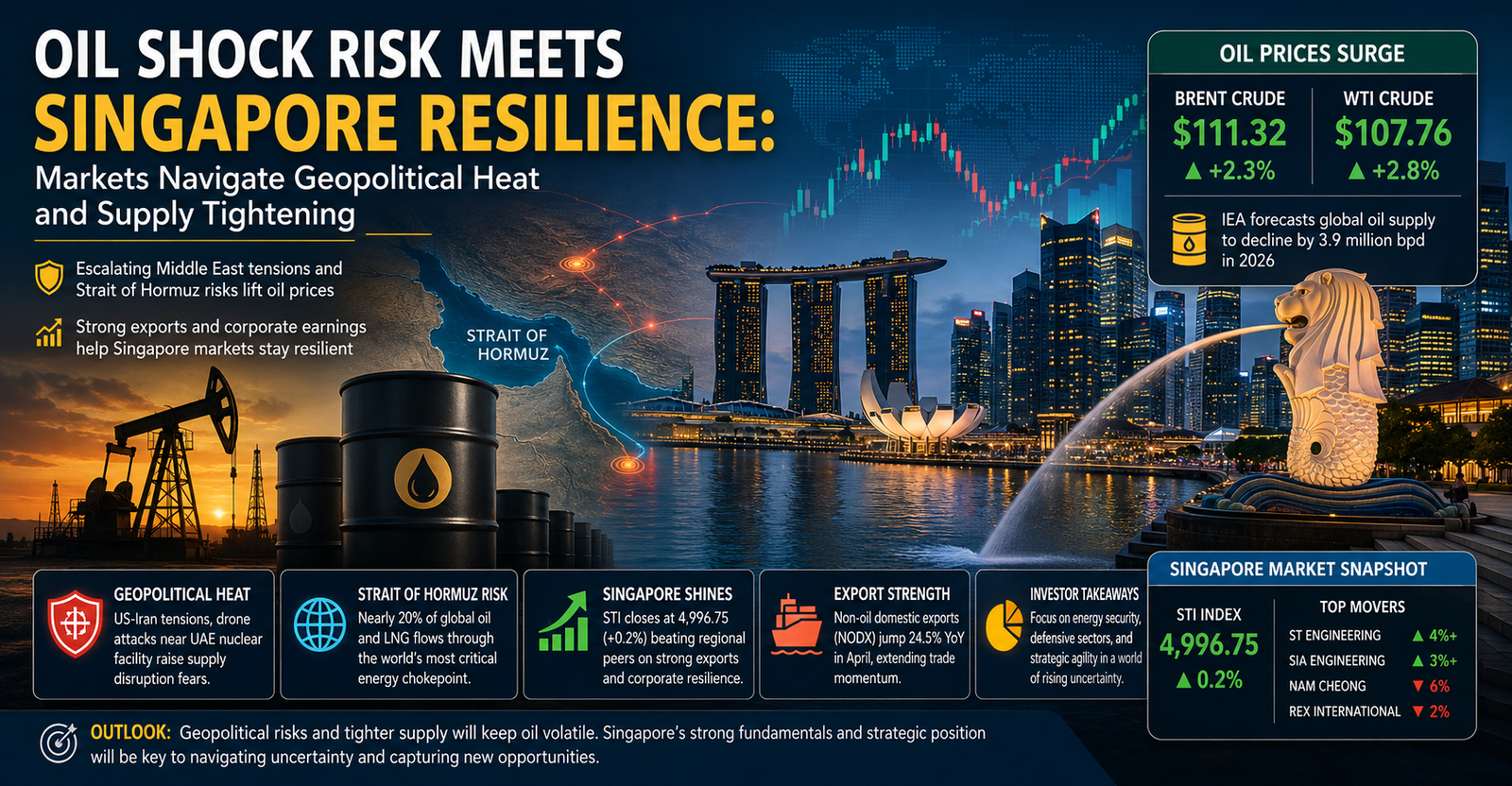
Global energy markets entered the week on a firm but fragile footing as crude oil prices extended their rally to the highest levels in nearly two weeks. Brent crude climbed to around $111 per barrel, while West Texas Intermediate hovered near $108, building on a more than 7% surge recorded over the previous week. The latest upward pressure reflects a convergence of geopolitical risk premiums and tightening long-term supply expectations—an equation that is increasingly shaping investor behavior from New York to Singapore.
At the center of market anxiety remains the Middle East, where tensions involving the United States and Iran continue to simmer. Concerns about maritime security in the Strait of Hormuz—a corridor through which nearly one-fifth of global oil and liquefied natural gas flows—have reintroduced a familiar but potent risk premium into energy pricing models. Any disruption in this passage would have immediate implications for Gulf exporters including Saudi Arabia, Iraq, and Qatar, and would reverberate through Asian import-dependent economies.
The International Energy Agency (IEA) has further sharpened the medium-term outlook, projecting global oil supply could decline by 3.9 million barrels per day in 2026. For policy makers in energy-sensitive hubs such as Singapore, the signal is clear: volatility is no longer episodic, but structural. Strategic reserves, hedging frameworks, and diversified procurement channels are likely to remain central policy priorities.
Trump Seals Historic Billion-Dollar China Deals in Landmark Beijing Breakthrough
Despite the turbulence in commodities, Singapore’s equity market demonstrated notable resilience. The Straits Times Index closed higher at 4,996.75, edging up 0.2% even as broader Asian markets softened. This divergence highlights Singapore’s dual identity—highly exposed to global trade flows, yet increasingly anchored by export strength and corporate adaptability.
US-Iran Tensions Heat Up Again, Brent Crude Breaches $110 Mark, Institutions Warn Oil Prices May Approach 2008 Peak Level
A key macroeconomic cushion came from trade data. Singapore’s non-oil domestic exports (NODX) surged 24.5% year-on-year in April, extending the previous month’s strong double-digit growth. For policy makers, this signals sustained external demand momentum despite geopolitical uncertainty, particularly in electronics and precision manufacturing segments that remain Singapore’s industrial backbone.
On the diplomatic front, market participants are closely monitoring indirect communication channels between Washington and Tehran, reportedly facilitated through Pakistan. While no breakthrough has been confirmed, even limited dialogue has helped prevent more aggressive risk repricing in global crude markets. For sovereign investors and energy importers in Asia, this represents a critical stabilizing factor in an otherwise volatile environment.
Iran–US War Nears Endgame as Tehran Sends Response via Pakistan, Breakthrough Expected Ahead of Trump’s China Visit
Corporate performance in Singapore reflected a mixed but constructive earnings landscape. ST Engineering advanced more than 4% after reporting double-digit revenue growth, reinforcing its position as a defensive industrial play amid geopolitical uncertainty. Defense, aerospace, and urban solutions remain attractive segments for long-term capital allocation, particularly as regional security budgets trend upward.
In contrast, Nam Cheong declined despite reporting a sharp rise in quarterly profit, suggesting profit-taking behavior in cyclical offshore marine stocks after recent gains tied to oil price strength. Similarly, Rex International slipped after announcing a temporary suspension of monthly production disclosures across key operating regions, a move that introduced short-term transparency concerns for investors closely tracking upstream output trends.
Financial and small-cap segments also displayed volatility. OxPay Financial saw a sharp rally driven by subsidiary investment news, while Medi Lifestyle experienced a decline despite narrowing losses, reflecting cautious sentiment toward early-stage restructuring stories. Meanwhile, SIA Engineering gained support after reporting improved profitability, underscoring continued strength in aviation maintenance demand as regional air traffic normalizes.
For sovereign wealth funds, asset managers, and policy makers, Singapore’s current market behavior offers three key signals. First, energy price volatility is now tightly interwoven with geopolitical escalation risk rather than pure supply-demand imbalance. Second, trade-sensitive economies can still outperform regionally during global shocks if export momentum remains intact. Third, sector rotation—particularly into defense, engineering, and logistics—will likely intensify as investors seek inflation-hedged, geopolitically resilient exposure.
Looking ahead, the interplay between Middle East diplomacy, maritime security in the Strait of Hormuz, and global supply forecasts will remain the dominant macro driver. For Singapore and similarly positioned financial hubs, the challenge is not merely to absorb volatility, but to structurally position capital flows to benefit from it. In an environment defined by compressed margins of predictability, strategic agility—not prediction—will define investment success.