



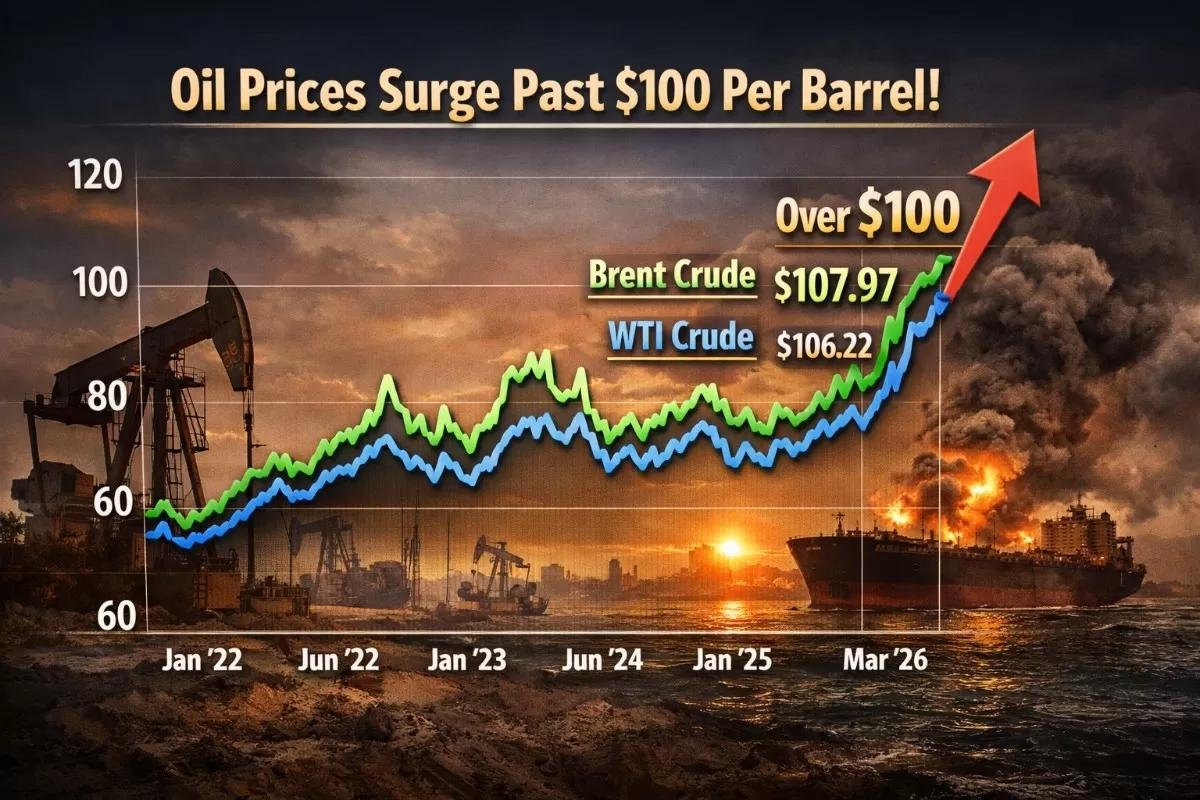
- Oil Prices Surge past $100 as Iran–US war intensifies and Red Sea attacks disrupt supply routes
- Houthi strikes on Saudi tankers open a new front, threatening global energy security
- Experts warn prolonged crisis could trigger global recession worse than COVID-19
ISLAMABAD — Global oil markets have been thrust into turmoil once again as the escalating conflict between the United States and Iran, compounded by renewed Houthi attacks on Saudi oil tankers in the Red Sea, has driven crude prices toward—and now beyond—the critical $100-per-barrel threshold.
Energy analysts warn that the surge is not a temporary spike but the beginning of a prolonged upward trend that could destabilize the global economy and trigger inflationary shocks more severe than those witnessed during the COVID-19 pandemic.
On Thursday, Brent crude, the international benchmark, surged past $100 a barrel for the first time since May, while U.S. crude jumped sharply, reflecting mounting fears of supply disruptions across key maritime chokepoints. The sudden escalation follows intensifying hostilities between Washington and Tehran, alongside missile and drone strikes by Iran-backed Houthi rebels targeting Saudi oil tankers navigating the Red Sea.
The attacks mark a dangerous expansion of the conflict’s geographic footprint. The Houthis claimed responsibility for striking two Saudi tankers, signaling their intent to enforce what they describe as a naval blockade. The move has heightened concerns over the security of the Bab al-Mandeb Strait, a vital artery for global energy shipments linking the Red Sea to international markets.
Saudi Nuclear Deal Hits Limbo as Trump Mandates Israel Normalization
Former U.S. President Donald Trump responded with a stark warning, declaring that Iran would face “major military punishment” for any continued proxy aggression. Washington has accused Tehran of orchestrating the attacks through its regional allies, further inflaming tensions that have already pushed the Middle East to the edge of a wider war.
War Premium Drives Oil Surge
Energy markets are now pricing in what analysts describe as a “war premium”—a risk factor that reflects the potential for prolonged disruptions in oil supply. The Strait of Hormuz, through which nearly 20% of global oil flows, remains under persistent threat as Iranian forces continue to challenge commercial shipping.
“The reality is simple,” said one energy executive familiar with U.S. policy discussions. “If conflict continues in the Gulf and key routes are compromised, oil prices will not just stay high—they will climb further.”
The situation has been exacerbated by the breakdown of a fragile ceasefire that had briefly stabilized markets. With hostilities resuming, prices at the pump are rising once again, reversing weeks of declining fuel costs.
Oil Prices Surge: Shockwaves Across Global Markets
The impact of surging oil prices has been immediate and far-reaching. Financial markets reacted sharply, with major U.S. indices—including the Dow Jones Industrial Average and the S&P 500—posting losses, while the Nasdaq slid more than 2% amid broader investor anxiety.
Bond markets have also come under pressure. Yields on U.S. Treasury notes surged to their highest levels in months, signaling expectations that central banks may be forced to maintain higher interest rates to combat inflation driven by energy costs.
Rising fuel prices are already hitting consumers hard. In the United States, gasoline prices have climbed back above $4 per gallon, while diesel costs—critical for transportation, agriculture, and industry—have surged even faster. Analysts warn that diesel inflation, in particular, has a multiplier effect across supply chains, raising the cost of goods and services globally.
Mortgage rates are also climbing, with the average 30-year fixed rate nearing 7%, further tightening financial conditions for households and businesses alike.
A New Front: Red Sea Instability
The Houthi attacks have opened a volatile new front in the conflict. By targeting Saudi tankers, the group has extended the risk beyond the Persian Gulf into the Red Sea, threatening one of the world’s most critical shipping corridors.
Saudi Arabia has increasingly relied on Red Sea routes to bypass the Strait of Hormuz, making these attacks strategically significant. The targeting of vessels such as the Encelia and Layla underscores the vulnerability of alternative النفط supply routes once considered relatively secure.
U.S. officials have deployed naval assets to the region, but there is no clear indication of direct military engagement against the Houthis. Meanwhile, Washington continues to intensify strikes on Iranian military infrastructure, aiming to degrade Tehran’s capacity to disrupt maritime trade.
Inflation, Politics, and Economic Fallout
The return of $100 oil poses a serious challenge for policymakers, particularly in the United States, where rising energy costs threaten to derail economic stability and complicate the political landscape.
Higher oil prices feed directly into inflation, increasing transportation and production costs across industries. This dynamic risks undoing recent progress in stabilizing prices and could force central banks to adopt more aggressive monetary tightening.
For political leaders, the stakes are equally high. Elevated fuel costs have historically influenced voter sentiment, and the current surge comes at a sensitive moment for U.S. domestic politics.
A Crisis Bigger Than the Pandemic?
Energy experts warn that the current trajectory could push the global economy toward a crisis that rivals—or even surpasses—the economic disruption caused by COVID-19. Unlike the pandemic, which constrained demand, the present crisis is driven by supply shocks rooted in geopolitical conflict.
“If oil sustains above $100, we are entering uncharted territory,” said a senior commodities strategist. “This is not just about energy—it’s about the entire global economic system.”
From aviation to manufacturing, industries are already feeling the strain. Airlines have begun revising profit forecasts downward as jet fuel costs soar, while logistics and shipping companies face rising operational expenses.
The Road Ahead
With no immediate resolution to the Iran–U.S. conflict in sight and regional actors increasingly drawn into the الأزمة, the outlook for oil markets remains highly uncertain. The combination of military escalation, strategic chokepoint vulnerabilities, and proxy warfare has created a perfect storm for sustained price volatility.
As crude edges beyond $100 per barrel, the world faces a stark reality: energy security is once again at the center of global stability. And unless tensions ease, the economic consequences could be profound—pushing nations toward recession and testing the resilience of an already fragile global order.