



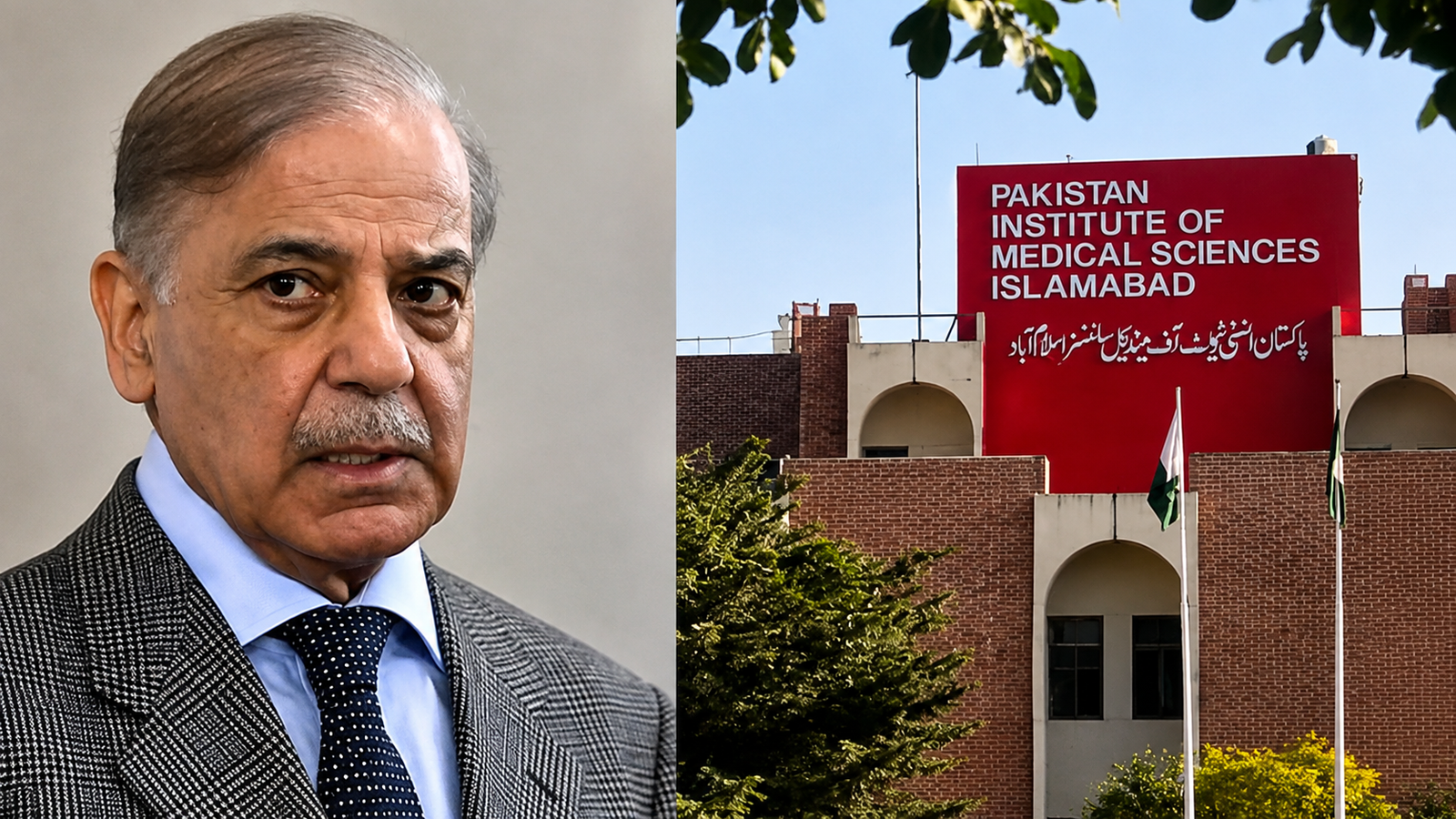
- PIMS fire: Prime Minister Shehbaz Sharif announced a Rs10 million (about $36,000) reward for Staff Nurse Razia, who entered the burning neonatal nursery and rescued the only surviving baby.
- PIMS fire inquiry: Investigators found prima facie failures involving fire safety, emergency exits, evacuation planning, security coordination and hospital preparedness.
- PIMS fire investigation: The exact source of the blaze remains unresolved, while the government has ordered suspensions, disciplinary proceedings and possible criminal investigations.
ISLAMABAD — Prime Minister Shehbaz Sharif has announced a financial reward of Rs10 million — approximately $36,000 — for Staff Nurse Razia, who risked her life by entering a burning neonatal nursery at Islamabad’s Pakistan Institute of Medical Sciences (PIMS) and rescuing the only surviving baby from the devastating fire that killed other newborns.
The Prime Minister spoke highly of Razia’s courage and sacrifice, with the government also recommending her for a suitable civil award. Her actions have emerged as one of the most powerful human stories from a tragedy that has now triggered a sweeping investigation into fire safety, hospital management, emergency preparedness and institutional accountability at one of Pakistan’s largest public hospitals.
The official inquiry found that Razia entered the burning nursery at approximately 6:38:56 a.m. on August 26 and emerged only seconds later carrying a baby. She then attempted to re-enter the affected area.
READ NEXT: CIA Chief’s Secret Moscow Mission: Washington Warns Russia Against NATO Attack and Iran Support
The Prime Minister’s decision to recognize the nurse comes as the government moves against senior officials following the submission of an interim inquiry report on August 29. The report recommends suspensions, disciplinary proceedings and possible criminal investigations over failures that may have allowed a rapidly developing fire to become a catastrophic event.
PIMS Fire: A rescue that unfolded in seconds
The inquiry committee reconstructed the incident largely through CCTV footage.
The first visible emergency occurred at approximately 6:38:15 a.m., when Charge Nurse Nasreen emerged from the nursery seeking assistance. Around 20 seconds later, Nasreen and Security Guard Maria entered the nursery, where flames were already visible.
At approximately 6:38:56, Staff Nurse Razia entered.
By approximately 6:39:04, she had emerged carrying a baby.
The committee said she attempted to enter the nursery again, while Dr Abdul Rehman emerged at approximately 6:39:12. Within seconds, smoke had substantially obscured the CCTV camera. By approximately 6:40:08, another camera covering the adjoining corridor was also obscured.
The sequence demonstrates how quickly conditions inside the nursery deteriorated.
The committee said the environment became substantially smoke-filled within roughly two minutes, leaving an extremely narrow window for rescue.
Razia’s actions are therefore significant not simply because she saved a newborn, but because she entered an environment that was rapidly becoming unsurvivable.
READ MORE: Door was locked at Pakistan hospital where fire killed 14 babies, witnesses say
The inquiry also cautioned against portraying all frontline staff as having abandoned the babies. Its CCTV review found evidence of immediate rescue attempts by nursing, medical and security personnel.
What caused the PIMS fire?
The most important question remains unanswered.
The inquiry has not conclusively established the source of ignition.
Different accounts have pointed toward an air conditioner, incubator or warmer, electrical short circuit, plug or overloaded electrical connection. However, the committee said it would be premature to identify a particular appliance or electrical component as the established cause.
Records from the Islamabad Electric Supply Company did not indicate a contemporaneous external feeder fault or trip. Investigators are consequently examining PIMS’s internal electrical distribution system, sockets, plugs, wiring and connected medical equipment.
Several incubators had recently undergone preventive maintenance, although the committee noted that servicing records alone could not establish the electrical safety of the equipment, plug, socket or circuit involved.
The distinction matters.
The investigation is examining not only what started the fire, but also why a fire that began inside a hospital nursery was able to become catastrophic.
The emergency response is under scrutiny
Another major question concerns the notification of emergency services.
CCTV indicates that the emergency was already visible at approximately 6:38 a.m. Yet Capital Emergency Service records show receipt of its first emergency call at approximately 6:54 a.m., dispatch at 6:55 and arrival at approximately 7:01.
The inquiry has deliberately stopped short of blaming any individual for what appears to be a substantial gap.
Other evidence reportedly indicates that an earlier call may have been made. Investigators therefore want telephone records, hospital control-room logs, emergency-service call recordings and synchronized CCTV timestamps before determining who made the first effective call and whether any avoidable delay occurred.
Once CES received the emergency notification, its recorded arrival was approximately six to seven minutes later.
The committee therefore considers the more important question to be what happened inside the hospital before the emergency call was effectively received.
Serious questions over fire exits and safety systems
The inquiry has raised particularly serious concerns about emergency exits and fire-safety arrangements.
CES reported that fire and life-safety arrangements at PIMS were inadequate and compromised. Emergency exits or escape routes were reportedly locked or obstructed, while firefighters were said to have been forced to open locked fire-exit doors and other access points.
The committee has not yet treated those findings as final proof of individual negligence. It is verifying which doors were designated emergency exits, who controlled them and whether they could have been opened immediately during an emergency.
That distinction will be critical to any future disciplinary or criminal proceedings.
The PIMS Security Department’s own 2023 SOP already recognized fire safety as an institutional responsibility, including the availability of fire exits, firefighting equipment and staff training.
The issue, therefore, is increasingly becoming one of implementation rather than whether fire risk was recognized on paper.
July fire had already provided a warning
Perhaps the most troubling finding is that PIMS had experienced another fire only weeks earlier.
A fire broke out at the PIMS Female Nursing Hostel on July 6, 2026. That earlier inquiry identified deficiencies involving smoke detection, automatic alarms, emergency warning systems, evacuation preparedness, fire-safety inspections, security response and record keeping.
It recommended measures including a comprehensive fire-safety audit, smoke detectors, alarm systems, emergency lighting, marked escape routes, functional extinguishers, electrical inspections, periodic testing and written emergency-response procedures.
Yet on August 25 — just one day before the nursery tragedy — the earlier inquiry report was reportedly still being returned for revision because it had not adequately addressed its terms of reference.
The significance is profound.
The July fire does not prove what caused the August fire. But it establishes that fire safety at PIMS was already a known institutional concern.
The central question for investigators is now whether officials were informed about those deficiencies, had the authority and opportunity to correct them, and failed to do so.
Prime minister orders suspensions
The interim report has recommended action against officials across clinical, administrative, security and external emergency-service structures.
The Prime Minister ordered the suspension and initiation of disciplinary proceedings against Dr Imran Sikandar, Dr Sadia Riaz, Dr Nagham, Mutahir Shah, Ch Waris Ali Raza, Nosheela Amjad, Abdul Rehman and Muhammad Usman.
Charge Nurse Nasreen and Security Guard Maria were ordered to remain off duty pending the final inquiry, with the committee to determine whether further proceedings should follow.
The report identifies three broad areas of concern: clinical oversight, hospital administration and external emergency/fire-safety responsibilities.
Investigators found that the number of officials present in the neonatal unit was lower than the duty roster required. The committee specifically questioned whether adequate qualified clinical supervision was available and recommended action against the head of Neonatology, Professor Sadia Riaz, and Senior Registrar Nagham.
At the administrative level, the committee said PIMS had failed to take necessary measures following the July fire, including fire drills, ensuring the integrity of firefighting equipment, detailed emergency SOPs and effective incident-handling arrangements.
Criminal investigation remains possible
The government has also directed that criminal proceedings be initiated against those found responsible.
But the inquiry makes an important distinction: suspension, administrative discipline, contractual action and criminal liability are not the same thing.
Criminal responsibility would require investigators to establish a legally sustainable chain connecting a specific duty, knowledge or negligence, an omission and the resulting loss of life.
Potential criminal questions include whether mandatory emergency exits were knowingly or negligently kept unavailable, whether previously identified life-safety deficiencies were ignored despite clear responsibility to correct them, and whether anyone responsible for emergency notification unjustifiably delayed summoning professional assistance.
The inquiry has also raised questions about Belfort Security Services, the private contractor providing security personnel at PIMS. The government has ordered a review of the company’s contractual obligations and said action should follow if a breach is established.
From tragedy to institutional test
The PIMS fire is now more than an investigation into a single night of horror.
It has become a test of whether Pakistan’s public healthcare system can translate safety regulations into functioning systems.
The committee has called for an immediate hospital-wide fire and electrical safety audit, beginning with neonatal and other high-risk areas. It wants every emergency exit physically inspected and tested, electrical systems examined, firefighting equipment verified and practical neonatal evacuation drills conducted.
It has also called for a clear emergency command system under which the discovery of a fire would simultaneously trigger internal alarms, mobilize designated responders and directly alert emergency services.
For the world watching Pakistan’s response, however, the most immediate symbol of this tragedy is likely to remain Staff Nurse Razia.
While investigators determine who failed, she represents the opposite: an individual who acted when seconds mattered.
She entered the fire.
She found the baby.
And she brought the child out alive.
The Prime Minister’s Rs10 million, or roughly $36,000, reward cannot undo the loss of the other newborns. But it places a national seal of recognition on a woman whose decision to risk her own life gave one family the possibility of taking its child home.
The final inquiry will determine whether institutional failures contributed to the deaths. Razia’s part in the story is already clear: when the nursery became engulfed in fire, she chose to go in.