



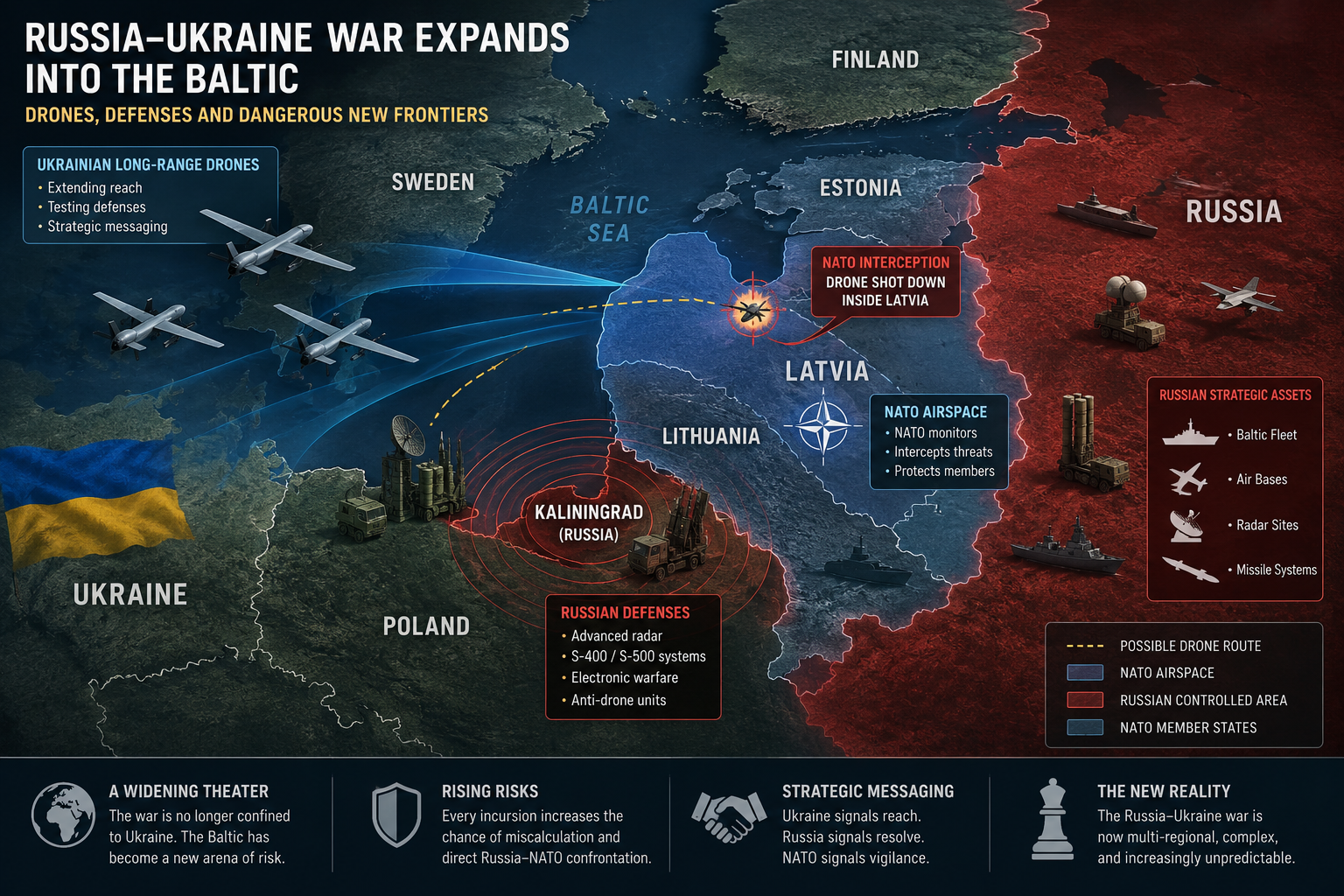
Russia’s interception of more than 50 Ukrainian drones across the Baltic region — including one downed inside Latvia by NATO forces — marks a meaningful expansion of the war’s operational geography. This was not a routine exchange. It was a strategic message: the conflict’s boundaries are widening, and both Moscow and Kyiv are adjusting their military thinking to match the new terrain.
Russia-Ukraine War: A New Geography of Conflict
The Baltic Sea has long been a zone of strategic sensitivity. It borders multiple NATO members and sits adjacent to Russia’s heavily fortified Kaliningrad exclave. Ukrainian drones reaching this region demonstrate a deliberate effort to stretch Russian defenses and expose vulnerabilities far from the traditional front lines.
For Ukraine, operating drones at extended ranges serves three strategic purposes:
- Strategic reach— Demonstrating the ability to strike or surveil targets well beyond the Donbas and southern theaters.
- Psychological pressure— Undermining Russia’s assumption that distance equals safety.
- Alliance messaging— Signaling to NATO that Ukraine’s security challenges are inseparable from Europe’s broader defense posture.
Russia’s rapid interception and public framing of the incident reflect its desire to portray the operation as Western-enabled escalation. But the geography matters: drones approaching Kaliningrad or passing near NATO airspace force Moscow to divert attention and resources to a region it typically considers secure.
Russia’s Strategic Adjustments
The Baltic drone incident complicates Russia’s air-defense architecture. Historically, Moscow has concentrated layered defenses around the capital, Crimea, and the Ukrainian border. Now, the Kremlin must rethink its posture in the northwest.
Key adjustments include:
- Kaliningrad fortification— Already one of Europe’s most militarized zones, Kaliningrad may see expanded radar coverage, counterdrone units, and electronicwarfare deployments.
- Baltic Fleet integration— Naval assets could assume broader airsurveillance responsibilities, increasing militarization of the sea.
- NATO proximity management— Russia must calibrate responses carefully to avoid accidental escalation with alliance forces.
The fact that NATO shot down one of the drones inside Latvia adds a new dimension. Russia must now assume that future Ukrainian longrange operations may involve NATO airspace or NATO interception. This complicates Moscow’s calculus, forcing it to consider how to respond without triggering a direct confrontation.
Ukraine’s Evolving Strategy
For Ukraine, the Baltic operation reflects a broader shift toward asymmetric warfare. With limited conventional airpower, Kyiv increasingly relies on drones to compensate for shortages in aircraft, missiles, and longrange artillery.
READ MORE: Ukraine Runs Out of Interceptors as Russian Missiles Strike Kyiv, Exposing Western Aid Failure
The operation suggests three strategic priorities:
- Testing Russian air defenses— Mapping radar coverage and response times in regions previously untouched by the war.
- Expanding the battlespace— Forcing Russia to defend more territory with finite resources.
- Strengthening NATO ties— Demonstrating interoperability with NATO airdefense systems, as seen in Latvia’s interception.
Ukraine’s rapidly advancing domestic drone program — with systems capable of flying hundreds of kilometers — is central to this strategy. By pushing operations into the Baltic, Kyiv signals that Russia cannot rely on geographic distance as a shield.
Russia-Ukraine War: NATO’s Dilemma
NATO’s involvement, even limited to intercepting a stray drone, underscores the alliance’s increasingly delicate position. While NATO maintains it is not a party to the conflict, its airdefense actions in Latvia show that the war’s geography is expanding toward alliance borders.
RELATED: NATO aircraft shoot down drone over Latvia, which blames ‘Russian electromagnetic warfare’
This raises several strategic questions:
- How far will NATO go in intercepting drones or missiles that threaten member airspace?
- Will Russia interpret such actions as hostile participation?
- Could repeated incidents force NATO to adopt a more active Baltic airpatrol posture?
The Baltic Sea, once a peripheral theater, is becoming a zone where miscalculation could have continental consequences.
A Conflict No Longer Contained
The drone incident illustrates a broader truth: the RussiaUkraine war is no longer confined to the Donbas trenches or the skies over Crimea. It is now a multiregional conflict touching the Arctic, the Black Sea, and increasingly the Baltic.
For Russia, this means defending more territory with finite resources. For Ukraine, it means leveraging innovation to offset conventional disadvantages. For NATO, it means navigating a tightening strategic corridor between deterrence and escalation.
The Baltic drone clash is not an isolated event — it is a preview of a more complex, geographically dispersed phase of the war.