



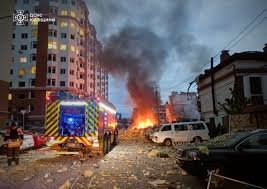
- Russia escalates war: 595 drones and 48 missiles fired, Kyiv heavily targeted.
- Civilian toll mounts: Hospitals, homes, and factories destroyed; at least four killed, dozens injured.
- Ukraine appeals for help: Zelenskiy urges U.S., Europe, G7, and G20 to cut Moscow’s energy revenues.
- Global stakes high: Weak response from international community risks emboldening authoritarian regimes.
Russia’s war on Ukraine is entering a darker, more destructive phase. The early hours of Sunday saw one of the most sustained assaults on Kyiv since the invasion began, with Moscow launching hundreds of drones and missiles in a coordinated storm that lasted more than 12 hours. At least four people were killed, dozens injured, and civilian infrastructure—including a cardiology clinic and newly built residential blocks—was left in ruins.
Ukraine’s military claimed that 595 drones and 48 missiles were fired, of which its battered air defences managed to intercept 568 drones and 43 missiles. Even with this remarkable resilience, the scale of destruction underscored a harsh truth: Ukraine’s defences are stretched thin, and Russia shows no signs of restraint.
A War on Cities, Not Just Soldiers
Moscow insists it targets only military infrastructure, pointing to airfields and weapons depots. Yet the smouldering ruins of homes, factories, and hospitals across Kyiv tell another story. This is a war not only against Ukraine’s armed forces but against the very idea of Ukrainian survival—its civilians, its homes, its future.
When residential areas collapse under falling debris, when a 12-year-old girl is counted among the fatalities, the Kremlin’s narrative that it does not target civilians collapses under the weight of reality.
The Silence of Partners
President Volodymyr Zelenskiy has been unequivocal in his appeal: cut off the energy revenues that fuel Russia’s war machine. Oil and gas remain Moscow’s economic lifeline, underwriting every missile that streaks across Ukrainian skies. Yet the international response has been frustratingly tepid.
The Biden administration once spoke of “crippling sanctions,” but in 2025, the calculus has shifted under Donald Trump’s presidency. Washington has resisted Kyiv’s pleas for new punitive measures, leaving Ukraine caught in a deadly balance between battlefield endurance and diplomatic fatigue.
Zelenskiy’s latest appeal—directed at the U.S., Europe, the G7, and the G20—is not just about sanctions but about credibility. If the world’s leading democracies cannot act decisively in the face of relentless bombardment, then the language of international law risks becoming little more than empty rhetoric.
A War Testing Global Defences
Sunday’s attack also exposed a new global security dilemma. Ukraine’s need for advanced air defence systems is desperate, yet supplies are limited, and other nations are scrambling to protect themselves against perceived threats from Moscow. Israel has supplied a Patriot system, with two more expected later this year. But it is not enough.
Each new barrage forces Ukraine to make impossible choices—protect its capital, shield its power grid, or defend its southern cities like Zaporizhzhia, where at least 16 people were injured during this latest wave. The sheer volume of drones and missiles is designed to overwhelm and exhaust Ukrainian defences, a strategy of attrition that extends beyond the battlefield into the psychological fabric of a nation.
Why This Moment Matters
The images of families rushing into metro stations, of residents sifting through the rubble of their homes, are not just scenes from Ukraine. They are reminders of what unchecked aggression looks like in the 21st century. They are warnings of how authoritarian power projects itself when unchallenged.
The world is not simply watching Ukraine fight for its sovereignty; it is witnessing a test of collective resolve. Every day that passes without decisive international action emboldens Moscow and signals to other authoritarian regimes that wars of aggression can be fought with impunity.
The Moral and Strategic Imperative
This is why Ukraine matters. Not just for Kyiv, not just for Zelenskiy, but for the principles that underpin the global order. The West’s delay in acting decisively—whether through sanctions or bolstering Ukraine’s defences—comes at a cost measured in destroyed homes, shattered communities, and lost lives.
History will not judge Russia’s brutality kindly, but it will also not absolve those who looked away when action was possible.
The question is no longer whether Ukraine can withstand Russia’s assault. It is whether the world can withstand the consequences of failing to stop it.